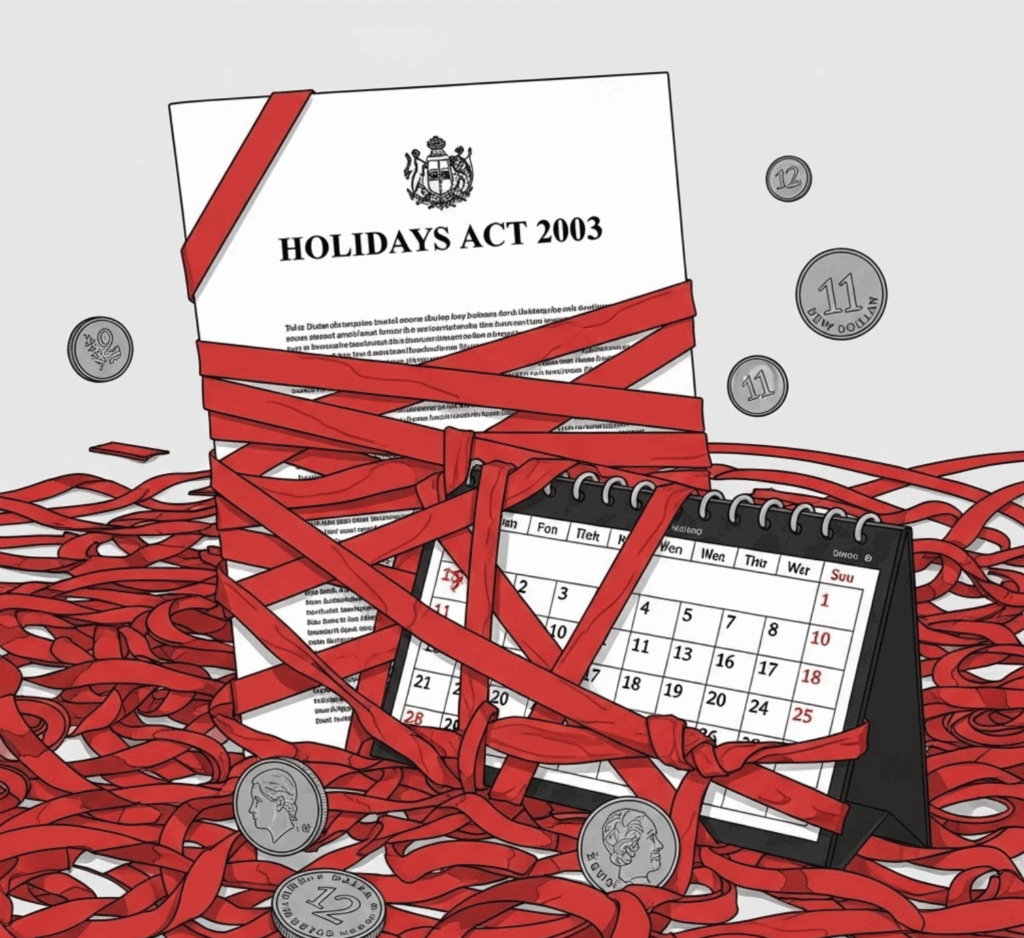
Untangling the Red Tape: Government Launches Overdue Review of New Zealand’s Notorious Holidays Act
By A Lions Roar News Staff Reporter WELLINGTON, NZ – October 18, 2025
The New Zealand government has officially fired the starting gun on a comprehensive review of the Holidays Act 2003, a piece of legislation long regarded by businesses as one of the most complex, costly, and convoluted regulations on the country’s statute books. The announcement brings a glimmer of hope to beleaguered payroll administrators and business owners, while simultaneously putting unions on alert to protect hard-won worker entitlements.
For over two decades, the Act has been the source of a persistent, multi-billion-dollar headache, leading to systemic payroll errors across both the private and public sectors. The core issue lies in its failure to adequately cater to the modern workforce, resulting in widespread miscalculations of holiday and sick leave pay. Now, a tripartite task force of government, business, and union representatives has been charged with untangling this legislative knot, with a mandate to deliver recommendations by mid-2026.
The move acknowledges a problem that has grown from a quiet administrative frustration into a significant economic burden. High-profile cases have seen major government departments, District Health Boards, police, and large private corporations forced to undertake painstaking audits and pay back hundreds of millions of dollars to current and former staff who were underpaid for their leave. The total cost to the New Zealand economy is widely believed to run into the billions, factoring in not just the back-pay itself, but the immense cost of audits, legal advice, and payroll system upgrades.
Deconstructing the Complexity
At the heart of the issue is the Act’s rigid and archaic method for calculating leave pay. Designed for a time when the 40-hour, Monday-to-Friday week was standard, its provisions clash with the reality of today’s flexible work arrangements.
The primary difficulty lies in determining what an employee should be paid for a day of leave. The Act requires employers to calculate two figures and pay the employee whichever is higher: their Relevant Daily Pay (what they would have normally earned on the day the leave was taken) or their Average Daily Pay (a daily average of their earnings over the preceding 52 weeks).
For a salaried employee with fixed hours, this is simple. But for a retail worker whose income includes variable commissions, a hospitality employee working irregular shifts, or a tradesperson who is consistently paid overtime, the calculation becomes a minefield. Determining what someone would have earned on a specific day can be almost impossible, forcing a reliance on the 52-week average, which itself can be skewed. This ambiguity has consistently baffled even the most sophisticated global payroll software systems, many of which are not designed to accommodate New Zealand’s unique legislative requirements.
“It’s an analogue law in a digital, flexible age,” commented one payroll consultant who spoke to Lions Roar News. “The legislation forces systems to make complex judgments that often result in errors. It’s not that companies are deliberately trying to underpay their staff; it’s that the law itself is fundamentally broken and impractical to apply correctly at scale.”
Balancing the Scales: The Voices of Business and Unions
The announcement has been met with cautious optimism from both sides of the industrial relations divide, though their priorities for the review differ significantly.
Business advocates have long campaigned for reform, framing the current Act as a handbrake on productivity and a major source of financial risk. A spokesperson for BusinessNZ welcomed the review, stating, “For years, our members have been crying out for certainty and simplicity. The current Act exposes well-meaning employers to enormous financial liabilities due to its sheer complexity. We need a modern, streamlined law that is easy to understand, easy to apply, and allows businesses to have confidence in their payroll systems. This review is a critical and long-overdue step.”
Conversely, unions, while acknowledging the Act’s flaws, are approaching the review with a focus on safeguarding worker entitlements. The Council of Trade Unions (CTU) has signalled it will be a vigilant participant in the process.
“We agree that the Act needs fixing, because right now it is failing the very people it’s meant to protect—the workers,” a CTU representative stated. “Our position is clear: simplicity cannot come at the expense of fairness. The solution must ensure that workers, especially those in precarious, part-time, or casual roles, receive their full and correct leave entitlements. We will not support any changes that dilute these fundamental rights.”
The Path Forward: A Tripartite Tightrope
The tripartite model is a well-established mechanism in New Zealand for tackling contentious industrial issues. By bringing employers, employees, and the government to the same table, the model aims to build consensus and create durable solutions. However, the path to reform will be a tightrope walk.
The working group will need to grapple with a host of difficult questions. How should bonuses, allowances, and commissions be treated for leave calculations? How can leave be fairly accrued and calculated for gig economy workers? The challenge will be to draft a new framework that is flexible enough for the modern economy but clear enough to prevent misinterpretation.
Potential solutions that have been floated include moving entirely to an accrual-based system, where all leave is calculated in hours rather than days or weeks, providing a clearer and more transparent method for all work patterns.
While the 2026 deadline for recommendations provides a clear timeframe, the subsequent process of drafting and passing legislation means a final resolution is still several years away. For now, the announcement marks a crucial acknowledgment of a problem that has festered for too long. The success of this review will be measured by its ability to finally deliver a Holidays Act that is fit for purpose in 21st-century Aotearoa—one that provides clarity for employers and, most importantly, fairness for all workers.