Supreme Court Upholds Sri Lanka–India Digital ID Deal: A Landmark Verdict on Sovereignty and Privacy
Colombo, October 2025 —
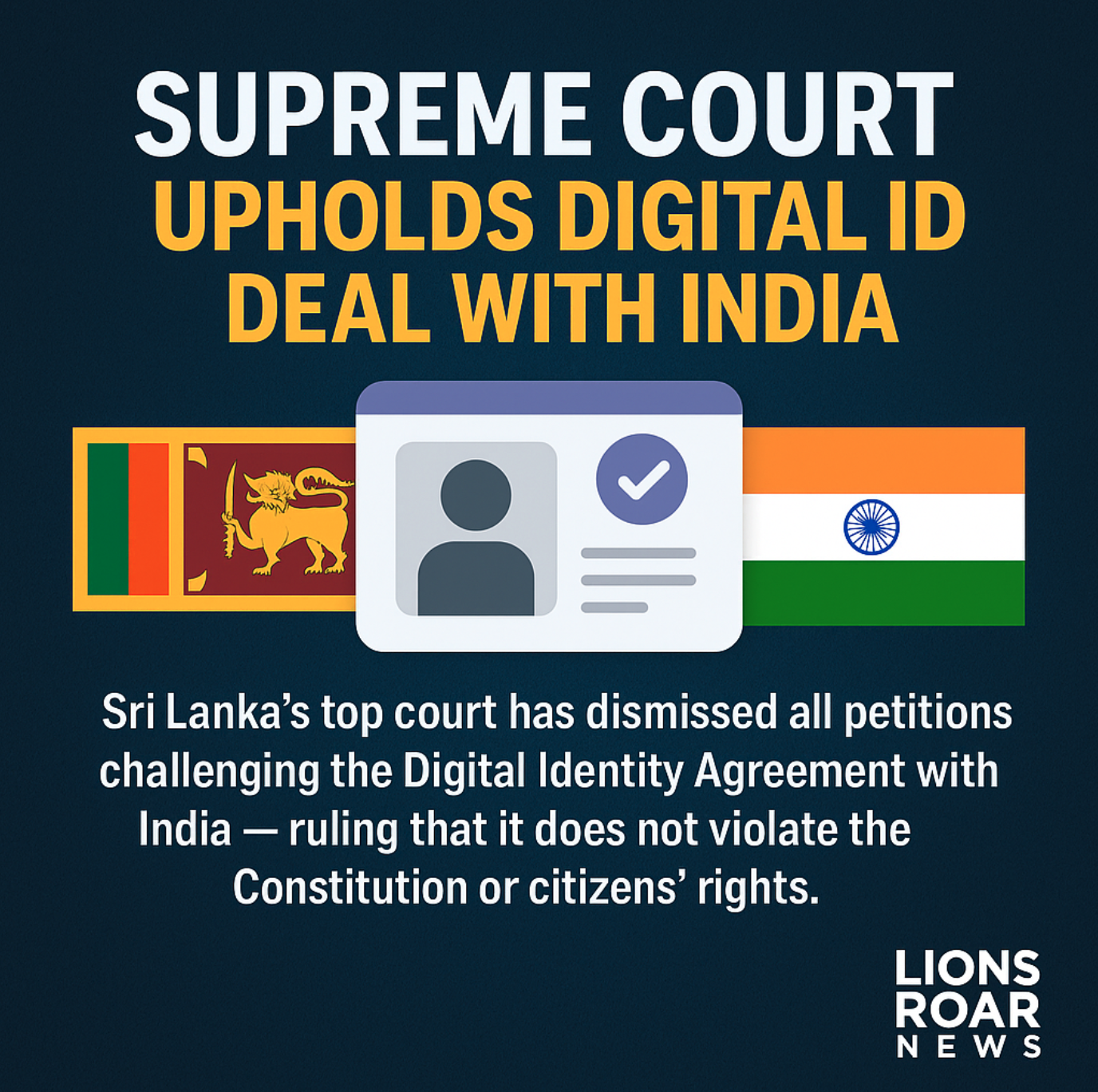
In a landmark ruling that may redefine the balance between national sovereignty and technological progress, the Supreme Court of Sri Lanka has dismissed all petitions challenging the government’s Digital Identity Agreement with India, declaring that the project does not violate the Constitution or citizens’ fundamental rights.
The verdict comes amid months of political debate, public protests, and online misinformation about the so-called “Digital ID” initiative — a program that aims to introduce a biometric-based national digital identification system across Sri Lanka, modeled partly on India’s Aadhaar framework.
🔹 What the Agreement Entails
The Sri Lanka–India Digital Identity Partnership was signed earlier this year as part of a wider cooperation framework under the Neighbourhood Digital Cooperation Initiative. The project seeks to modernize Sri Lanka’s civil registration and verification systems through secure digital credentials — incorporating facial recognition, fingerprints, and iris scans — all encrypted and linked to a centralized national registry.
The agreement involves both technical and financial assistance from India, with several Indian technology agencies and private sector vendors providing software, encryption frameworks, and training.
According to the Sri Lankan government, the new Digital ID is intended to:
- Simplify access to welfare schemes and government services.
- Enable more efficient tax collection and reduce corruption.
- Strengthen border control and national security.
- Support digital transformation and e-governance.
However, critics have long argued that it may expose citizens to data privacy violations, foreign surveillance risks, and overreach of state control.
🔹 The Legal Challenge
Multiple civil society organizations and opposition politicians filed petitions before the Supreme Court, claiming that the government had entered into the agreement without adequate parliamentary scrutiny and that the project potentially violated citizens’ rights to privacy, freedom of expression, and national sovereignty.
Petitioners alleged that:
- The agreement allowed foreign entities access to citizens’ biometric data.
- Data servers and encryption keys might be managed by non-Sri Lankan parties.
- The project was launched without public consultation or data protection law enforcement.
The case drew intense public interest, with rallies in Colombo, Kandy, and Jaffna demanding full transparency and calling for the government to table the agreement in Parliament.
🔹 Supreme Court’s Decision
After months of hearings, the five-judge bench, headed by Chief Justice Priyantha Abeysekara, ruled that the petitioners failed to establish any direct or imminent threat to citizens’ rights. The Court noted that:
“The Digital ID framework, as presented, does not transfer data ownership to any foreign party, nor does it confer decision-making powers outside Sri Lanka’s jurisdiction. All data collected and stored shall remain under the control of the Government of Sri Lanka and subject to local data protection law.”
The ruling emphasized that technological partnerships do not automatically imply sovereignty compromise and that Sri Lanka retains the right to audit, monitor, and restrict any external system linked to its national registry.
“Digital transformation is not antithetical to privacy — it depends on the constitutional safeguards and institutional oversight applied in its implementation,” the judgment stated.
🔹 Government Reaction
Minister of Technology, Dr. Harsha de Alwis, welcomed the decision, saying it reaffirmed the country’s digital transformation agenda and its strategic partnership with India.
“This is a victory for modernization and transparency. The court’s decision clears the way for a secure, inclusive, and efficient digital ID system that will empower citizens, not control them,” he said.
He also announced that the first phase of the system — biometric registration for public employees — would begin early next year, followed by nationwide rollout by late 2026.
🔹 Opposition & Civil Society Concerns
Opposition lawmakers and activists expressed disappointment but vowed to continue monitoring the implementation.
Former Minister of Justice Nalinda Jayatissa argued that the ruling “sets a concerning precedent” because “Sri Lanka still lacks robust cybersecurity and data protection institutions.”
“The risk is not just foreign access — it’s domestic misuse. Without independent oversight, any government could weaponize citizens’ data for political gain,” he warned.
Digital rights organizations have also called for greater parliamentary oversight, urging the government to publish the full contract, the names of all implementing companies, and details of where the servers will be hosted.
🔹 India’s Role and Strategic Context
For India, the agreement represents another major step in its Digital South Asia diplomacy strategy, through which it exports technology infrastructure and digital know-how to neighboring nations. The Indian government has helped countries like Bhutan, Nepal, and Mauritius develop similar identity systems.
In Sri Lanka’s case, the cooperation is politically sensitive. The partnership coincides with a renewed wave of Indian investments in infrastructure, energy, and fintech sectors. Observers say that the Digital ID deal not only enhances administrative efficiency but also deepens Colombo’s technological dependence on New Delhi — a factor that China and Western partners are likely watching closely.
🔹 The Public Debate
Public opinion remains deeply divided.
Supporters argue that Sri Lanka cannot afford to remain behind in digital transformation when most nations are moving toward biometric authentication and AI-based citizen services. They highlight the benefits of faster government aid delivery, improved election security, and easier financial inclusion for rural populations.
Critics, however, fear a “surveillance state” scenario. Some warn that once biometric data becomes centralized, misuse or unauthorized access could have irreversible consequences, particularly in the absence of a comprehensive national data protection authority with enforcement powers.
Social media discourse has further amplified the divide, with misinformation spreading about foreign control, secret data transfers, and even conspiracies linking the project to international tracking programs.
🔹 The Bigger Picture: Digital Sovereignty vs. Global Integration
Experts view this case as a watershed moment for Sri Lanka’s legal and technological policy landscape.
Professor Malathi Perera, a constitutional scholar at the University of Colombo, notes that the ruling “draws a clear line between technological cooperation and loss of sovereignty.”
“The challenge ahead is ensuring that Sri Lanka doesn’t merely import technology, but builds the institutional and ethical frameworks to govern it responsibly,” she said.
🔹 What Happens Next
Following the verdict, the government plans to:
- Launch a National Data Security Council to oversee all aspects of the Digital ID rollout.
- Finalize the Data Protection Act, currently under Cabinet review.
- Begin pilot testing in select districts by mid-2026.
Officials have also hinted at potential integration of the Digital ID with e-passport systems, health records, and tax databases, aiming to create a “single citizen interface” by 2030.
🔹 A Defining Moment for Sri Lanka
The Supreme Court’s decision underscores the complexity of modern governance — where technology, law, and diplomacy converge. For a nation still recovering from economic crisis and political instability, the Digital ID project represents both an opportunity and a challenge: an opportunity to rebuild trust through efficiency, and a challenge to ensure that the digital future remains democratic, transparent, and locally controlled.
Whether this marks the dawn of a new era in Sri Lankan e-governance or the start of a long debate over digital rights will depend on how the system is implemented — and how the government chooses to handle the power that comes with it.