The Weight of Corruption: Fez Tragedy Kills 22 as Illegal Construction Crumbles Hope in Morocco
By Lions Roar News Staff
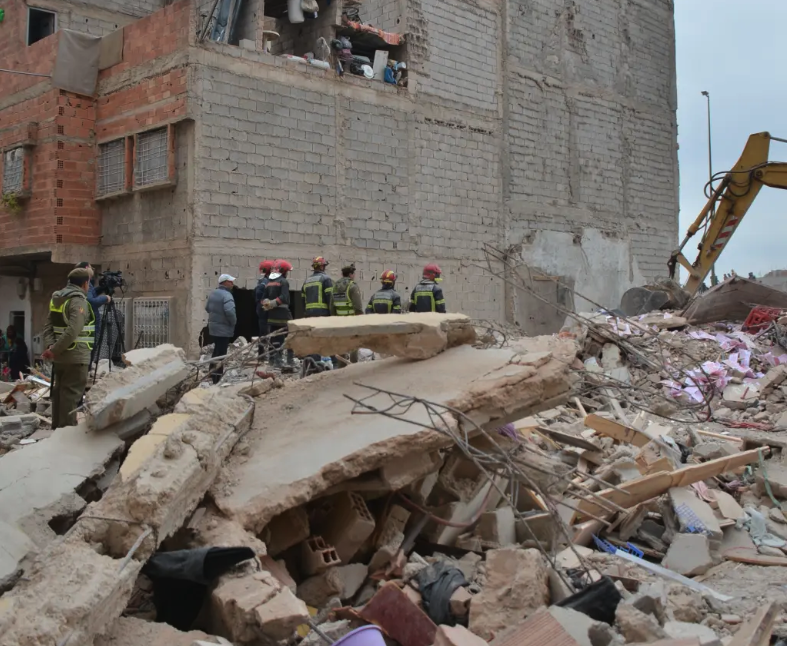
In the cold pre-dawn hours of Wednesday, a catastrophic failure of infrastructure and governance tore through the Al-Mustaqbal neighborhood of Fez, Morocco, as two adjacent four-story residential buildings collapsed into dust. The official death toll stands at 22 souls lost, with 16 others injured, marking the deadliest structural accident in the kingdom in over a decade. This tragedy, occurring during a celebratory Aqiqah—a traditional Muslim feast for a newborn—is not merely a disaster of architecture, but a stark, brutal exposure of Morocco’s deep-seated crisis of illegal construction, regulatory negligence, and crushing urban inequality.
The disaster struck just after 11 p.m. local time on Tuesday night, December 9, 2025. What was a moment of communal joy inside one of the buildings, home to eight families and filled with guests celebrating a new life, instantly transformed into a tomb of concrete and metal. Eyewitnesses described a sound that tore through the quiet night, followed by a suffocating cloud of dust and debris.
“I heard a loud noise around midnight, then screams,” recounted 17-year-old Bilal El Bachir, a local resident interviewed at the scene. “It was shocking. Everyone went outside and I saw what looked like a cloud of dust, and that’s when I realised both buildings had collapsed.”
The immediate aftermath was defined by raw, desperate human effort. Residents, acting as first responders, clawed at the rubble alongside Civil Protection teams, using jackhammers, pickaxes, and even bare hands, illuminated by the harsh glare of emergency lights. The search was painfully slow and fraught with danger, as the unstable mountains of collapsed masonry threatened further harm. Reports confirmed the devastation was compounded by the time of day, with most families asleep or gathered in close quarters for the celebration, dramatically increasing the fatalities, which included numerous women and children.
The grief was immediate and profound. One survivor, who chose to speak with local media in his shock, told Medi1 TV he had lost his wife and three children in the rubble. He was left waiting as rescuers, moving with agonizing caution, attempted to retrieve the bodies of his family. By Wednesday mid-afternoon, rescue teams had tragically concluded their search for survivors, shifting fully to recovery efforts as the provisional death toll of 22 solidified.
The Foundations of Corruption: A System Designed to Fail
The root cause of this calamity lies not in the whims of nature, but in a systematic failure of urban planning and enforcement that plagues many of Morocco’s rapidly expanding cities. The buildings in the Al-Mustaqbal neighborhood were relatively new, constructed around 2006 as part of a government initiative known as “City Without Slums.” This program aimed to rehouse former shantytown residents by allocating them plots of land for self-construction.
However, residents and local analysts point to a chaotic and “anarchic” development environment that followed. Local regulations in the area supposedly limit buildings to two stories to ensure structural integrity and public safety. Yet, the collapsed buildings—like many others in the vicinity—had been illegally extended to four stories.
“I’m sure the upper floors were illegal,” Bilal El Bachir observed, articulating the common knowledge that permeated the community. “And these aren’t the only buildings here with illegal floors. I’m afraid this kind of incident will happen again.”
Another local resident, interviewed by Le 360, summed up the environment: “After 2007, everyone built as they wished.” This widespread disregard for safety standards, often facilitated by corruption or regulatory indifference, meant the structures were fundamentally unsound, bearing loads they were never designed to handle. A technical report will ultimately determine the specifics, but the narrative is already clear: the structures lacked the maintenance and oversight necessary to prevent a catastrophic collapse. Witnesses confirmed to state-owned broadcaster SNRT News that the buildings had exhibited “signs of cracking for some time,” yet no effective preventative measures were taken by either the occupants or the local authorities responsible for public safety.
A Nation on the Brink: Infrastructure vs. Spectacle
The Fez disaster instantly reignited simmering national anger over infrastructure inequality and government priorities. This is the second fatal building collapse in Fez in 2025 alone; an incident in May killed 10 people in a structure that had been officially slated for evacuation. Nationally, the threat looms large: Adib Ben Ibrahim, the housing secretary of state, previously noted that approximately 38,800 buildings across Morocco are officially classified as being at risk of collapse.
The failure of aging and illegally modified housing infrastructure stands in sharp contrast to Morocco’s ambitious international profile. Fez, one of the country’s oldest and third-most-populous cities, is currently a host for the Africa Cup of Nations and is slated to be a key venue for the 2030 FIFA World Cup.
The massive capital investment poured into modern stadiums and world-class tourist facilities while basic safety measures and public services languish in working-class neighborhoods has been the focus of anti-government protests that swept the country earlier this year. Demonstrators across Moroccan cities voiced deep-seated frustration, criticizing the government for investing in spectacle over social equality, healthcare, and infrastructure stability. This latest catastrophe transforms that political critique from a protest slogan into a deadly, physical reality.
The Fez prosecutor’s office has announced the opening of both a judicial probe and a parallel technical and administrative investigation “to determine the real causes” of the incident. For the families mourning the 22 lost souls, including those who tragically gathered to celebrate a birth only to find death, the investigation must go beyond identifying structural flaws. It must hold accountable every administrative and official authority that allowed illegal construction to flourish and ignored clear signs of imminent danger.
This tragedy serves as a roaring, undeniable call for immediate and comprehensive infrastructural reform across the Kingdom. The Lions Roar News demands transparency and swift justice. The lives of 22 people were extinguished not by an accident, but by neglect. Morocco cannot afford to let the weight of its own administrative corruption crush its citizens beneath the rubble of a compromised future. The true test of the nation’s leadership now lies in whether it finally addresses the systemic rot that turned a celebration into the deadliest collapse in a generation.