The Perfect Storm: New Zealand’s Energy Crisis Deepens as Businesses Face Closure and Government Bets on Gas
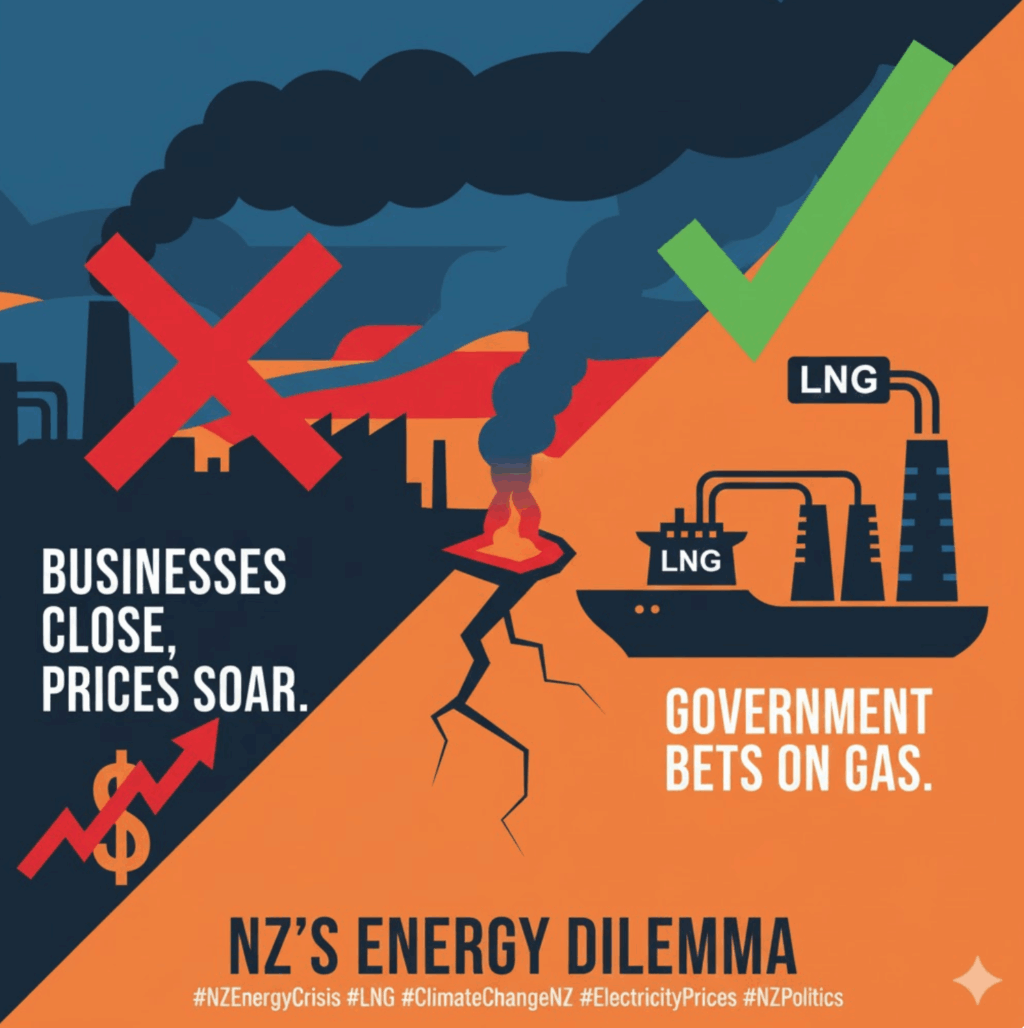
WELLINGTON, NZ — New Zealand’s long-standing vulnerability in its energy system has erupted into a full-blown crisis, characterized by soaring prices, business instability, and a fundamental threat to the nation’s economic competitiveness. The situation—a devastating confluence of depleting domestic natural gas reserves, low hydro lake levels, and an under-invested electricity transmission network—has forced the coalition government to pivot toward a controversial, fossil fuel-heavy short-term solution, casting a long shadow over the nation’s climate commitments.
Reports from across the country confirm that the energy security crisis, declared by the government, is having tangible, immediate, and dire consequences.
The Business Impact: Closures, Job Losses, and Deindustrialisation
The most urgent sign of the crisis is the mounting pressure on New Zealand’s industrial heartland, particularly gas-dependent manufacturers, food processors, and large-scale growers. As domestic gas supplies decline faster than anticipated, long-term contracts have become scarce, and spot prices have exploded, often increasing by over 300% for some users in the past five years.
- Manufacturing Headwinds: Major industrial players are being hit hard. Winstone’s central North Island pulp mill was forced to close in 2024, leading to over 200 job losses, a closure explicitly citing unsustainable energy costs. Similarly, other manufacturers, including paper mills, have either temporarily shut down, curtailed production, or are warning of imminent closure.
- The Cost of Uncertainty: A survey from the BusinessNZ Energy Council (BEC) found that nearly half of major industrial and commercial gas users had already been forced to reduce operations, raise prices, or cut staff due to cost and uncertainty. For firms like Bay of Plenty’s Whakatāne Growers, which rely on gas for heating and essential $\text{CO}_2$ capture to boost crop yields by up to 20%, they are caught in a limbo, unable to secure affordable, long-term gas contracts or find economically viable alternatives like geothermal or heat pumps.
- The Deindustrialisation Threat: Business leaders warn that the continuation of this trend risks a major “deindustrialisation crisis,” where vital domestic capacity is lost, leading to shortages, steep price hikes for consumers, and increased reliance on imports—often from countries with less stringent environmental standards.
The crisis is forcing an unmanaged, “forced transition” away from fossil fuels for industry, where the financial outlay for electrification or switching to biomass is simply “mind-blowing” and too high for many businesses to absorb without support.
The Coalition Government’s Proposed Solution: Importing LNG
Facing mounting political pressure and a genuine threat to national energy security, the coalition government’s primary short-term solution is the procurement of an Liquified Natural Gas (LNG) import terminal.
The government has commenced the first phase of procurement for an LNG facility, describing it as a necessary measure to provide reliable and on-demand access to fuel. The rationale is multifaceted:
- Dry-Year Risk Mitigation: The terminal would guarantee fuel for existing gas-fired thermal plants, which are crucial for firming up electricity supply during extended “dry years” when hydro lake levels are low, and during periods of low wind generation.
- Industrial Continuity: It aims to provide continuity for industrial, commercial, and residential users who cannot immediately switch away from gas.
- Investor Confidence: By shoring up energy security, the government hopes to give investors the confidence to accelerate investment in large-scale renewable projects, knowing that the system has a secure backup.
In addition to the LNG focus, the government has also signalled a move to:
- Lift Constraints on Power Companies: Removing capital constraints on the Mixed Ownership Model (MOM) companies (like Genesis, Meridian, and Mercury) to encourage them to accelerate investment in new generation.
- Reverse Oil and Gas Exploration Ban: Reversing the 2018 ban on offshore oil and gas exploration to potentially bring more domestic supply online, though the feasibility of this is debated.
- Streamline Consenting: Speeding up approval processes for new energy infrastructure, including renewables, through reforms like the Fast-track Approvals Bill.
Feasibility and Controversy: Is LNG the Answer?
The decision to pursue an LNG import terminal is highly controversial, with critics arguing it is a costly and environmentally regressive “band-aid” solution.
Feasibility and Short-Term Impact
In the short term, the LNG proposal offers a tangible solution to the immediate security risk posed by critically low gas reserves and dry-year electricity risk.
- Security: If successfully procured and constructed, it would ensure that existing thermal power plants, such as those at Huntly, have fuel to burn during electricity shortages. This reduces the immediate risk of blackouts and prevents further unmanaged industrial closures driven purely by supply uncertainty.
- Stabilisation: The introduction of a reliable fuel source could help stabilise wholesale electricity prices, which have seen wild, five-fold spikes during periods of supply stress (reaching as high as $1000/MWh).
However, critics warn that LNG is not a perfect fix:
- Cost: Importing LNG is inherently expensive. It exposes New Zealand to volatile international price shocks, making local exporters less competitive and putting upward pressure on energy bills.
- Lock-In Risk: Critics warn that the significant capital investment required for an LNG terminal risks locking New Zealand into a costly fossil fuel dependence for decades, creating a long-term problem under the guise of a short-term fix.
Long-Term Economic and Environmental Impact
The long-term impact is where the solution faces the most scrutiny, particularly concerning the environment.
- Economic Opportunity Cost: The enormous capital required for the LNG terminal could arguably be better spent on accelerating domestic, zero-emission solutions like large-scale battery storage, pumped-hydro (like the NZ Battery Project), and transmission upgrades necessary to support a 100% renewable grid. Focusing on imported gas diverts investment and focus away from building genuine energy independence.
- Environmental Setback: LNG is a fossil fuel. While cleaner than coal, its use and importation contradict the nation’s stated goal of a rapid transition to a low-carbon economy. This move signals a prioritisation of energy security over emissions reduction, potentially undermining confidence in the Emissions Trading Scheme (ETS) and complicating New Zealand’s ability to meet its global climate obligations. The decision to resume offshore oil and gas exploration further reinforces this environmental concern.
The coalition’s long-term plan is a clear attempt to rebalance the “energy trilemma” (security, affordability, and sustainability), but critics argue it dangerously tips the scales towards fossil fuel security at the expense of environmental sustainability.
The Challenges: Government, Business, and the Customer
The energy crisis presents a unique set of challenges across the entire energy ecosystem.
Government Challenges
The government faces the daunting task of simultaneously addressing multiple, conflicting priorities:
- Balancing the Trilemma: The primary challenge is delivering on the three competing demands of energy policy: security, affordability, and sustainability. The LNG solution is a difficult trade-off, pleasing industry but angering environmental groups.
- Investor Confidence: The government must signal a clear, consistent regulatory framework to encourage the $10-20 billion in private investment required for new renewable generation. Policy flip-flops and market uncertainty, especially concerning the future role of gas, deter long-term capital deployment.
- Infrastructure: Urgent upgrades to the national electricity grid and local lines are needed to handle the massive load increases expected from the widespread electrification of transport and industrial process heat.
Business Challenges
For industrial users, the future is fraught with risk:
- Capital Outlay: The high capital cost of transitioning to non-gas alternatives (biomass, geothermal, or electrification) is the single biggest barrier, with payback periods often exceeding a decade. Without government grants or loan guarantees—schemes like the decarbonisation GIDI fund have been frozen—many businesses simply cannot afford the transition.
- Supply and Price Certainty: The lack of long-term gas contracts and the volatility of wholesale prices make future planning nearly impossible, leading to decisions based on panic rather than strategy.
- Technology Gap: For some high-heat industrial processes, proven alternative technologies to gas or coal are not yet commercially viable in New Zealand, forcing them to stay reliant on legacy fuels.
The Final Consumer Impact
Ultimately, the crisis lands on the shoulders of the final customer in two devastating ways:
- Higher Prices: As industrial users absorb or pass on massive energy cost increases, consumers face higher prices for everything from food (glasshouse-grown produce) to manufactured goods. Residential electricity prices have already soared, being 38% higher than they were in the late nineties, driven by a lack of competitive investment in generation.
- Energy Hardship and Resilience: Over 360,000 New Zealand households reported difficulty paying power bills last winter, highlighting severe energy hardship. The ongoing threat of supply shortages and the lack of grid resilience—evidenced by past load shedding events—mean the comfort and security of power supply for the average home cannot be guaranteed, particularly during cold snaps. Consumers bear the brunt of an under-invested and vulnerable system.
The New Zealand energy crisis is a complex tangle of historical underinvestment and urgent geopolitical pressures. The coalition government’s pivot to LNG offers a necessary, albeit costly and climate-compromised, short-term security fix. However, without an equally robust, funded, and streamlined path for renewable transition and infrastructure build-out, the crisis risks becoming chronic, potentially deindustrializing key sectors of the economy and cementing a legacy of high prices and environmental drift. The ultimate success of the government’s approach will be measured not by the survival of this winter, but by the security and affordability of New Zealand’s energy system a decade from now.