The Last Hope: MH370 Search Set to Resume, Eleven Years Later
By Lions Roar News Aviation Desk
KUALA LUMPUR/PERTH – The world’s most enduring aviation mystery is set for a monumental new chapter this month. The search for Malaysia Airlines Flight MH370, which vanished on March 8, 2014, with 239 people on board, is officially set to resume from December 30, 2025.
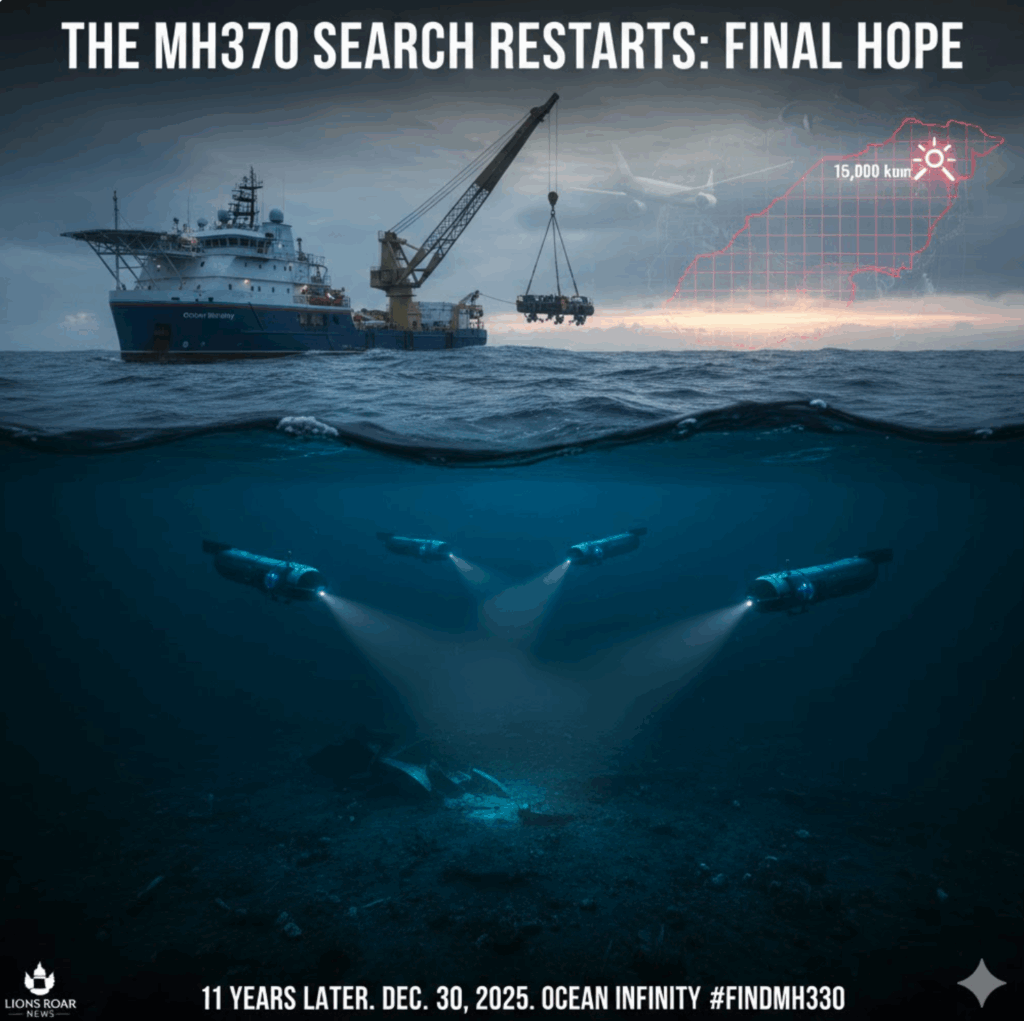
More than 11 years after the Boeing 777 disappeared from radar en route from Kuala Lumpur to Beijing, the Malaysian government has given the green light for a renewed deep-sea search effort led by the American marine robotics firm Ocean Infinity. This mission, which will focus on a highly refined, high-probability area of the Southern Indian Ocean, represents the most technologically advanced and perhaps the final organized attempt to locate the main wreckage and provide long-awaited closure.
The announcement, made by Malaysia’s Transport Ministry, confirms a new search agreement that places the financial risk entirely on the exploration company. The mission is structured as a “no-find, no-fee” contract, under which Ocean Infinity will only receive payment—reportedly up to US$70 million—if the aircraft or substantial wreckage is discovered. The company will conduct the search intermittently over a 55-day window, targeting a new, focused area assessed to have the highest likelihood of success.
🌑 The Enduring Enigma: A Flight That Refused to Land
The disappearance of MH370 remains unparalleled in modern aviation history. After departing Kuala Lumpur International Airport in the early hours of March 8, 2014, the aircraft disappeared from civilian air traffic control screens at 01:22 MYT. Military radar tracked the jet for another hour as it deviated sharply from its planned northeastern course, turning west, crossing the Malay Peninsula, and heading toward the Andaman Sea.
Subsequent analysis of the unique satellite “handshake” data between the aircraft and an Inmarsat satellite concluded that the plane flew on for approximately six more hours, ultimately turning south and continuing its flight path until it ran out of fuel and crashed into the remote, unforgiving depths of the southern Indian Ocean.
The initial, multinational search effort—coordinated by Malaysia, China, and Australia—covered a vast 120,000 square kilometre area of the seabed. It was the most expensive search in aviation history, costing over A$200 million, and was suspended in January 2017 without success.
Since then, only small pieces of debris—confirmed to be from MH370—have washed ashore thousands of kilometers away on the coast of East Africa and islands like Réunion, confirming the plane’s ultimate resting place in the oceanic south. However, the main wreckage, the Black Boxes (Flight Data Recorder and Cockpit Voice Recorder), and the answers they hold have remained elusive.
🌊 A New Horizon: Why the Search Restarts Now
The decision by the Malaysian government to restart the search, over a decade after the initial multinational operation was called off, is driven by three critical factors:
1. Refined Data and High-Probability Zones
Ocean Infinity, an experienced deep-sea explorer, previously conducted a search in 2018 under a similar “no-find, no-fee” arrangement. While that mission came up empty, the company and a dedicated international team of independent experts have spent the intervening years conducting rigorous re-analysis of all available data.
This includes:
- Re-evaluating Inmarsat Satellite Data: Refining the mathematical models of the ‘handshake’ signals between the aircraft and the satellite.
- Debris Drift Modelling: Using the precise locations and times of confirmed debris finds (such as the wing flaperon) to run reverse-drift analysis, tracing the probable impact point more accurately.
- WSPRnet Analysis (New Clues): Some experts, notably Richard Godfrey, have used weak signal propagation reporter (WSPR) data—a form of “passive radar” using radio amateur signals—to generate a refined flight path and a smaller, more focused crash location.
This combined, advanced data analysis has allowed Ocean Infinity to define a new 15,000 square kilometre zone that is now considered the “highest probability” area, a location that may have been missed by the sweeping initial search effort.
2. Advanced Robotic Technology
Ocean Infinity is renowned for its deployment of cutting-edge marine technology. The new search will see the company utilizing its upgraded fleet of Autonomous Underwater Vehicles (AUVs). These AUVs are capable of operating in coordinated “swarms,” covering vast expanses of the deep-sea floor more efficiently and at a higher resolution than previous methods.
Crucially, these robotic systems can operate at depths greater than 6,000 metres (over 3.7 miles), mapping the ocean terrain using multibeam sonar and high-resolution imaging to detect even the smallest pieces of wreckage in the crushing darkness of the abyssal plain.
3. Closure for Families and Accountability
The renewed mission underscores the Malaysian government’s stated commitment to provide closure for the families of the 239 victims. For more than a decade, relatives from countries including China, Malaysia, Australia, and Indonesia have relentlessly campaigned for the search to continue, viewing the recovery of the wreckage as the only way to find definitive answers about what caused the jet’s catastrophic diversion.
As Danica Weeks, whose husband Paul was on board, stated: “We’ve never stopped wishing for answers, and knowing the search will go on brings a sense of comfort. I truly hope this next phase gives us the clarity and peace we’ve been so desperately longing for…”
🤔 The Unanswered Questions
The recovery of the main wreckage and the aircraft’s recorders is essential because, despite the extensive investigation, the definitive reason for the disappearance remains unknown.
Official reports have concluded that the plane’s controls were likely manually altered, leading to the diversion. This conclusion leaves open the possibility of “unlawful interference”—either a deliberate act by a person on board or an incapacitation event followed by the plane flying on autopilot until fuel exhaustion. Theories have ranged from a malicious act by a crew member to a slow-developing hypoxia event. The only way to separate fact from speculation is to recover the black boxes.
For the international community, the successful conclusion of the search would not only solve a decade-old mystery but could also yield invaluable data to prevent future tragedies. The initial disappearance prompted regulatory changes in the aviation sector, including new standards for aircraft position reporting over open ocean. Finding MH370 now would provide the final, crucial pieces of data to understand the ultimate limits of human and mechanical failure.
The clock is now ticking on the 55-day window. As the search vessel makes its long transit to the remote search area southwest of Perth, the world waits, hoping that after 11 years of silence, the abyss is finally ready to surrender its secret.