China’s New ‘K-Visa’ Sparks Domestic Backlash Amid Youth Unemployment Crisis
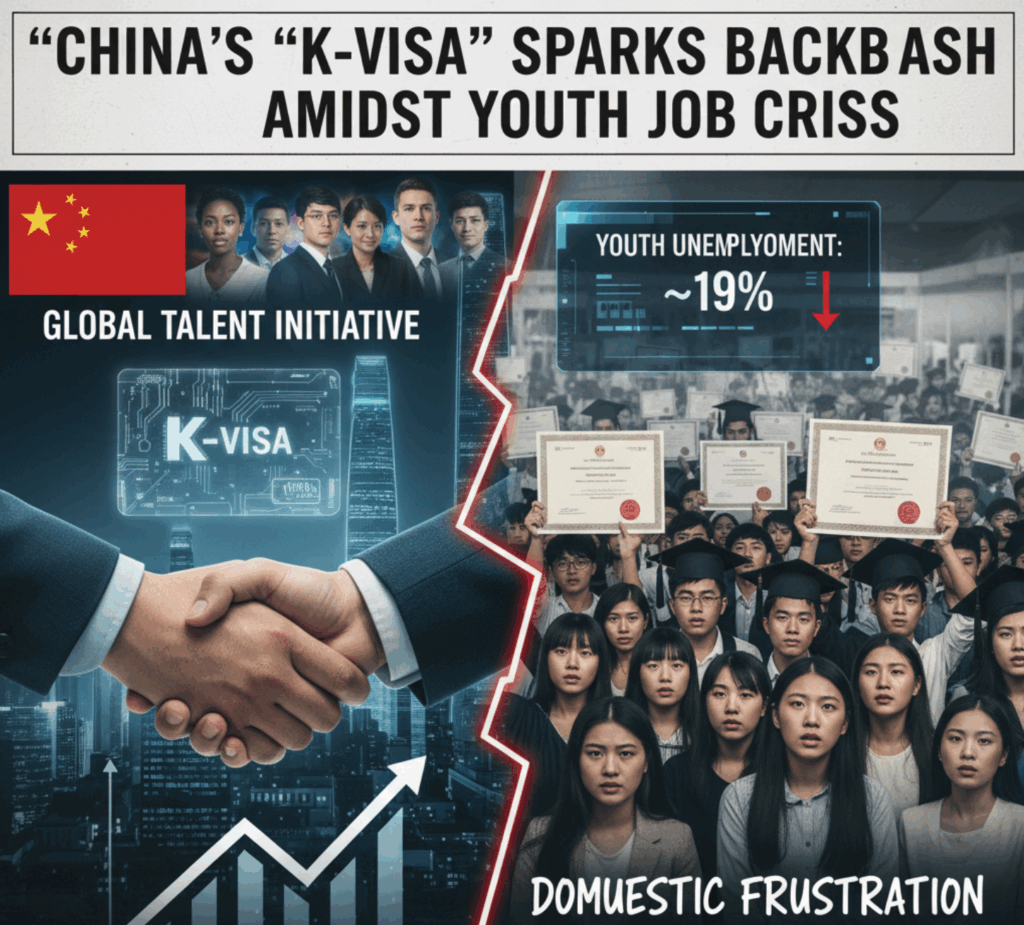
The “K-Visa” program, designed to attract foreign high-skilled workers, has ignited fierce opposition among China’s highly educated youth, who are already struggling to secure jobs in a fiercely competitive market.
Beijing, China – In a bold strategic move to gain an advantage in the global technological race, the Chinese government has launched a new visa category, reportedly dubbed the “K-Visa,” aimed at attracting highly skilled foreign professionals, particularly those in science and technology fields. However, what Chinese officials have promoted as a necessary catalyst for national development has been met with significant domestic discontent and outright fury from a critical segment of the population: the nation’s young, educated workforce.
The new visa category, which was reportedly launched around October 1st, has become the dominant topic of social media discussion in recent days. Hashtags related to the visa surged to approximately half a billion views within just two days, underscoring the raw emotion and deep anxiety this policy has tapped into. The overwhelming sentiment among young Chinese citizens is a profound sense of injustice and marginalisation.
The core of the backlash is rooted in China’s severe youth unemployment crisis. With the youth jobless rate hovering stubbornly close to 19%—and potentially higher given that official reporting on this metric was temporarily suspended—and a record 12.2 million new university graduates entering the job market this year, competition for meaningful employment is at an all-time high.
The common refrain echoed across social platforms is one of disbelief and frustration: “There are so many of us here with Master’s degrees struggling to find a job, and yet you want to bring in more talent from overseas?” This rhetorical question highlights the stark disconnect between the government’s pursuit of global talent and the immediate, painful realities of its own citizens.
The Strategic Logic: A Geopolitical Gambit
The timing and nature of the K-Visa program suggest it is a direct component of Beijing’s long-term strategy to gain a significant advantage in its ongoing technological rivalry with the United States. This geopolitical contest, particularly in critical sectors like artificial intelligence, microprocessors, and advanced manufacturing, is widely seen as the defining conflict of the 21st century.
For years, the U.S. has been the world’s primary magnet for elite global talent, attracting top students and researchers through institutions like the Fulbright Programme and visa categories like the H-1B. However, the political environment in the U.S. has recently presented an opportunity for China. Under the administration of President Donald Trump, there were clear efforts to cut federal funding for research and tighten restrictions on international students and workers, driven by security and immigration concerns.
Beijing appears to be capitalising on this perceived shift in sentiment, attempting to project itself as a more welcoming and stable destination for global intellectual capital. By launching the K-Visa, China is signaling its commitment to a strategy of “talent poaching”—aggressively recruiting skilled individuals who might otherwise have gone to Western nations. These professionals are seen as essential to filling the technological gaps exposed by U.S. sanctions and accelerating China’s self-reliance drive in high-tech industries. The official narrative promoting the K-Visa emphasizes its role in injecting fresh ideas and necessary expertise to drive innovation and high-quality economic development.
The Depth of the Youth Employment Crisis
To fully appreciate the intensity of the backlash, one must understand the depth of China’s structural unemployment problem, especially for college graduates.
The “985” and “Double First-Class” Squeeze
China’s education system produces an enormous number of graduates, many from highly prestigious institutions. The nation’s decades-long emphasis on tertiary education as a path to prosperity has created a severe oversupply of university-educated workers relative to the current demand for white-collar jobs. Furthermore, the economic sectors that traditionally absorbed these graduates have been under immense pressure:
- Tech Sector Crackdowns: Regulatory crackdowns on major internet and technology companies (such as Alibaba, Tencent, and others) over the past few years led to massive layoffs and a significant slow-down in hiring. This effectively capped the primary source of high-paying jobs for engineering and computer science graduates.
- Property Sector Collapse: The debt crisis in China’s colossal property and construction sector—a traditional pillar of the economy and a major employer of finance, engineering, and management graduates—has led to freezing construction projects and bankruptcies, eliminating countless entry-level and mid-career positions.
- The “Lying Flat” Phenomenon (Tāng Píng): The high-stress, low-opportunity environment has fueled a social movement known as “lying flat,” where disillusioned young people reject the culture of aggressive careerism and excessive work, opting for minimal effort. This is both a reaction to, and a symptom of, the lack of quality job opportunities.
The “Internal Volume” (Nèijuǎn) Effect
The term “Nèijuǎn,” often translated as “involution” or simply “internal volume,” is a widespread concept in modern Chinese society describing the hyper-competitive pressure to succeed. For young graduates, it manifests as endless competition for a limited number of positions, forcing them to work long hours for diminishing returns. The K-Visa is viewed through this lens as an attempt to artificially increase “internal volume” by importing foreign competitors, thereby making life even harder for domestic talent.
Many young people feel betrayed by the education system that promised prosperity. They invested significant time and financial resources—often supported by their entire extended families—to obtain advanced degrees, only to find themselves stuck in a precarious economic situation. The government’s decision to prioritize foreign talent over addressing this deep-seated domestic anxiety is perceived as a political slight.
Historical Parallels and Policy Precedents
China is not the first nation to use specialised visas to attract talent. Many countries have similar programs designed to plug specific, high-end skills gaps. The United Kingdom, Germany, and Canada have all launched initiatives to simplify the immigration process for top-tier researchers and entrepreneurs.
However, the political environment in China differs dramatically. Unlike Western nations, where high-skilled immigration is often framed as necessary for national GDP growth and cultural diversity, the K-Visa program in China is being implemented at a time of severe domestic hardship. This has led to accusations that the central government is out of touch with the daily struggles of its citizens.
Furthermore, there are concerns that the K-Visa may be misused. Critics argue that while the government claims to be targeting only the “best and brightest” to work on key state projects, in reality, the system could be exploited to fill positions that domestic graduates are perfectly capable of performing, simply because foreign workers may be perceived by some employers as a source of prestige or specific international connections. This fear is exacerbated by the broader trend of “internal volume” where young people already struggle to compete with older, more experienced domestic professionals.
In a global economic environment where talent mobility is becoming crucial, the K-Visa is a strategically sound policy on paper—a tool to ensure China remains competitive in the high-stakes game of technological supremacy. Yet, its launch serves as a stark reminder of the social contract under duress: the government’s efforts to ensure global power are colliding directly with its failure to guarantee prosperity and stability for its own most educated generation. The backlash is not just against a piece of immigration policy; it is a profound expression of economic anxiety and political frustration from a generation that feels increasingly like an afterthought in their nation’s grand strategic plan.
The coming months will be critical to observe how Beijing manages this intense public relations and social challenge. The government faces a difficult balancing act: how to simultaneously secure the foreign talent necessary for its technological ambitions while addressing the very real and deeply felt unemployment crisis affecting the future of the nation. Failure to address the latter could turn this economic anxiety into a more significant source of social and political instability.