New Zealand and Singapore Forge Comprehensive Strategic Partnership to Deepen Regional Cooperation
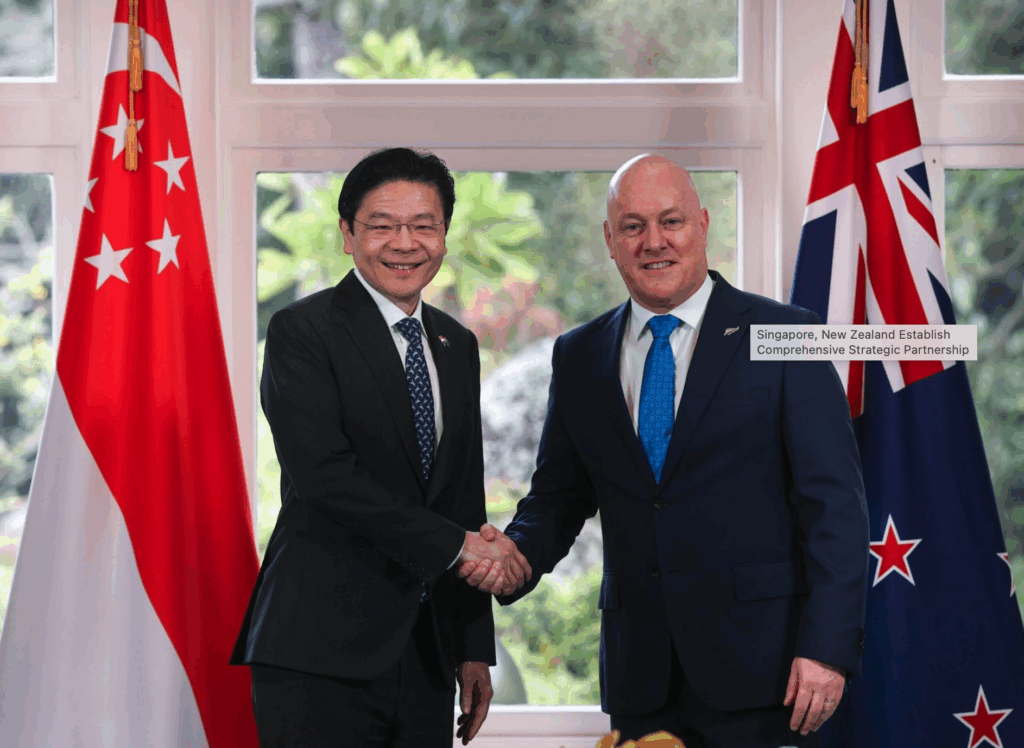
Auckland, October 12, 2025 —
In a landmark development for the Asia-Pacific region, New Zealand Prime Minister Christopher Luxon and Singapore Prime Minister Lawrence Wong have jointly launched the New Zealand–Singapore Comprehensive Strategic Partnership (CSP) — a wide-ranging framework designed to strengthen bilateral ties across trade, security, innovation, and geopolitical collaboration.
The announcement, made during Wong’s official visit to New Zealand, marks a significant upgrade in the two countries’ relationship, reflecting shared values, economic complementarities, and a mutual commitment to regional stability.
A Milestone in Bilateral Relations
The CSP builds upon decades of strong diplomatic and economic cooperation between New Zealand and Singapore. Both nations have long been recognized as like-minded, open economies with global outlooks, strong adherence to the rule of law, and active participation in multilateral institutions.
The new partnership expands this cooperation into emerging domains such as green technology, digital innovation, cybersecurity, defense coordination, and strategic diplomacy in the Indo-Pacific.
Prime Minister Luxon described the CSP as a “future-focused partnership for a changing world,” saying it represents “a deepening of trust and a shared commitment to navigating global complexity together.”
“Singapore has been one of our most consistent and reliable partners in Asia,” Luxon said. “As small, outward-looking nations, both New Zealand and Singapore understand the importance of working together to protect our shared prosperity, resilience, and regional security.”
Prime Minister Wong echoed those sentiments, emphasizing that both countries “punch above their weight” in global affairs through innovation, diplomacy, and cooperation.
“This Comprehensive Strategic Partnership reflects our shared belief that collaboration, not competition, is the path forward in an uncertain world,” Wong said. “It will enable us to leverage each other’s strengths — in trade, technology, and talent — for the benefit of our peoples and the wider region.”
Key Pillars of the Partnership
The CSP outlines several strategic areas of cooperation designed to deliver tangible benefits for both nations:
- Trade and Economic Integration
- The two countries plan to expand their already robust trade relationship, focusing on innovation-driven industries, digital trade, and supply-chain resilience.
- Singapore is New Zealand’s fifth-largest trading partner, with two-way trade valued at over NZ$6 billion annually.
- The partnership aims to promote new investment opportunities in renewable energy, agri-tech, and biotechnology.
- Green Economy and Sustainability
- Both governments have committed to accelerating the transition to low-carbon economies.
- Initiatives will include joint projects in green hydrogen, carbon-capture research, and sustainable aviation fuel.
- The CSP reinforces shared goals under the Singapore–New Zealand Enhanced Partnership and the ASEAN–Australia–New Zealand Free Trade Area (AANZFTA) modernization process.
- Innovation, Science, and Technology
- A new Innovation Exchange program will facilitate partnerships between universities, research institutes, and start-ups in both countries.
- Areas of focus include artificial intelligence, fintech, climate modelling, and smart-city technologies.
- Both governments will also collaborate on establishing digital standards and cybersecurity protocols to ensure safe cross-border data flow.
- Defense and Security Cooperation
- The CSP formalizes a framework for enhanced defense collaboration, including joint military training, intelligence sharing, and crisis-response coordination.
- New Zealand and Singapore have a long history of defense cooperation under the Five Power Defence Arrangements (FPDA), and this new agreement strengthens interoperability between the two defense forces.
- People-to-People Links
- The agreement also expands educational exchanges, cultural partnerships, and tourism cooperation.
- A new Work and Holiday Visa pathway will make it easier for young citizens to gain work experience across both countries.
- The two nations will jointly promote the movement of skilled workers, researchers, and entrepreneurs to drive innovation.
Strategic and Geopolitical Significance
Analysts see the launch of the CSP as both a symbolic and practical move that underscores the increasing importance of middle-power diplomacy in the Indo-Pacific.
With growing geopolitical tensions, global supply-chain disruptions, and climate-related challenges, small and mid-sized nations like New Zealand and Singapore are seeking to strengthen alliances that emphasize multilateralism, openness, and stability.
“Both Wellington and Singapore have a strong record of championing free trade, regional cooperation, and international law,” said Dr. Rachel Ng, a senior fellow at the Asia-Pacific Policy Institute. “This partnership gives both nations greater strategic depth and a stronger collective voice in global forums.”
Economic Opportunities for Businesses
The CSP is expected to provide new opportunities for businesses on both sides. New Zealand companies will gain better access to Singapore’s position as a regional financial and logistics hub, while Singaporean firms can tap into New Zealand’s advanced agri-tech, renewable-energy, and education sectors.
The agreement also encourages collaboration between chambers of commerce and trade promotion agencies.
New Zealand Trade & Enterprise (NZTE) CEO Peter Chrisp said the deal “will open up significant new channels for small and medium-sized enterprises,” particularly in sustainability, food innovation, and digital services.
Shared Vision on Regional and Global Challenges
Both nations reaffirmed their commitment to maintaining a free, open, and rules-based Indo-Pacific. They emphasized the importance of cooperation on maritime security, disaster relief, and upholding international law — including the United Nations Convention on the Law of the Sea (UNCLOS).
Prime Minister Luxon and Prime Minister Wong also discussed collaboration in regional forums such as APEC, ASEAN, and the Comprehensive and Progressive Agreement for Trans-Pacific Partnership (CPTPP).
The two leaders agreed that strengthening cooperation between small but agile economies is vital to ensuring stability in an era of great-power rivalry and economic uncertainty.
Public and Industry Reaction
The CSP announcement has been widely welcomed by business and policy circles.
Business NZ CEO Kirk Hope praised the initiative as “a bold step that puts innovation and partnership at the heart of New Zealand’s foreign policy.”
In Singapore, the Economic Development Board (EDB) described the deal as “a forward-looking model for how smaller economies can collaborate to remain competitive in the digital and green eras.”
Academic observers also highlighted the symbolic value of the partnership, noting that it reflects a new generation of leadership — with both Luxon and Wong representing pragmatic, globally engaged leaders focused on economic transformation and resilience.
Looking Ahead
As part of the CSP rollout, both governments have committed to establishing a Joint Ministerial Committee to oversee implementation and track progress. The first review meeting is expected to be held in Singapore in early 2026.
Analysts suggest the partnership could serve as a blueprint for other bilateral relationships in the region, particularly among like-minded states seeking to navigate a volatile global environment through innovation, sustainability, and diplomacy.
“This partnership is not just about trade or defense,” Luxon concluded. “It’s about shaping the future — one where New Zealand and Singapore, working together, can make a meaningful impact on global issues that matter to all of us.”