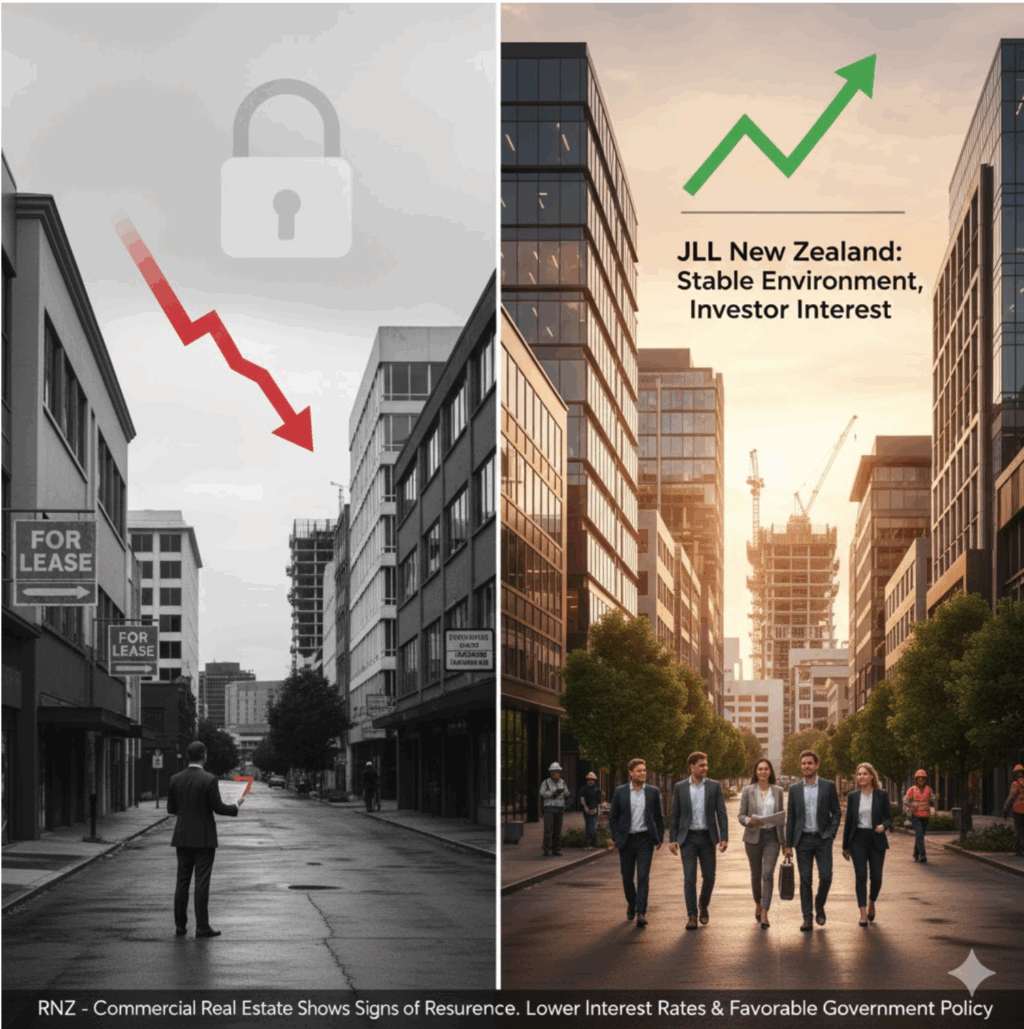
Commercial Real Estate Market Shows Signs of Resurgence Amid Policy Shifts and Lower Interest Rates
Auckland, October 12, 2025 —
After a period of uncertainty and subdued activity, New Zealand’s commercial property market is showing strong signs of recovery. Analysts report renewed investor confidence and steady growth in demand for industrial, office, and retail assets, driven by lower interest rates, a more favourable policy environment, and stabilizing economic conditions.
The revival comes just weeks after the Reserve Bank of New Zealand (RBNZ) surprised markets with a sharp 50 basis point cut to the Official Cash Rate (OCR), reducing it to 2.5%, the lowest in three years. The rate cut has significantly improved borrowing conditions, prompting businesses and investors to re-enter the commercial real estate sector.
Market Momentum Builds After Period of Caution
According to a report by JLL New Zealand, the commercial property landscape is becoming increasingly stable, with more consistent transaction volumes and growing interest in key asset classes. The report highlights that industrial properties remain the standout performers, while select office and retail assets are also showing signs of renewed vitality.
“The environment is more balanced than it was 12 months ago,” said Paul Winstanley, JLL’s Head of Research. “We’re seeing confidence gradually returning, particularly in logistics and warehousing sectors where long-term fundamentals remain strong.”
Over the past two years, the commercial sector was hit by a combination of rising interest rates, construction cost inflation, and changing workplace patterns. Many investors adopted a wait-and-see approach, leading to lower transaction volumes and price corrections in several urban markets.
However, the recent combination of monetary easing, fiscal incentives, and stabilizing inflation has created a more attractive climate for property investment.
Lower Interest Rates: A Turning Point
The RBNZ’s latest rate cut has had an immediate effect on investor sentiment. Lower borrowing costs have improved project feasibility and boosted yields relative to financing expenses.
Analysts say this has spurred renewed demand for quality assets in Auckland, Wellington, and Christchurch, with both domestic and offshore investors reassessing opportunities.
“Capital markets are waking up again,” said Rachel Field, Property Economist at CoreLogic NZ. “Investors are now factoring in a more accommodative interest rate cycle, which supports asset values and encourages new development.”
Industrial and logistics facilities — especially those near transport hubs — are leading the recovery, with yields tightening by an average of 30 to 40 basis points in the past quarter.
Meanwhile, the office market, which had faced challenges due to remote work trends, is showing resilience as hybrid work models stabilize and companies reinvest in collaborative office environments.
Government Policy Boosting Investor Confidence
The government’s recent adjustments to property taxation, infrastructure investment, and regional development policies have also contributed to the sector’s revival.
The 2025 Budget included measures to incentivize commercial construction, streamline consents for mixed-use developments, and attract international capital through clearer foreign investment regulations.
“Policy stability matters,” said Simon Munro, CEO of the Property Council New Zealand. “Investors need predictable frameworks and confidence in long-term economic direction. Recent reforms have made the landscape more attractive, particularly for institutional investors and property funds.”
Additionally, regional councils have begun promoting urban regeneration zones, offering planning incentives for developers to repurpose older buildings into flexible office spaces, co-working hubs, and mixed-use precincts.
These initiatives, analysts say, are helping rebalance the supply-demand dynamic and driving renewed investment in secondary city markets such as Hamilton, Tauranga, and Dunedin.
Industrial Sector Remains Star Performer
Among all segments, industrial real estate continues to outperform due to sustained demand from e-commerce, logistics, and manufacturing sectors.
Warehouse vacancies remain low — averaging below 2% nationwide — as businesses seek efficient distribution networks to serve both domestic and export markets.
“Industrial assets are still the backbone of the sector,” said Michael Jones, Industrial Director at Colliers New Zealand. “Even during the slowdown, logistics and storage spaces held value because they are directly tied to trade and supply-chain activity.”
Rental growth in prime industrial precincts around Auckland’s Airport Corridor and South Auckland has averaged 4–5% annually, with strong leasing activity expected to continue into 2026.
Office Sector Adapts to New Realities
The office property segment is also showing renewed signs of life. While vacancy rates remain elevated in some CBD locations, the flight-to-quality trend — where tenants move from older, less efficient buildings to modern, sustainable offices — continues to reshape the market.
Flexible workspace providers and technology firms are driving much of the leasing activity, while government agencies and financial services companies are reconfiguring space for hybrid operations.
Sustainability has become a critical differentiator, with green-certified buildings commanding premium rents. Developers are increasingly integrating energy-efficient systems, smart building technology, and employee wellness features to meet tenant expectations.
“The days of one-size-fits-all offices are over,” said Amy Leung, Head of Commercial Leasing at Bayleys Realty Group. “Companies want adaptable spaces that reflect their culture, attract talent, and optimize productivity.”
Retail and Hospitality Recovery Emerging
The retail property market, which suffered severely during the inflation and cost-of-living crisis, is showing tentative recovery signs.
Lower interest rates, improved consumer sentiment, and rising tourism flows are contributing to a slow but steady rebound.
Prime retail locations in Auckland’s Queen Street and Wellington’s Lambton Quay are seeing new lease activity, while suburban retail centres benefit from population growth and convenience-based shopping patterns.
Hospitality operators, too, are expanding, particularly in mixed-use developments that combine dining, entertainment, and accommodation options.
Foreign Investment and Global Interest
New Zealand’s reputation for economic stability, transparent governance, and sustainable development continues to attract international investors.
Funds from Singapore, Australia, and the Middle East are reportedly exploring opportunities in logistics, data centres, and renewable-energy-linked real estate projects.
JLL reports that cross-border investment in New Zealand commercial assets rose by 18% year-on-year in the first half of 2025, driven by portfolio acquisitions and joint ventures.
“Global investors view New Zealand as a safe, transparent, and high-quality market,” Winstanley noted. “The recent rate cut and government consistency have strengthened that perception.”
Outlook: Cautious Optimism Ahead
Despite the improving outlook, experts caution that the recovery remains uneven across asset types and locations. Economic headwinds, such as global uncertainty and slowing demand from China, still pose risks to sustained momentum.
Nonetheless, the overall sentiment in the commercial real estate sector has turned positive for the first time in more than two years.
“The next 12 to 18 months will likely see steady stabilization rather than explosive growth,” said Field from CoreLogic. “But the fundamentals — lower rates, stable policy, and strong demand for industrial and quality office assets — are all aligning for a healthy rebound.”
Conclusion
New Zealand’s commercial real estate sector is on a path to recovery, reflecting a broader return of confidence in the post-pandemic economy.
With supportive monetary policy, resilient fundamentals, and renewed investor activity, the country’s property market is once again positioned as a cornerstone of sustainable economic growth.
As interest rates remain low and reforms take root, analysts say the focus will shift toward long-term sustainability, smart development, and balanced regional growth — ensuring that this resurgence is both inclusive and enduring.