Local democracy on show — what the 2025 New Zealand local elections have told us so far

By Lions Roar News political desk
New Zealand’s 2025 local election marathon — a month-long postal voting period that closed at midday on Saturday, October 11 — has produced an early picture of what communities around Aotearoa want from the people who will run their cities, districts and regions for the next three years. As progress and preliminary counts roll in across the country, several clear themes are emerging: low turnout remains a stubborn problem, incumbents are holding in several of the major centres, Māori ward referendums have added a volatile, rights-focused dimension to many ballots, and voters appear to be responding to bread-and-butter local issues such as rates, infrastructure and service delivery rather than national party politics.
This article summarises the status of the count as it stands, explains the big races and why they mattered, examines turnout and the referendum question on Māori wards that appeared on dozens of ballots, and offers an early read on what the results say about local democracy in 2025.
Where we are now: progress counts and what “final” means
Because New Zealand uses a mix of postal ballots, early processing and a final count that includes special votes, today’s figures are best understood as progress or preliminary results. Many councils publish “progress results” the afternoon of the close of voting; final, certified counts (which include late-arriving special votes and are subject to verification) are typically declared later in the week — many councils are pointing to final results to be published between October 16–19. For example, Rangitīkei District Council has signalled its final declaration is expected on Friday, 17 October.
That means the names currently leading certain mayoral and council races should be treated as highly informative, but not yet absolutely final in every case. Some contests will be decided by large margins and are unlikely to change; others remain tight and could be affected by the final special-vote tally.
Early national picture: turnout still a worry
Turnout has been a major talking point throughout this election. Local Government New Zealand (LGNZ) and council daily tallies showed fewer than 1 million votes returned by October 9 — roughly 28–29% of enrolled voters — and Auckland in particular recorded worrying lows. As of the late stages of the voting period, Auckland Council reported just over 261,000 ballots returned from more than 1.19 million eligible voters — a turnout near 21.8%, the lowest in the country. Several other cities, including Hamilton and Porirua, recorded low 20s percentages at similar times. Commentators and local analysts warned the nation risked another record-low local turnout, a long-term trend that erodes the mandate of those elected.
Low turnout matters because local councils make decisions that tangibly affect everyday life — from rates and rubbish collection to spatial planning, transport and stormwater spending. When under 30% of voters participate, questions arise about representativeness: who is being heard, and whose priorities are shaping local planning for the next three years?
Big races and early winners: incumbents largely doing well in the main centres
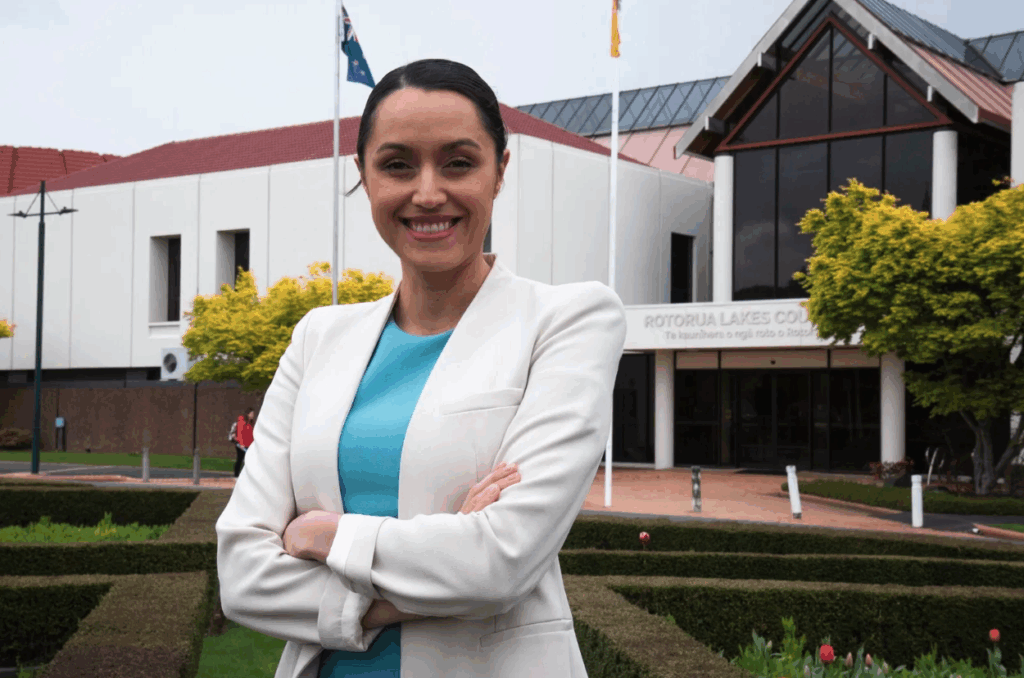
Tania Tapsell tells the Rotorua Daily Post she has been re-elected to the role.
A handful of mayoral races have produced decisive early outcomes.
- Auckland: Incumbent Wayne Brown is reported as having won a second term as Auckland mayor, beating challenger Kerrin Leoni and others, reinforcing Brown’s “Fix Auckland” platform and signalling voter acceptance of his agenda on transport priorities and rates restraint. The New Zealand Herald has reported Brown’s re-election in early progress counts. Given the scale of Auckland’s electorate, the result will be watched closely as a bellwether for suburban and metropolitan sentiment on rates and service delivery.
- Christchurch: Progress results show Phil Mauger re-elected as Christchurch mayor by a comfortable margin, with an early lead of roughly 20,000 votes over his nearest rival, Sara Templeton. Christchurch’s result suggests incumbency advantage and that voters in Ōtautahi have backed Mauger’s approach to local rebuild, infrastructure and amenity projects.
- Other centres: Across the regions, a mix of returning councillors and some new faces are appearing in progress results. Media outlets and councils are publishing interactive trackers as results arrive; the New Zealand Herald, RNZ and 1News have been among the most active at collating those updates. Some smaller districts have had unopposed candidates or guaranteed changes where no incumbents stood.
These early mayoral outcomes indicate that, in several of the country’s largest councils, incumbents with clearly communicated local agendas have retained the trust of voters — even as overall participation lagged.
What voters were choosing between: the issues that mattered
Local elections rarely turn on national party slogans. Instead, they are often decided by the quality of council services and the immediacy of everyday issues. In 2025 the dominant themes were:
- Rates and affordability: Many councils are grappling with the legacies of post-quake rebuilds, infrastructure backlogs and rising construction costs. In a climate of household budget pressure, candidates promising to limit rate increases or to prioritise core services over ambitious new projects found receptive electorates. That emphasis on tight fiscal stewardship was visible in candidate messaging across regions.
- Infrastructure and maintenance: Crumbling pipes, road repairs and three-waters related investment remained on ballots. Concerns about local resilience — to flooding, storm events and ageing assets — pushed infrastructure planning to the top of many council manifestos.
- Housing and planning: Councils with pressing housing shortages and controversial plan changes saw strong contestation. Local decisions on zoning and consenting are where national housing policy meets everyday politics.
- Representation and rights: The return of Māori ward questions to ballots (discussed below) made representation and tikanga a central issue in many districts. Candidates’ stances on Māori representation, and how councils should engage with iwi, factored into voters’ calculations.
National-level budget settings and central-government austerity also created a backdrop — towns with heavy reliance on public-sector employment (notably Wellington) felt the impact of government cutbacks, which filtered into local debate about economic strategy and council priorities. International commentators have also noted the fiscal squeeze on regional economies this year.
The Māori wards referendum: a returning flashpoint
One of the signature features of the 2025 local election cycle was the legally mandated referendums on Māori wards in councils that had introduced them without a binding public poll. Following legislation passed by the current government, councils that had established Māori wards were required to put the matter to the public during the 2025 elections. In total, ballots included this question for dozens of territorial and regional councils (Wikipedia and Vote Local tallies list some 42 councils required to hold referendums). That made the polls not just about who sits on councils, but who those councils are intended to represent.
The requirement injected a polarising element into some local races. For supporters, Māori wards are a mechanism to ensure Māori voices are present in local decision-making and to improve representation for tāngata whenua. For opponents, referendums became a vehicle to campaign on “one person, one vote” messaging. The upshot: in many communities the ballot paper asked voters to take a position on both representation and the future shape of local democracy itself. Election authorities and civic groups warned this could drive higher engagement in some places — though the nationwide turnout trend suggests that in many areas it did not overturn the overall participation slump.
Problems and process: errors, trust and calls for reform
The run-up to voting and the early progress count were not without hiccups. LGNZ and some councils reported errors affecting voting packs in a small number of districts (Whanganui, Ōpōtiki and South Wairarapa were cited), prompting calls from sector bodies for a clearer, professionally managed national approach. LGNZ’s interim leadership has argued future local elections should be administered by the Electoral Commission to prevent mistakes that undermine public trust in the process. The combination of administrative errors and low turnout compounds concerns about the legitimacy of some outcomes.
What the results (so far) tell us about larger trends
Taken together, the preliminary results and the election dynamics suggest several broader readings:
- Local incumbency remains powerful. Where incumbents were visible and campaigned on local results (roads fixed, services delivered, pragmatic cost control), voters were likely to back them. Both Auckland’s reported re-election of Wayne Brown and Christchurch’s early re-election of Phil Mauger fit that pattern.
- Engagement is uneven and falling in many places. The persistent problem for local democracy continues to be low and geographically uneven turnout — Auckland’s very low return rate stands out. Low turnout shifts the balance of decision-making power toward highly motivated, organised voting blocs rather than broad majorities. Civic advocates will see this as a call to re-think how councils and electoral bodies engage voters.
- Representation debates have national resonance. The Māori ward referendums — legally required this cycle — have national implications for how local governance interfaces with Treaty obligations and for relationships between councils and iwi. Even if many referendums produce narrow results, the national debate about how Māori should be represented in local government has been sharpened by this election.
- Local issues beat national party lines — mostly. While national politics provides context (central government spending, national infrastructure programmes), the votes have mostly turned on local delivery: rates, roads, water, consenting and local resilience. That reinforces the long-term pattern that voters treat local elections as pragmatist contests rather than proxies for national party battles.
What to watch next: final counts, legal challenges and the long game
Over the coming days councils will publish preliminary and then final results as special votes are counted and returns are certified. In some tight council races the final special-vote tally can change outcomes, so candidates in marginal contests should expect close scrutiny through to the final declaration. Several councils have already set dates for their final results — many pointing to the October 16–19 window — and the sector is watching for any lodged challenges or recount requests.
Beyond the immediate count, the big questions are structural. Low turnout and administrative errors have reignited discussion about whether local elections should be run differently — for example, with stronger national oversight, a longer or different voting method, improved voter education campaigns, or measures to encourage higher Māori and youth participation. Local Government New Zealand and several civic bodies will no doubt press the case for reforms in the months ahead.
The bottom line: cautious reading of a mixed verdict
The 2025 local elections have delivered some decisive mayoral outcomes in the country’s biggest cities, reinforced incumbency in several places and placed the question of Māori representation centre stage. But they have also underlined a persistent problem for Aotearoa’s civic life — namely, low and uneven participation. Progress results provide the first draft of what the next three years of local government in New Zealand will look like; final certified results and the post-election analysis will fill in the rest.
For communities, the practical consequences matter most: who will set rates, who will sign off on planning decisions, and how councils will respond to climate impacts, housing pressures and ageing infrastructure. Those are the decisions that will be felt in households and neighbourhoods long after the headlines fade.
Lions Roar News will continue to follow the final declarations as councils publish their certified results, report on the outcomes of Māori ward referendums as they are confirmed, and track any legal or procedural challenges that could affect final outcomes. Expect a steady flow of local reaction pieces in the week ahead as new councils settle in, coalition arrangements are formed around mayoral offices, and the real work of local governance begins.