IRD Cracks Down: Nearly 900 Companies Liquidated in One Year as Tax Debt Explodes
By Lions Roar News Business & Finance Team
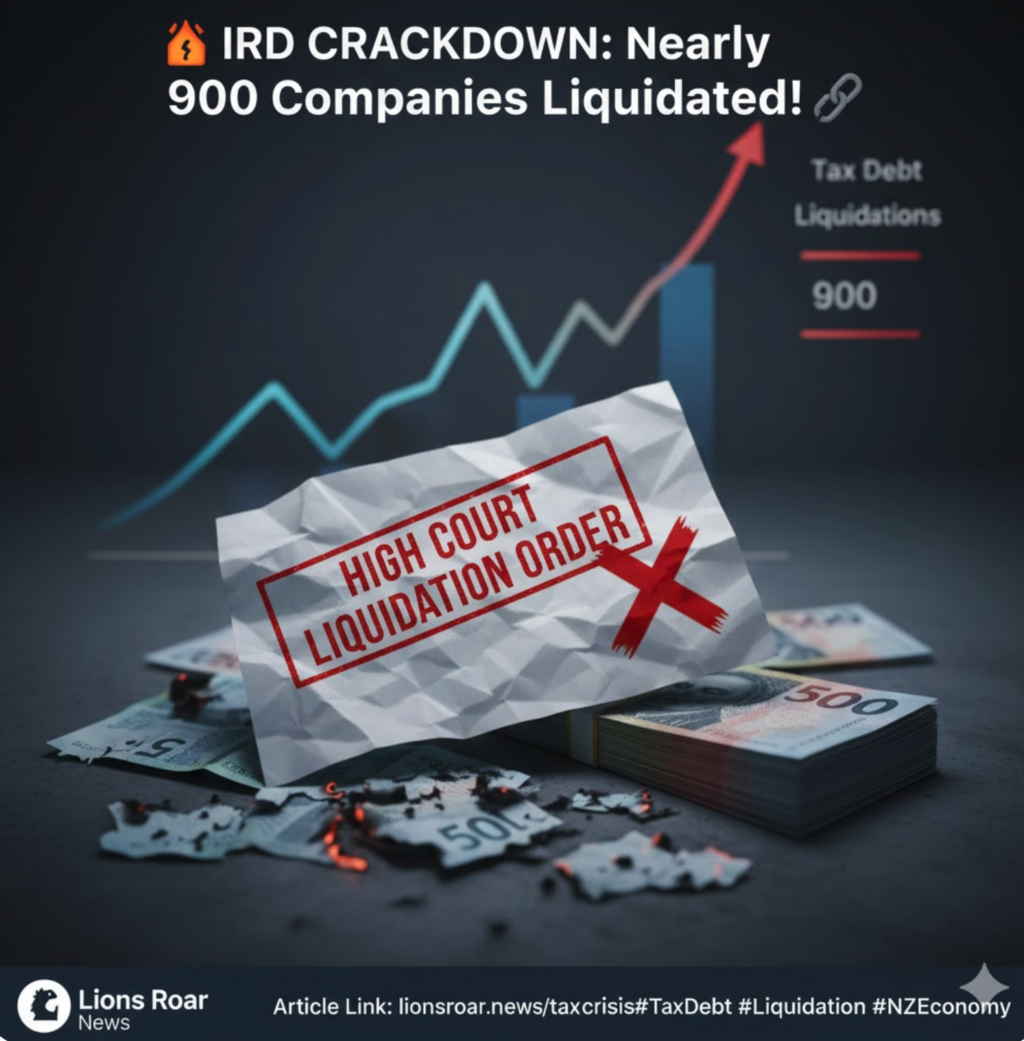
WELLINGTON, NZ – The New Zealand business landscape is facing a severe reality check as Inland Revenue (IRD) dramatically steps up its debt collection efforts, applying to wind up nearly 900 companies in the year to November 2025. This surge in enforcement activity, described by experts as the highest in six years, signals the decisive end of the tax department’s post-Covid leniency and a sharp focus on recovering a ballooning $9 billion tax debt.
In November alone, the IRD filed applications to wind up 127 businesses, contributing to a total of 167 winding up applications for the month—the highest volume seen since 2019.
📉 The End of Leniency: $9 Billion Debt Recovery Drive
The aggressive return to enforcement by the IRD is being driven by the substantial growth of the nation’s total overdue tax debt, which has now reached approximately $9 billion (with some experts expecting it to hit $10 billion soon).
Keaton Pronk, an insolvency practitioner at McDonald Vague, confirmed the significant shift in approach.
“For the year to November, Inland Revenue (IRD) applied to wind up just under 900 companies,” Pronk said. “They always ramp up towards the end of the year but they’ve exceeded what they’ve done in the last five years quite easily.”
During the Covid-19 pandemic and the immediate recovery period, the IRD adopted a softer stance, often allowing businesses struggling with cashflow to defer tax payments and enter into instalment arrangements. With the Government now determined to collect outstanding revenue to fund its spending, that period of patience is over.
Pronk noted:
“Their debt is now blowing out to $9 billion and they’ve got a government sitting there saying we want that money so we can spend it… So IRD is now taking an approach where they need to try and go and collect that $9b.”
🏗️ No Sector is Safe: Widespread Business Pain
The wave of liquidations is not confined to a single industry. Insolvency practitioners are reporting that the financial stress is widespread, reflecting a prolonged and difficult recessionary environment.
While the Construction industry has consistently led the liquidation figures over the past year due to low consumer confidence, material cost fluctuations, and slow migration affecting real estate, other sectors are also feeling the intense pressure. Insolvency experts confirm that it is rare to see any liquidation appointment today that does not involve some form of IRD debt, often stemming from the accumulation of unpaid GST and PAYE.
John Cuthbertson, a spokesperson for Chartered Accountants Australia New Zealand, indicated that the IRD’s overall liquidation activity has stepped up by about 30 percent in the last year, and they are taking a “tougher stance on new debt as well”—meaning businesses accruing new tax arrears will face rapid action.
⚠️ A Wake-Up Call for Directors
The IRD considers liquidation its last resort, often only pursuing this path when a company is unresponsive or demonstrates no viable plan to manage its tax debt.
“It’s really the last rites for zombie companies,” Cuthbertson explained. He stressed that the primary purpose of IRD’s aggressive liquidation drive is not just collection (the return on liquidation efforts can be low) but to maintain the integrity and fairness of the tax system. Liquidation stops unviable businesses from incurring further debt, protecting other creditors and suppliers.
Insolvency experts are urgently warning directors who are struggling to communicate openly with the IRD. Ignoring a statutory demand or failing to update contact details severely limits a company’s options and almost guarantees a winding-up application. Directors can also face personal liability, particularly for unpaid PAYE, if they are found to have traded while insolvent or failed to act in the best interests of creditors.
The message to the business community is unequivocal: the era of debt deferral is over. Pronk does not expect the pressure to ease in the short term, predicting the IRD will continue to push hard well into 2026 as it works through the backlog of accumulated tax debt.
Businesses are advised to immediately review their tax position, engage with an advisor, and proactively contact the IRD to negotiate instalment arrangements before formal demands escalate to High Court liquidation proceedings.