IPL’s Economic Slide: The Indian Premier League Faces a New Financial Reality
Mumbai, October 2025 —
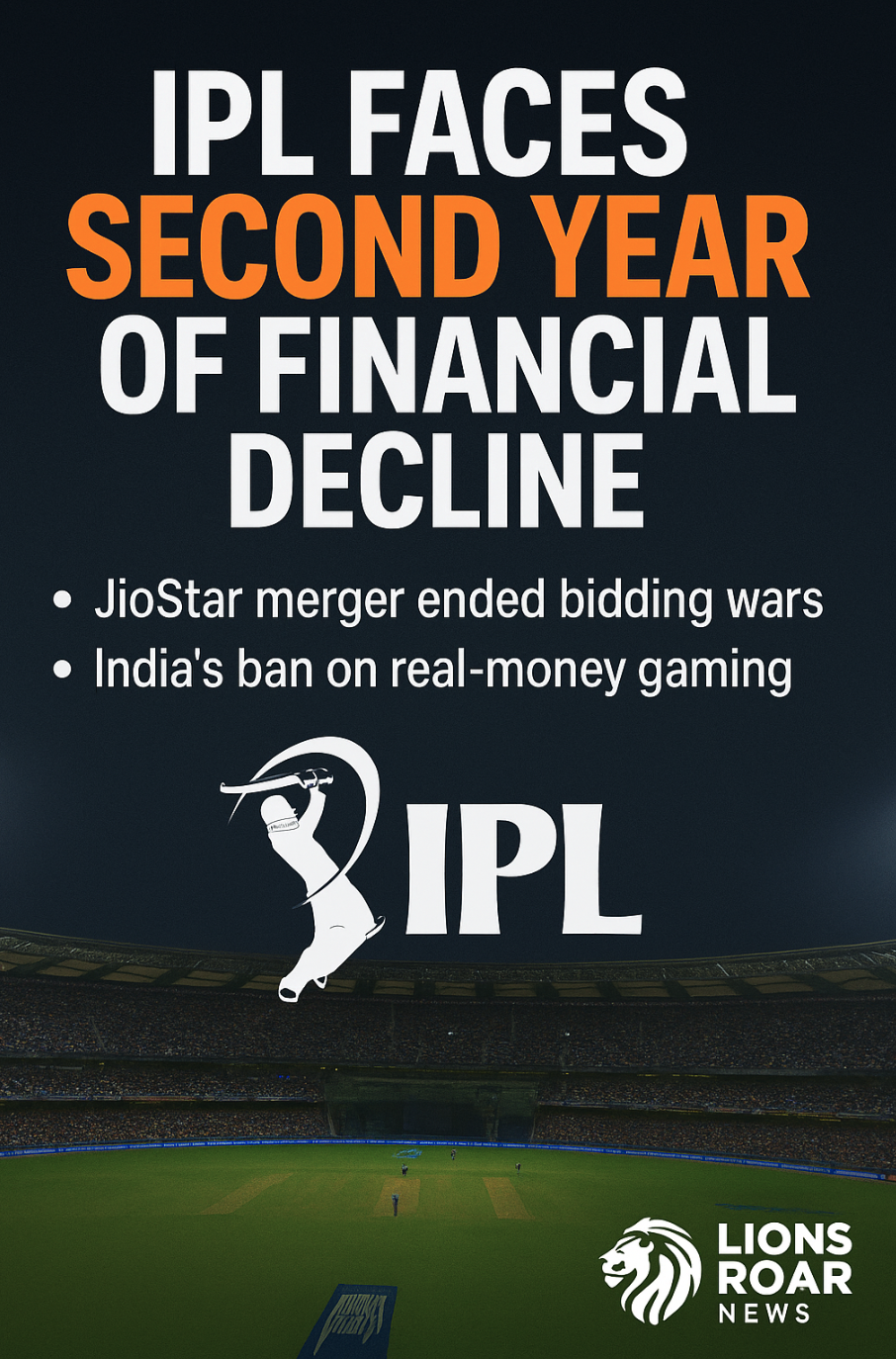
The Indian Premier League (IPL), once hailed as the crown jewel of world cricket’s commercial empire, is facing its second consecutive year of decline in overall monetary valuation. This downturn marks a rare moment of financial contraction for a tournament long synonymous with wealth, glamour, and explosive growth.
Analysts point to two key factors driving this change: the consolidation of broadcast and digital media rights under JioStar, which effectively ended India’s high-stakes bidding wars, and the nationwide ban on real-money online gaming, a move that has dried up one of the league’s most lucrative advertising and sponsorship pipelines.
The developments signal a maturing — and in some ways, sobering — phase for a competition that reshaped global cricket economics over the past 17 years.
🔹 From Booming Expansion to Cautious Correction
Since its inception in 2008, the IPL has been a financial phenomenon. It transformed Indian cricket into a global business model — merging sports, entertainment, and celebrity culture into a single spectacle that attracted billions in investment.
Franchise valuations skyrocketed, players became millionaires overnight, and advertisers poured funds into broadcast rights that often broke world records.
However, according to recent assessments from market analysts and sports business agencies, the total monetary ecosystem surrounding the IPL has now shrunk for the second consecutive year — a clear sign that the market is stabilizing after more than a decade of unchecked growth.
The decline does not necessarily indicate crisis — but it reflects market normalization, as media and sponsorship values realign with more sustainable metrics.
🔹 The JioStar Merger and End of the Bidding Wars
Perhaps the most significant factor in the IPL’s current valuation decline is the merger of broadcast and digital streaming rights under JioStar, the media conglomerate jointly operated by Reliance Industries and Disney India.
In 2022, the IPL’s five-year broadcast deal was valued at an astonishing USD 6.2 billion, split between television and digital platforms (Star India and Viacom18). The competition between networks drove prices to record-breaking levels — but the consolidation under JioStar has effectively removed this competitive tension.
Without rival bidders like Amazon, Zee, or Sony in the latest cycle, media rights were renewed at a lower rate — still massive by global standards, but reduced from the previous inflationary peak.
Industry observers say the new structure provides long-term stability for the league but caps its short-term value growth.
“The media-rights consolidation has ensured reliability but at the cost of aggressive bidding,” explains a Mumbai-based sports economist.
“JioStar now holds both the television and streaming reins, meaning the IPL’s broadcast value is determined internally rather than by open-market competition.”
🔹 The Ripple Effect of India’s Real-Money Gaming Ban
The second major blow came from India’s regulatory crackdown on real-money gaming platforms — including fantasy sports and online betting-adjacent apps.
For years, companies like Dream11, MPL, and Games24x7 were among the IPL’s biggest advertisers, pouring hundreds of crores into team sponsorships, jersey placements, and in-match digital ads.
Following the 2024 government directive banning real-money games with financial stakes, the advertising landscape shifted overnight.
The result: a dramatic fall in advertising revenue during the 2025 season, particularly in digital channels.
“Nearly 25% of IPL’s ad inventory was tied to fantasy gaming and betting platforms,” notes a senior marketing executive from a major team sponsor.
“When that vanished, many franchises had to renegotiate contracts or find secondary sponsors at far lower rates.”
This regulatory shift also impacted related industries, including financial technology, crypto exchanges, and payment gateways that had previously leveraged IPL visibility for market reach.
🔹 Franchise Struggles and Adjusted Valuations
While the IPL as a brand remains financially dominant compared to other cricket leagues, several franchises have experienced tangible drops in valuation.
Reports suggest that four teams have seen declines between 8% and 12% in their market worth since 2023. The teams most dependent on sponsorship from real-money gaming companies — including those with Dream11 and MPL partnerships — were the hardest hit.
Franchise owners are also facing increased operational costs, from player contracts to logistics and marketing. With sponsorships flattening and ad revenues declining, margins have tightened.
The introduction of salary cap revisions and digital rights restructuring has somewhat balanced the books, but the golden days of rapid valuation inflation appear to be on pause.
“The IPL’s growth story isn’t over — it’s evolving,” says a senior consultant from a Mumbai sports finance firm.
“Franchises are now focusing more on sustainable business models: merchandise, international fan bases, and digital community engagement.”
🔹 Viewer Numbers Still Strong — But Shifting
Despite its financial recalibration, the IPL continues to command massive global audiences. The 2025 season drew an estimated 550 million cumulative viewers, though engagement patterns have changed.
- Television audiences in India remain steady, supported by regional-language commentary and high production quality.
- Digital streaming, however, has seen slower growth, partly due to subscription fatigue and limited innovation in viewing experience.
The merger under JioStar promises improved technology integration — such as AI-driven camera angles, real-time stats, and fan interactivity — but these features have yet to deliver a significant new revenue model.
Moreover, the international audience share is growing, with streaming access now expanding in the Middle East, Australia, and Southeast Asia. This diversification could help offset domestic revenue declines in the long term.
🔹 The End of “Endless Growth”
The IPL’s current financial dip reflects a broader trend across global sports: a correction from unsustainably inflated valuations.
Between 2018 and 2022, IPL revenues grew by over 200%, driven by aggressive media spending and speculative brand partnerships. However, experts note that much of this growth was fueled by “future expectation value” rather than direct profit returns.
Now, with the market consolidating, investors are focusing on profitability over prestige.
“We’ve moved from a phase of expansion to one of consolidation,” explains a sports business analyst.
“The IPL is no longer just a glamorous product — it’s a mature enterprise that must operate efficiently, not just expensively.”
🔹 What’s Next for the IPL?
Industry insiders suggest the IPL’s next phase will revolve around innovation, sustainability, and digital monetization. Key strategies under discussion include:
- New global broadcast partnerships, particularly targeting South Asia, Africa, and the US.
- Virtual fan experiences using AR and VR technology to re-engage younger audiences.
- Green initiatives, as franchises and stadiums adopt environmental sustainability goals.
- Women’s IPL expansion, expected to add both diversity and new commercial value to the brand.
The Women’s Premier League (WPL), launched in 2023, continues to grow in popularity and may help reignite the commercial dynamism of the IPL ecosystem.
🔹 A Sign of Maturity, Not Decline
While headlines about a “declining IPL value” may sound dramatic, most analysts view this phase as a healthy correction — the sign of a league transitioning from hyper-growth to stability.
With nearly two decades of dominance, the IPL remains the world’s most valuable cricket property, generating more annual revenue than the combined totals of most other national leagues.
The dip, in many ways, forces innovation and financial discipline — qualities that could ultimately strengthen the tournament’s foundation.
“You can’t grow forever on adrenaline and sponsorship alone,” said one long-time team investor.
“The IPL’s next decade will be defined by smarter economics, stronger technology, and global reach — not just local hype.”
🔹 Conclusion
The Indian Premier League’s story has always been about transformation — from cricket matches to multi-billion-dollar entertainment. Its current recalibration is not the end of that story but the beginning of a more mature, sustainable chapter.
As India redefines its regulatory environment and media landscape, the IPL must adapt — focusing on innovation, inclusivity, and international engagement.
For the fans, the magic of the IPL remains undimmed. But for investors and administrators, the league’s future now lies in finding the delicate balance between commerce and continuity — ensuring that cricket’s brightest stage continues to shine, not just brightly, but sustainably.