Government Unveils Stricter Jobseeker Support Rules and $1,000 Bonus to Push Young Kiwis Into Work
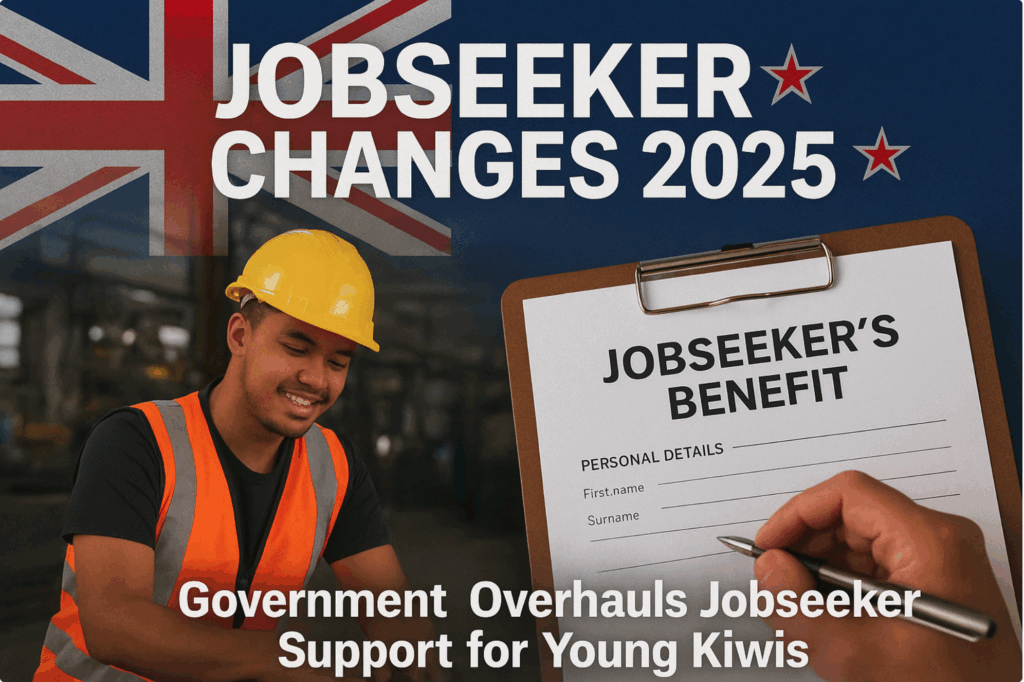
WELLINGTON — The New Zealand Government today revealed major changes to the Jobseeker Support scheme aimed primarily at youth, tightening eligibility for certain young beneficiaries while introducing a new bonus incentive for sustained work. The reforms, announced by Minister for Social Development and Employment Louise Upston, are intended to reduce long-term benefit dependency among 18– and 19-year olds and reward those who successfully transition from welfare to employment.
But the changes have sparked fierce debate, with critics warning that the burden is being shifted onto young people already grappling with limited opportunities, housing pressures, and economic uncertainty.
What’s Changing — The Key Measures
The two headline reforms announced today are:
- Parental Assistance Test for 18- and 19-year-olds (from November 2026)
From November next year, young people aged 18 and 19 (who do not have dependent children) will need to pass a Parental Assistance Test before they can access Jobseeker Support or the equivalent Emergency Benefit.- The test will have two components: a parental income test and a parental support gap test.
- The income test requires that their parents’ income falls below a certain threshold.
- The support gap test is to determine whether the young person can reasonably expect to rely on their parents; if not, that may justify access even if their parents are above the income threshold.
- The income cut-off is currently set at NZ$65,529, aligned with the cut-off for couples receiving the Supported Living Payment. That threshold will be adjusted over time via the annual general adjustment of benefit payments. The Beehive+2RNZ+2
- Young people who are estranged from parents, or have dependent children themselves, will still retain eligibility under the new rules. RNZ+2The Beehive+2
- The original plan had slated this policy for July 2027, but the Government is accelerating the timeline to November 2026. The Beehive+21News+2
- The test will have two components: a parental income test and a parental support gap test.
- $1,000 Bonus for Sustained Work (from October 2026 eligibility)
In tandem with the stricter eligibility, the Government is introducing a $1,000 bonus incentive for 18– to 24-year-olds who move off benefit and stay in sustained employment.- To qualify, the recipient must have been on Jobseeker Support for at least 12 months, participated in the Ministry of Social Development’s Community Job Coaching programme, found a job, and remained off the benefit for 12 months while still being in employment at the time of application. NZ Herald+3The Beehive+3RNZ+3
- The bonus payments will begin from October 2026. The Beehive+2RNZ+2
- The Government currently has 4,000 places available for its job coaching programme targeting young benefit recipients. The Beehive+2RNZ+2
Minister Upston described the reforms as part of the Government’s “Welfare that Works” agenda, emphasizing that they would help shift expectations: from dependency to responsibility, and from welfare to opportunity. The Beehive+1
“Going on welfare when you’re young is a trap,” she said in her statement. Modelling cited by the Government suggests that people under age 25 who start on Jobseeker Support may end up spending 18 or more years on a benefit over their lifetime. The Beehive+21News+2
Political and Public Reaction
The announcement has drawn strong responses across the political spectrum and from advocacy groups.
- Labour Party
Labour’s social development spokesperson, Willie Jackson, accused the Government of “shutting young people out of the future they deserve.” He argued the changes disproportionately burden youth at a time of rising job insecurity. 1News+1 - Green Party
Green Party spokesperson Ricardo Menéndez March cautioned that the parental income threshold of $65,529 is too low and fails to account for the cost of living pressures experienced by ordinary households. RNZ+1 - Youth Advocates & NGOs
Some youth development organizations say the new rules risk punishing vulnerable youth for structural labour market shortcomings. As one advocate put it: “Young people are being punished for an economic crisis they did not create.” RNZ
Concern has also been raised about adding bureaucracy: proving estrangement or gap support may depend on medical or counselling verification, which could be difficult for many. RNZ+1 - Prime Minister Christopher Luxon
Luxon defended the policy, describing it as a matter of balancing rights and responsibilities. He argued that parents earning above the threshold should support their children before taxpayer funds are needed, and that the policy encourages young people to engage in education, training, or work rather than welfare. NZ Herald+2The Beehive+2
Luxon acknowledged that the $65,529 cap is modest, but insisted it “puts the pressure back on parents to say: get those young people into work or education.” NZ Herald
He also challenged critics to show him where the jobs are, stating that many regions (e.g. in primary industries, horticulture) are actively seeking young workers. RNZ+1
Implications and Challenges
The changes are ambitious and potentially far-reaching, but several challenges and caveats have emerged:
- Job Availability and Economic Conditions
With the national unemployment rate already at 5.2 percent as of June 2025, critics argue there simply may not be enough job opportunities for all affected youth. RNZ+1
Many industries (particularly in regions) are shedding roles, making the transition to employment harder. Youth already face precarious, short-term work. - Administrative Burden and Fairness
Determining estrangement, assessing parental support gaps, and verifying medical or counselling records could impose significant administrative burdens on both young people and the Ministry of Social Development (MSD).
There is a risk that the process becomes a barrier for those who genuinely cannot rely on parental support but struggle to meet bureaucratic tests. - Impact on Vulnerable Youth
Some of the young individuals affected may come from dysfunctional or unstable households. Requiring parental support in those cases may be unrealistic, even detrimental.
Youth homelessness, mental health, and social support needs could worsen if young people lose benefit access without adequate safety nets in place. - Effectiveness of the Bonus Scheme
The $1,000 bonus is intended as a carrot to complement the stick approach. But its effectiveness depends heavily on the quality and accessibility of the job coaching and ongoing support services.
A lack of wraparound support (transport, childcare, mental health) may limit the reach and uptake of this incentive. - Equity and Regional Disparities
Young people in rural or remote regions may face fewer job options, making this policy more punitive in those areas.
Disadvantaged youth—Māori, Pasifika, those with disabilities—may disproportionately bear the effects if not mitigated.
Government’s Rationale and Expected Fiscal Impact
The Government frames these reforms as both socially responsible and fiscally prudent:
- The parental test is intended to target benefit provision to those who truly need it, reducing what the Government sees as misuse or dependency at a young age.
- The earlier implementation (moving from 2027 to November 2026) signals urgency and political priority. The Beehive+21News+2
- In past documentation, the parental change was projected to yield savings of about NZ$163 million over four years. 1News+2The Beehive+2
However, actual savings will depend greatly on how many youth are disqualified, how many re-enter alternate benefit categories, or how many avoid benefit dependency altogether.
What This Means for Affected Young People
For a significant cohort of 18–19-year-olds currently on Jobseeker Support, the new rules mean they may need to rely on parents even where that support is not feasible.
Some may need to turn to study, training, or transitional labour schemes to stay eligible or avoid being cut off.
Those who successfully transition out of benefit dependency and remain employed for a year may see a modest reward via the $1,000 bonus—but that bonus is only available to those navigating coaching, employment, and sustained eligibility hurdles.
Timeline & Transition
- November 2026: Parental Assistance Test takes effect for 18–19-year-olds applying for Jobseeker or Emergency Benefit. NZ Herald+3The Beehive+3RNZ+3
- October 2026 onward: Eligibility for the $1,000 bonus begins for those who meet the criteria—i.e. find sustained work and remain off benefit for 12 months. The Beehive+2NZ Herald+2
- The government says the intervening period gives time for families, youth, and MSD to prepare. RNZ+2The Beehive+2
Conclusion: A Bold Shift with Risks
Today’s announcement marks one of the most consequential overhauls of the youth welfare regime in recent years. The Government is clearly betting on a paradigm shift: that young people and families should carry more responsibility in the early adult years, and that incentives and tests can shape long-term behaviour.
Yet, the line between motivation and punishment is thin. In a labour market under stress, with rising costs of living, housing pressures, and social vulnerabilities among youth, the reforms may exacerbate hardship for those already on the margins.
Success will hinge not only on the robustness of administration and fairness of exemptions, but also on sufficient employment opportunities, support services, and sensitivity to individual circumstance. If well implemented, the reforms may curb welfare dependence; missteps could leave many struggling without the support they need.
For now, the nation watches closely as the policy unfolds—and as thousands of young Kiwis, their families, and advocacy groups prepare to weigh the human impact of this “Welfare That Works” experiment.