Bondi Massacre Aftershock: Experts Warn NZ is “A Small Millimetre Away” from Another Mass-Casualty Event
By Lions Roar News National Security Team
AUCKLAND, NZ – The horrific terrorist attack at Bondi Beach, Sydney, over the weekend, which targeted a Jewish Hanukkah celebration and left 16 people dead (including one of the perpetrators) and dozens wounded, has sent immediate ripples across the Tasman, with security experts warning that New Zealand remains perilously close to another mass-casualty incident.
While the New Zealand terrorism threat level remains unchanged at Low—meaning an attack is assessed as a “realistic possibility” but there is no specific intelligence of an imminent threat—the nature and target of the Sydney violence have painfully refocused attention on domestic vulnerabilities, particularly within vulnerable minority communities.
💔 Trauma and Vigilance: NZ Jewish Community on Edge
The Bondi attack, which unfolded at a public Hanukkah celebration, has been described by Australian Prime Minister Anthony Albanese as an “act of pure evil” driven by antisemitic ideology. For New Zealand’s Jewish community, the event has triggered a deep and familiar sense of shock, grief, and heightened fear.
Juliet Moses, President of the New Zealand Jewish Council, articulated this fear, telling media she was “sickened, shocked… but not completely surprised,” citing a perceived global normalization of antisemitism and incitement to violence.
The Chair of the New Zealand Holocaust Centre, Deborah Hart, highlighted the painful symbolism and reality of the threat:
“New Zealand Jews, like our Australian brethren, now live with increased fear and vigilance… I have MC’d many Chanukah in the Park events in New Zealand over the years—events just like the one in Bondi. We don’t hold them any more. We can’t.”
The revelation that the attack occurred during a joyous festival in a crowded public space serves as a chilling reminder of the ever-present risk to communal gatherings.
🚨 Security Stepped Up: Police Increase Presence
In immediate response to the tragedy, New Zealand police and government agencies have moved swiftly to reassure and protect the local Jewish community.
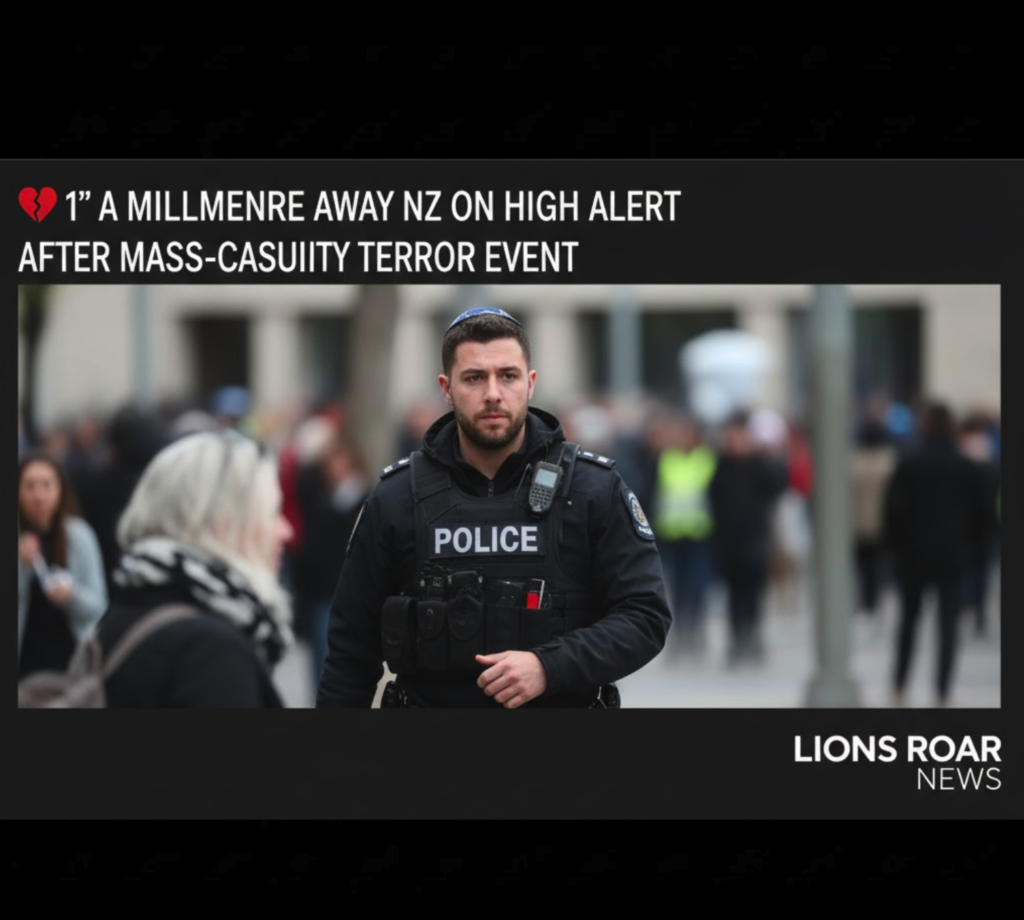
Prime Minister Christopher Luxon confirmed that police are meeting with Jewish community leaders and that security measures have been enhanced across the country.
- Increased Visible Presence: Acting Deputy Commissioner Tusha Penny confirmed there would be an increased visible police presence nationally, with additional patrols at significant sites of Jewish worship, including synagogues in major centres like Wellington and Auckland.
- Government Funding: Since late 2024, the government has been funding security upgrades at Jewish and Muslim places of worship in New Zealand through the Prime Minister’s Emerging Priorities fund, a proactive measure recognizing the heightened threat environment.
Luxon offered his condolences to Prime Minister Albanese and the victims, stating that there was “no space for terrorism, anti-Semitism, or hate in this country or anywhere else for that matter.”
⚔️ The Threat Model: Lone Actors and Crowded Places
While the Bondi massacre reportedly involved two gunmen (a father and son), the underlying security concerns in New Zealand often revolve around the threat of the lone actor radicalised online—a profile that mirrors the 2019 Christchurch mosque attacker, Brenton Tarrant, and to some extent, the man responsible for the 2021 LynnMall attack in Auckland.
Security experts consulting with the NZ government on the recently launched Protecting Our Crowded Places from Attack strategy emphasize that the most plausible domestic terrorist threat remains a lone actor using easily accessible weapons (or vehicles) in crowded public spaces.
New Zealand has taken significant legislative steps following the 2019 Christchurch attack, particularly in strengthening gun laws, but the challenge remains constant:
- Christchurch Legacy: The 2019 attack, which killed 51 people, led to sweeping reforms banning most semi-automatic weapons and launching a mandatory firearms registry—actions New Zealand took within days, setting a global precedent.
- The LynnMall Incident: The 2021 attack in Auckland, where an individual used a knife to injure multiple people in a supermarket, highlighted that even with strict gun laws, determined individuals can still use readily available means to perpetrate mass-casualty events.
The focus in New Zealand now heavily rests on intelligence gathering, community outreach to de-radicalise, and securing “Crowded Places”—public venues that are easily accessible, such as shopping malls, sports grounds, and community centres.
🤝 Standing in Solidarity: The Trans-Tasman Link
The Bondi tragedy is intensely felt in New Zealand, not only due to the shared cultural and historical link with Australia but because the nature of the attack closely resembles the ideological and community-targeting events that have scarred both nations.
The fact that the Christchurch terrorist was an Australian citizen who legally purchased his weapons in New Zealand, and now the Bondi attack has drawn comparisons to this kind of targeted ideological violence, underscores the shared, evolving nature of the threat landscape in the region.
As security measures increase and communities grieve, the message from both sides of the Tasman is clear: an attack on one is viewed as an attack on the values of the other. The latest events serve as a sobering reminder that while New Zealand’s gun laws and security posture have been dramatically improved since 2019, the risk of a mass-casualty event—driven by extremist ideology and hate—remains a tangible threat, indeed, “a small millimetre away.”