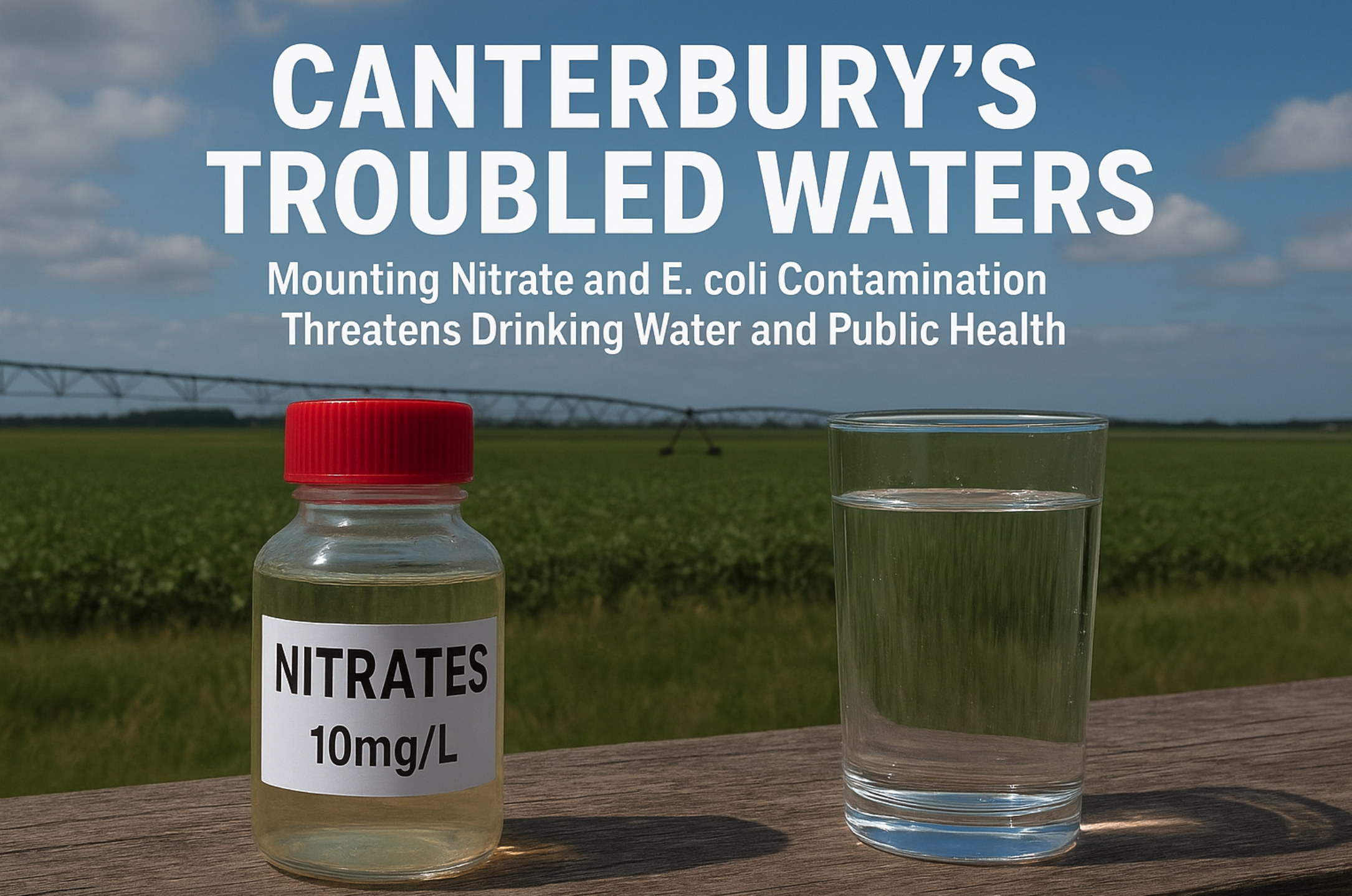
Canterbury’s Troubled Waters: Mounting Nitrate and E. coli Contamination Threatens Drinking Water and Public Health
By Lions Roar News Environment Desk – October 2025
A crisis beneath the surface
Beneath the rolling farmlands and dairy plains of Canterbury, a growing environmental and public-health crisis is quietly unfolding. Recent studies by regional scientists, community water trusts, and environmental agencies reveal that many rural wells in the Canterbury region now show dangerously high concentrations of nitrates, alongside frequent detections of E. coli contamination.
The findings — some of which were released through Environment Canterbury’s latest groundwater quality reports — highlight a troubling trend that has persisted for more than a decade and is now intensifying. What was once a localized concern has evolved into a region-wide issue affecting thousands of households, farms, and small rural communities that depend on groundwater for drinking and irrigation.
The numbers that worry scientists
According to data gathered across hundreds of wells from Ashburton to Waimakariri, around one in five rural drinking-water wells now exceed the World Health Organization’s recommended limit of 11.3 mg/L of nitrate-nitrogen (NO₃-N). In some areas, readings as high as 15–20 mg/L have been recorded — levels considered potentially harmful to infants and pregnant women.
Equally concerning, E. coli — a bacterium that signals fecal contamination — has been detected in a significant proportion of wells, suggesting surface contaminants are infiltrating aquifers once thought to be secure. For households relying on untreated bore water, these findings mean that every glass of water could carry invisible risks.
Environment Canterbury (ECan) officials say the patterns are consistent with nitrate leaching from intensive dairying and crop farming, compounded by over-irrigation, which accelerates nutrient runoff into shallow groundwater systems.
The human cost — when clean water turns toxic
For decades, Canterbury’s groundwater has been a symbol of purity — drawn from deep aquifers beneath the plains. But for some families, the tap water has turned from life-giving to life-threatening.
Medical researchers at the University of Otago and Massey University have raised growing alarm about the link between nitrate-contaminated water and health problems, including methemoglobinemia (“blue baby syndrome”) in infants and a possible connection to colorectal cancer in adults exposed over long periods.
Dr Tim Chambers, an environmental health researcher, noted in a 2024 study that “Canterbury’s nitrate levels are among the highest in the country, and we are now seeing early epidemiological evidence that long-term exposure may have serious health consequences.”
Local GP practices in parts of Ashburton and Selwyn have begun encouraging patients who rely on bore water to use nitrate-testing kits and to consider filtration systems where possible. However, the cost of treatment — often exceeding NZ $1,000 for a home filtration setup — puts protection out of reach for many rural families.
How did Canterbury reach this point?
The Canterbury Plains are the economic powerhouse of New Zealand’s dairy industry. Over the past three decades, the expansion of large-scale dairy operations has transformed the region’s landscape. Where once stood dryland sheep farms, now stretch pivot irrigators and fertiliser-rich paddocks supporting thousands of cows.
Each cow produces the nutrient load equivalent of several humans, and much of that waste, despite management systems, ultimately seeps into the soil and groundwater. Nitrates from urine patches, synthetic fertiliser, and effluent ponds gradually percolate down, joining the network of underground aquifers that also supply household bores.
Environment Canterbury’s own environmental scientists have repeatedly identified agricultural intensification as the leading cause of rising nitrate contamination. In several catchments — notably Hinds, Selwyn-Waihora, and Ashburton-Hinds — nitrate concentrations have exceeded safe limits for more than ten consecutive years.
Regulation, reform, and resistance
The Canterbury Water Management Strategy (CWMS), launched in 2009, was meant to balance economic growth with environmental protection. It created a network of ten zone committees responsible for setting local water-quality limits and developing catchment-based solutions.
Yet critics argue that the system has been too lenient and too slow. Many of the zone committees are dominated by industry representatives, and compliance efforts have often lagged behind the pace of farm expansion.
“After more than a decade of promises and plans, the nitrate levels are still climbing,” says Ali Jones, a community advocate with the group Choose Clean Water NZ. “We’ve normalised water that’s not safe to drink, and families are paying the price for our failure to act.”
Farm groups, on the other hand, insist that the sector has made major progress. Federated Farmers spokesperson Colin Hurst points to widespread investment in effluent management systems, nutrient budgeting, and precision irrigation technologies. “Farmers are aware of their impact,” he said, “and most are genuinely trying to reduce it. But it takes time for changes on the land to show up in groundwater — sometimes decades.”
Testing the water — literally and politically
The Ministry for the Environment’s Our Environment 2025 report reinforces what local data shows: nitrate contamination is one of the country’s most urgent environmental health challenges. Yet, national monitoring remains inconsistent, and private well testing is voluntary.
Community-led initiatives, such as the Canterbury Water Quality Study, have stepped in to fill the gap. Volunteers and local councils collaborate to collect and analyse samples, creating open-access maps showing nitrate “hot spots.” The transparency has helped push the issue onto the political agenda — both locally and nationally.
In Wellington, the central government’s Essential Freshwater programme set nutrient limits and cap levels in 2020, but enforcement has been patchy, and recent budget constraints have further weakened monitoring capacity. Critics fear that political shifts in 2025 could water down standards further under pressure from the agricultural lobby.
Māori perspectives: protecting wai as taonga
Ngāi Tahu, the principal iwi of Canterbury, has long voiced deep concern over the decline of water quality in its ancestral rohe. In traditional Māori worldview, wai (water) is a living ancestor, not merely a resource.
Rūnanga representatives have been calling for co-governance and stronger kaitiakitanga (guardianship) in regional water management, arguing that current regulatory structures fail to honour Treaty principles or protect mauri (life force) of waterways.
“Māori have a deep responsibility to protect our wai for future generations,” said Te Rūnanga o Ngāi Tahu environment lead, Hana O’Regan. “What is happening in Canterbury is not just an environmental issue — it’s a cultural crisis.”
Innovation and hope: cleaner farming futures
Despite the grim statistics, several Canterbury farmers are demonstrating that cleaner practices are achievable. Some are trialling regenerative agriculture techniques that reduce fertiliser use and improve soil health. Others are installing constructed wetlands and riparian planting to capture nutrients before they reach waterways.
Researchers at Lincoln University are testing new systems such as denitrifying bioreactors — woodchip-filled trenches that remove nitrate from drainage water — and smart irrigation controls that match water application precisely to plant needs, reducing runoff.
While these innovations show promise, experts caution that they must be scaled up quickly and supported by policy incentives if Canterbury’s groundwater is to recover.
What needs to happen next
Environmental advocates, public-health experts, and community leaders are converging on a few key demands:
- Mandatory well-water testing for all private bores, with public disclosure of results.
- Stronger nitrate caps and a rapid phase-down of synthetic fertiliser use.
- Investment in rural drinking-water treatment infrastructure for affected communities.
- Transparent, independent monitoring and enforcement by regional and central authorities.
- Recognition of Māori rights and leadership in water management.
Without decisive action, the risk is not only environmental degradation but also erosion of public trust in the safety of one of New Zealand’s most vital resources.
The bigger picture
Canterbury’s nitrate crisis is not an isolated story. Similar patterns are emerging across the Waikato, Southland, and Hawke’s Bay regions, where intensive dairying has reshaped both landscapes and waterways. But Canterbury — with its vast aquifers, its economic reliance on agriculture, and its history of environmental conflict — stands as the starkest example of what happens when productivity outpaces sustainability.
For now, the region faces an uncomfortable truth: the water that sustains its farms, towns, and families is under siege. Whether Canterbury’s leaders, farmers, and communities can come together to restore its purity will be a defining test of Aotearoa’s environmental stewardship in the decade ahead.