Too Many Laws Passing Without ‘Proper Scrutiny’, Warns Former PM Sir Geoffrey Palmer
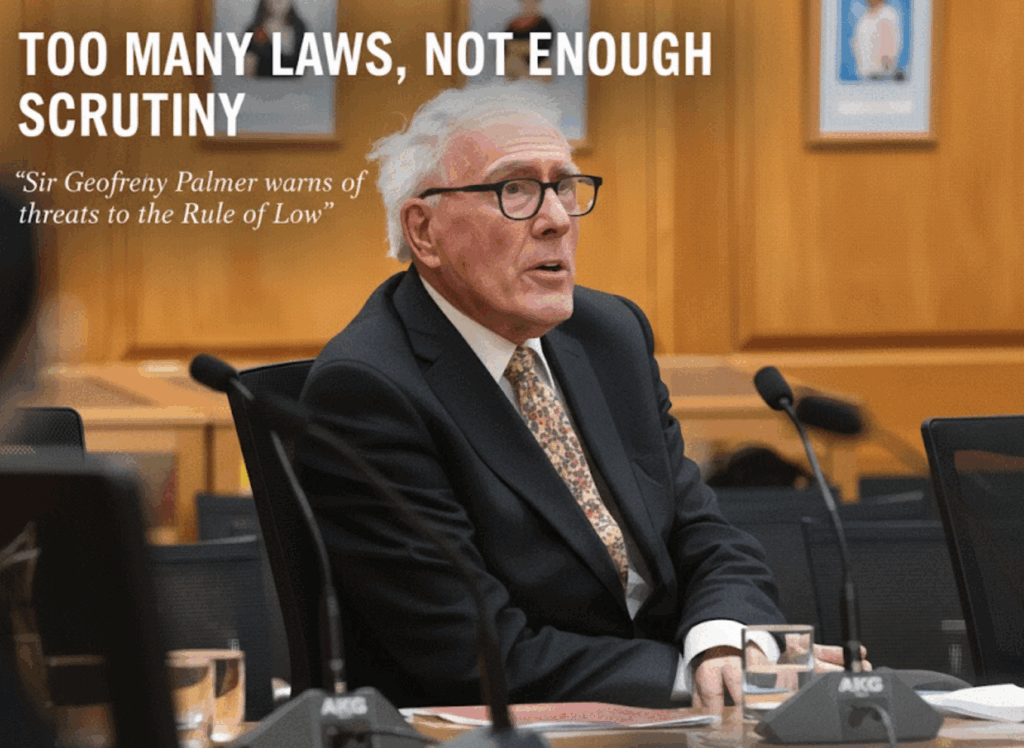
WELLINGTON – December 8, 2025 — New Zealand’s legislative process is under intense pressure, with too many laws being passed without adequate analysis or “proper scrutiny,” according to constitutional law expert and former Prime Minister Sir Geoffrey Palmer. Speaking to a gathering of legal professionals and academics in Wellington, Sir Geoffrey issued a stark warning that the country’s practice of fast-tracking complex legislation poses a serious threat to the quality and durability of New Zealand’s legal framework.
Sir Geoffrey, who served as Prime Minister and Attorney-General, and was a key architect of the 1986 Constitution Act and the 1990 New Zealand Bill of Rights Act, argued that successive governments have become increasingly reliant on urgency motions and abbreviated select committee processes, particularly when implementing significant policy changes.
“The volume of legislation is immense, and the speed at which some of these Bills are pushed through Parliament leaves little room for the rigorous, detailed examination they deserve,” Sir Geoffrey stated. “We risk creating laws that are poorly drafted, difficult to interpret, and potentially riddled with unintended consequences that burden our judiciary and, ultimately, the public.”
The Erosion of Scrutiny
The former Prime Minister specifically highlighted the diminishing role of the parliamentary Select Committee process, traditionally regarded as the bedrock of legislative scrutiny. Select Committees allow submissions from the public, expert testimony, and non-partisan review—a process Sir Geoffrey sees as increasingly compromised by political deadlines.
“When you severely truncate the time available for public consultation, you marginalize the very people these laws are supposed to serve. The ability of experts and civil society groups to influence or flag problems in complex Bills, like those concerning economic regulation or environmental policy, is being eroded,” he warned.
Sir Geoffrey’s critique centres on two key practices:
- Use of Urgency: The frequent use of urgency motions, which bypasses normal procedural time limits, often leads to marathon sessions where detailed clause-by-clause scrutiny is simply not feasible.
- Lack of Independent Vetting: While the Attorney-General’s Bill of Rights vetting process remains crucial, Sir Geoffrey suggested that broader, non-partisan constitutional vetting and impact analysis are not being given sufficient weight before Bills reach the floor of the House.
The Risk to the Rule of Law
The distinguished lawyer framed the issue not merely as a matter of parliamentary efficiency, but as a foundational threat to the Rule of Law.
“The credibility of our law rests on the assumption that it has been thoughtfully considered,” he explained. “If the public perceives that major changes are being imposed hastily and without proper debate, trust in the institutions that govern them begins to fracture. The perception of transparency and fairness is essential.”
Sir Geoffrey pointed to several complex pieces of recent legislation (without naming specific current Bills) as examples where the technical drafting required more time than the legislative schedule permitted, resulting in subsequent legal amendments or clarifying regulations.
A Call for Reform
Sir Geoffrey concluded his address with a call for parliamentary procedural reform. He recommended that political parties agree to significantly restrict the use of urgency motions, reserving them strictly for genuine emergencies (such as natural disasters or national security issues) rather than routine, though politically pressing, policy implementation.
Furthermore, he urged greater resource allocation to parliamentary counsel and independent expert advisory groups to ensure Bills are robustly tested for compliance, practicality, and long-term economic and social impact before they are tabled.
“New Zealand’s constitution is built on convention and trust. We must trust the process, and that means giving the legislative process the time and respect it deserves. Quality law-making requires patience, not speed,” Sir Geoffrey concluded. His remarks are expected to ignite debate among parliamentary proceduralists and opposition parties concerned about the executive’s growing control over the legislative agenda.