‘The Great Reset’: National Education Overhaul Announced Amidst Educator Revolt
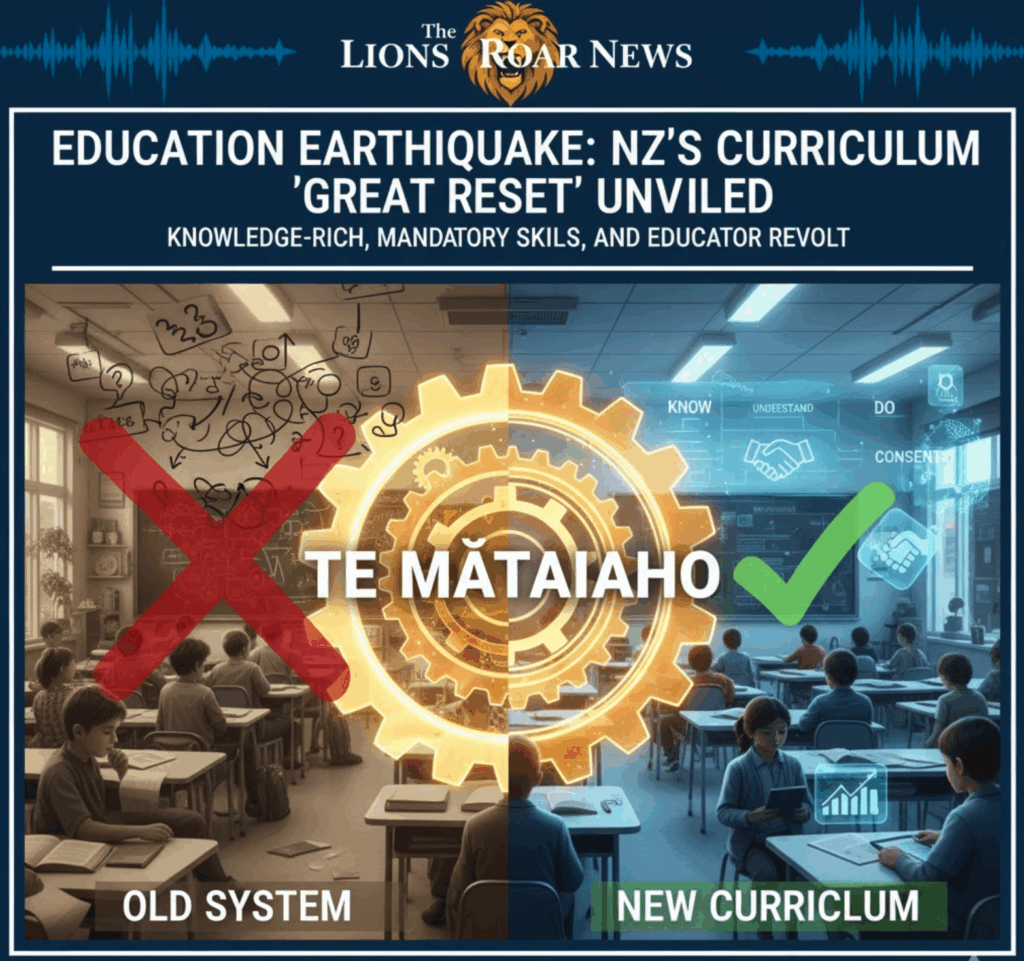
KNOWLEDGE-RICH CURRICULUM TE MĀTAIAHO MANDATED FOR 2027 ROLLOUT, SPARKS UNPRECEDENTED CRITICISM OVER PACE AND PEDAGOGY
By Lions Roar, Education Editor Date: October 30, 2025
In what is being hailed as the most significant transformation of New Zealand’s education system in nearly two decades, the government has unveiled the full draft of its refreshed national curriculum, Te Mātaiaho. The sweeping overhaul, which mandates a “knowledge-rich” and explicitly sequenced learning framework from Years 1 to 10, is intended to curb regional variation and lift stubbornly stagnant achievement levels across the country.
While the government frames the curriculum as a necessary shift toward clarity and global standards, the announcement has triggered an unprecedented backlash from educators, with the Principals Federation declaring they have “lost total trust” in the Ministry of Education’s process. The final framework for Years 1–10 is set to be fully implemented by the start of the 2027 school year, following the earlier mandatory introduction of the updated English and Mathematics curricula.
The Fundamental Shift: From ‘Open’ to Explicit
The core of the change lies in a move away from the highly flexible, outcomes-focused 2007 curriculum, which critics claimed was too ambiguous, leaving content choices to individual schools and leading to inequitable knowledge coverage.
The refreshed curriculum is built upon the Understand – Know – Do (UKD) structure. This model aims to clearly delineate the conceptual understandings (Understand), the specific content (Know), and the disciplinary practices and skills (Do) that students must master. It replaces the overlapping “Curriculum Levels” with five distinct, end-on-end Phases of Learning (e.g., Phase 1: Years 1-3, Phase 4: Years 9-10), setting out a year-by-year learning progression.
Education Minister Erica Stanford affirmed that this explicit sequencing is critical to the reform’s ambition. “Going forward, New Zealand will have a clear, knowledge-rich, year-by-year curriculum that sets out what every child should learn and when, ensuring consistency, coherence, and a fairer education system,” she stated.
Proponents argue that this national consistency will act as an “equity bridge,” ensuring that no student misses out on foundational knowledge, regardless of the school they attend. However, the move has generated significant pushback from teachers who valued the autonomy and flexibility of the previous model, viewing the prescriptive nature as a step back from modern pedagogical practice.
Two Compulsory Pillars: Consent and Capital
Among the most impactful additions to the curriculum are the compulsory embedding of two crucial, real-world skills: Consent Education and Financial Literacy.
Compulsory Consent Education, integrated within the Health & Physical Education (HPE) learning area’s Relationships and Sexuality strand, is designed to ensure every student develops the foundational understanding required to build safe, respectful, and consensual relationships. For years, the provision of comprehensive sex and consent education varied wildly between schools, often relying on the local curriculum preferences of individual institutions. The Ministry has now made it an explicit, mandated learning outcome.
The decision has been broadly welcomed by youth advocates, though some subject experts have already raised concerns that the draft HPE curriculum is too narrow, focusing heavily on movement skills and neglecting broader social knowledge related to wellbeing and digital safety.
Equally significant is the embedding of Financial Literacy into the Social Sciences curriculum under a new strand focused on Economic Activity. Previously treated as a “cross-curricular theme,” financial education was often left to chance. Now, students from Year 1 to 10 will progressively learn core financial skills, moving from understanding “wants versus needs” and saving in primary school, to grasping complex concepts like budgeting, investment, taxes, and insurance in the intermediate and junior secondary years.
Financial experts and the Retirement Commission have praised the move, noting that declining financial knowledge disproportionately affects women and minority groups. The change aims to equip every student to become a “savvy consumer” and make “informed financial decisions,” potentially breaking cycles of intergenerational financial disadvantage.
The Battle for History: Local vs. Global Narratives
Perhaps the most politically charged element of the overhaul is the revision of the Social Sciences curriculum, particularly the history component. The draft seeks to restore a balance between New Zealand and global history, moving away from the controversial “Aotearoa New Zealand’s Histories” framework introduced by the previous government.
Critics of the former curriculum, including ACT Leader David Seymour, claimed it was overly ideological and fostered a “simplistic victims-and-villains narrative” by prioritising themes of colonisation and power use. The new curriculum explicitly removes these “Big Ideas.”
Instead, the draft history content mandates learning about early explorers, settlers, and migration stories alongside key global civilisations, including Ancient Egypt, Rome, and Greece, extending through to the Victorian Age.
While the curriculum states it honours Te Tiriti o Waitangi by making Mātauranga Māori a starting point for design, the Principals Federation has accused the draft of sidelining the principles of Te Tiriti and Mātauranga Māori, arguing that the document “feels like a foreign document” and does not reflect New Zealand students.
Conversely, the government maintains that the curriculum is “rigorous” and “rooted in the science of how children learn, while celebrating who we are as a nation,” ensuring that students are not restricted to a narrow, local focus but are stimulated by global ideas. The explicit inclusion of Civics and Society as a new strand is also intended to foster a shared sense of citizenship.
Educator Revolt: ‘Just Absolutely Ridiculous’
The speed and nature of the curriculum changes have provoked a strong response from educators, culminating in a near-revolt by professional associations.
Principals Federation president Leanne Otene minced no words following the full draft release, stating that her members were “disgusted” and felt the process was “just absolutely ridiculous.” Otene claimed the federation had “passed the point of revolt,” citing the recent major, last-minute revisions to the newly introduced Maths curriculum as the final straw.
“We’ve lost total trust,” Otene stated. “Inclusion and giving effect to Te Tiriti o Waitangi have long been foundational principles in our uniquely New Zealand curriculum. Now they are not even core expectations, making this feel like a foreign document.”
Subject associations have echoed the outrage, describing the revisions as a “significant blow” to their disciplines.
- Mathematics: A group of 44 maths education experts expressed “deep concern,” citing the latest draft as being “overcrowded with an unrealistic number of learning objectives” and containing errors. They estimate that the number of learning objectives for Year 1 students has nearly tripled compared to a prior version.
- The Arts and Physical Education: Teachers in these areas criticized the curriculum for showing a “total lack of understanding of our disciplines.” Arts teachers worry that combining dance and drama into a single “performing arts” framework narrows the scope and fails to value crucial skills like teamwork and cultural understanding, claiming they are “not training actors.” Similarly, PE teachers have requested a pause on their draft, arguing it focuses too much on performance skills at the expense of social and cultural knowledge surrounding movement.
The overwhelming consensus among school leaders is that the pace of change—with multiple, complex curriculum revisions mandated within a two-year window—is unsustainable and fails to address the fundamental issue of inadequate resourcing for students with additional learning needs. A recent survey showed that a vast majority of principals and teachers felt the change was happening “too fast to be effective,” adding significant, unmanageable workload stress.
The Path to 2027: A Test of Will
The Ministry of Education, in response to the criticism, maintains that the curriculum will be supported by an implementation package that includes professional learning and development (PLD), ready-to-use classroom resources, and guidance. The full draft is now open for a six-month consultation period to gather feedback, which the Ministry insists will be integral to the final document.
The government acknowledges that this initiative marks a significant step, placing a strong emphasis on real-world skills and a return to explicit knowledge instruction. The new approach is designed to create a clear, coherent pathway from school into tertiary study, training, and employment, with future-focused secondary subjects like Electronics and Mechatronics and Music Technology planned for Years 11-13.
However, as the countdown to the 2027 mandatory implementation begins, the government faces a steep challenge: selling a vision of “equity and excellence” to a teaching profession that feels exhausted, distrustful, and burdened by a change process they overwhelmingly believe is “rushed” and “unmanageable.” The success of Te Mātaiaho will ultimately depend not just on the quality of the final document, but on the political will and resources committed to supporting teachers on the ground as they navigate this ambitious—and controversial—educational reset.
Lions Roar News aims to provide insightful and balanced coverage of national policy shifts. Our logo, featuring the roaring lion against a backdrop of the New Zealand flag, can be seen on our digital masthead.