THE GREAT RECKONING: President Anura Kumara’s 2026 Budget Solidifies the Turn from Austerity to Structural Discipline
By Lions Roar News Economic Bureau
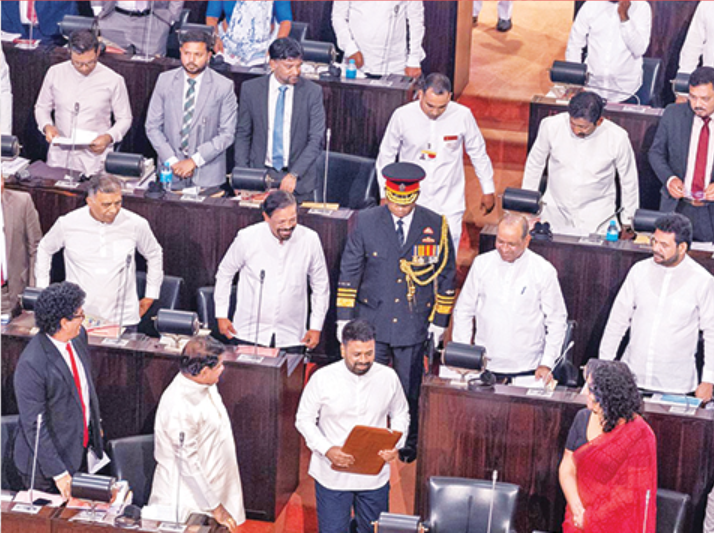
COLOMBO, SRI LANKA — In a momentous address to the nation’s Parliament on Friday, November 7, 2025, President Anura Kumara Dissanayake, serving concurrently as the Minister of Finance, unveiled the National Budget for 2026.3 This fiscal blueprint, the second under his administration, is a crucial inflection point in Sri Lanka’s economic recovery, signalling a shift from the initial, painful phase of crisis management to a long-term strategy of structural reform, fiscal discipline, and institutional integrity.
The budget, framed under the government’s unwavering commitment to the International Monetary Fund (IMF) Extended Fund Facility (EFF), targets a total estimated government expenditure of LKR 4,434 Billion (approx.4 11.5% of projected 2026 GDP) against an ambitious total revenue target of LKR 5,300 Billion. This fiscal framework is designed to cement Sri Lanka’s pathway to sustained recovery and debt sustainability.5
The core message of the 2026 budget is that fiscal consolidation and inclusive development are not conflicting goals, but interdependent necessities for achieving national resilience.6 The proposal’s scholarly significance lies in its deliberate, detailed measures aimed at increasing state revenue to above 15.3% of GDP by 2026 and accelerating the digitalization of the state to eliminate the chronic corruption that fueled the nation’s 2022 collapse.7
💰 THE FISCAL ANCHORS: DEBT, REVENUE, AND IMF MANDATES
The architecture of the 2026 budget is fundamentally dictated by the ongoing obligations under the IMF bailout and the need to restore international financial credibility.8
Cementing Fiscal Consolidation
The primary macroeconomic goal is to achieve a Primary Budget Surplus of at least 2.3% of GDP—a figure considered non-negotiable for securing future IMF tranches and ensuring a viable path for the finalization of external debt restructuring.9 President Dissanayake expressed confidence that the nation is on track to reduce the crippling Debt-to-GDP ratio to below 90% by 2032, a significant marker of returning stability.10
The projected expenditure for 2026 is significantly streamlined, reflecting the administration’s continued efforts at expenditure rationalization, which is crucial for maximizing funds available for debt servicing and targeted investment. The President proudly noted that this year’s debt servicing totals USD 2,435 million, with the successful repayment of a significant portion already completed by September 2025.11
Aggressive Revenue Mobilization and Tax Reform
The budget’s central, bold strategy for 2026 is revenue-side reform, which aims to boost state revenue to 15.3% of GDP.12 This requires a systemic overhaul of the tax structure to improve compliance and broaden the narrow tax base.13
Key Revenue Proposals include:
- Tax Base Broadening: The annual turnover threshold for VAT and Social Security Contribution Levy (SSCL) registration will be reduced from LKR 60 million to LKR 36 million, effective April 1, 2026.14 This move is projected to bring a substantial number of small and medium enterprises (SMEs) into the tax net, generating significant new revenue while aiming to formalize the grey economy.
- Modern Tax Audit Framework: A new, risk-based tax audit framework will be introduced for returns filed from January 2026.15 This system will leverage digitalization to identify non-compliant entities, reduce discretionary power, and significantly curb high-level tax evasion—a historic weakness of the revenue system.16
- National Tariff Policy: Customs Import Duty rates will be revised under a new National Tariff Policy, moving towards a simplified structure of 0%, 10%, 20%, and 30% bands, effective April 2026.17 This is paired with a phased plan to gradually eliminate highly distortive para-tariffs, which are often cited as barriers to export competitiveness.18
- Sector-Specific Taxes: Amendments to the Telecommunications Tax and the elimination of the Special Commodity Levy (SCL) on certain imports (like coconut and palm oil), replacing them with VAT and SSCL, are intended to create a level playing field between local and imported goods while enhancing revenue stability.
Digitalisation for Tax Compliance
A significant allocation of LKR 2,000 million is earmarked for the creation of a new, consolidated office for the Department of Inland Revenue (DIR) to support the full digitalization and centralization of tax collection operations.19 Furthermore, the initiation of a national E-invoicing System will provide real-time connectivity between taxpayer ERP systems and the Revenue Administration Management Information System (RAMIS), marking a powerful technological leap in the fight against tax fraud.
🤝 PUBLIC BENEFITS AND SOCIAL RECONSTRUCTION
Acknowledging the severe social cost of the stabilization process, the 2026 budget makes crucial, targeted allocations toward public welfare, income stability, and poverty alleviation.20
Welfare and Vulnerable Groups
- Aswesuma Programme: The allocation for the central social safety net, Aswesuma, is further enhanced, reflecting the government’s commitment to protecting the 25.9% of the population currently living below the poverty line.
- Estate Workers’ Wage Hike: The budget directly addresses the persistent crisis of low wages in the plantation sector by confirming the government’s plan to raise the estate workers’ daily wage from LKR 1,350 to LKR 1,750 by January 2026.21 This is a major social relief measure for the highly vulnerable Malayagam community.
- Housing for Estate Workers: A dedicated allocation of LKR 4,290 million, supported by the Government of India, is designated to build 2,000 houses for Malayagam estate workers, addressing critical housing shortages.22
- Urban Regeneration and Housing: A combined LKR 25.2 billion is allocated for the “A Place of Your Own – A Beautiful Life” programme for low-income families and the Urban Regeneration Project in the Colombo suburbs, signaling a focus on urban poverty and slum dwelling.
Public Sector and Economic Environment
The budget commits to fostering a stable environment conducive to employment and economic activity:23
- Unemployment Reduction: The President noted that unemployment has already reduced from 4.5% in early 2024 to 3.8% in early 2025, validating the overall stabilization efforts.24
- Ease of Doing Business: The introduction of a new, transparent Investment Protection Act and a formalized Public-Private Partnership (PPP) framework are designed to significantly de-risk large-scale investment and promote domestic and foreign capital inflows.
- SME Support: Measures to reduce the minimum investment threshold to qualify for tax incentives from USD 3 million to USD 250,000 aims to make these incentives accessible to SMEs, which form the backbone of the domestic economy.
🎯 KEY AREAS AND ALLOCATIONAL STRATEGY
The total expenditure plan of LKR 4,434 billion reflects the administration’s strategic priorities, with the largest allocations focusing on the institutional and social sectors critical for a stable, long-term future.25
Major Ministry Allocations (LKR Billion):
| Ministry / Sector | Allocated Amount (LKR Billion) | Strategic Rationale |
| Finance | 634 | Highest allocation, driven by debt servicing obligations and managing the financial architecture of reform. |
| Provincial Councils & Local Government | 618 | Focus on devolution, local service delivery, and grassroots development following crisis-era centralization issues. |
| Public Administration | 596 | Allocated for salary and welfare provisions, alongside institutional restructuring and the planned public sector digitalization drive. |
| Health and Mass Media | 554 | Maintaining universal healthcare, purchasing essential drugs, and managing the public health sector budget. |
| Defence | 455 | Continued maintenance of a large military apparatus, though civil society groups continue to press for reduction and demilitarization. |
| Education, Higher Education, & Vocational Training | 301 | Long-term human capital investment, infrastructure upgrades, and aligning skills training with the digital economy goal. |
Digital Government and Institutional Reform
Beyond the specific financial allocations, a major commitment of the 2026 budget is the digital-first transformation of the state.26
- Fully Digital Government: The budget re-emphasizes the shift to fully digital government payments and service delivery.27 A measure to eliminate fees for QR transactions below LKR 5,000 is introduced to encourage mass adoption of digital financial services, bypassing traditional cash-based vulnerabilities.28
- Digital ID: The completion of the Sri Lanka Unique Digital Identification (SL-UDI) by March 2026 is confirmed as a foundational piece of public infrastructure, essential for targeted welfare delivery, citizen services, and national security.29
- Anti-Corruption Framework: The budget is interwoven with the theme of institutional integrity, supported by the recent passage of the Proceeds of Crime Act (April 2025) and the government’s public anti-corruption campaign.
🔎 SCHOLARLY ASSESSMENT: PROMISE VS. PERIL
President Dissanayake’s 2026 budget has been met with applause for its fiscal honesty and strategic direction but also with critical skepticism regarding its execution and distributional impact.
Risk 1: Execution and Institutional Inertia
The most significant risk to the 2026 budget is the potential failure of execution. The ambitious digitalization and tax reform targets require a level of institutional capacity and political will that has historically been lacking in Sri Lanka. The establishment of a modern tax audit framework and the successful rollout of the national e-invoicing system depend on overcoming deep-seated bureaucratic resistance and technical challenges. Analysts warn that merely allocating funds is insufficient; the key lies in the systemic dismantling of the patronage and corruption networks that the new administration has promised to eliminate.
Risk 2: Socio-Economic Inequality
While the budget includes essential social protection measures, a critical scholarly perspective highlights that the overall framework of IMF-mandated austerity inherently exacerbates socio-economic inequalities. The aggressive tax collection strategy, particularly the broadening of the VAT base, disproportionately affects low and middle-income groups by increasing the cost of essential goods.30 The budget provides relief through wage hikes, but the long-term impact of rising living costs, coupled with structural adjustments in key sectors (like the “commercial grounds” operation of State-Owned Enterprises), continues to place an unsustainable burden on the poor.
Opportunity: Investment and Growth
Conversely, the budget’s focus on simplifying the investment climate and the phased elimination of para-tariffs presents a genuine opportunity for export-led growth. By reducing the minimum investment threshold for incentives, the government is attempting to democratize investment and empower local capital. If successful, the synergy between a stable debt outlook, streamlined regulations, and digital efficiency could finally unlock Sri Lanka’s long-dormant potential for sustained growth above 5% GDP.
🏁 CONCLUSION: THE PATH OF NO RETURN
President Anura Kumara Dissanayake’s 2026 budget is a political and economic statement that Sri Lanka has chosen the difficult, but necessary, path of discipline and structural transformation.31 It firmly commits the nation to the fiscal consolidation required for international recovery while making calculated, targeted investments to protect the most vulnerable sectors of the population.32
This budget is not about short-term populist gain; it is a foundational document for a post-crisis state. Its success will be measured not just in the figures achieved by the end of 2026, but in the administration’s ability to use the allocated funds to effect the deep-rooted institutional and cultural change required to ensure the nation never relapses into financial chaos. The debate now moves to Parliament, where the true test of political will begins.