TERROR SHOCKWAVE HITS DELHI: Car Blast Near Red Fort Kills Nine, Hours After Massive Explosives Haul
By Lions Roar News Global Security Desk
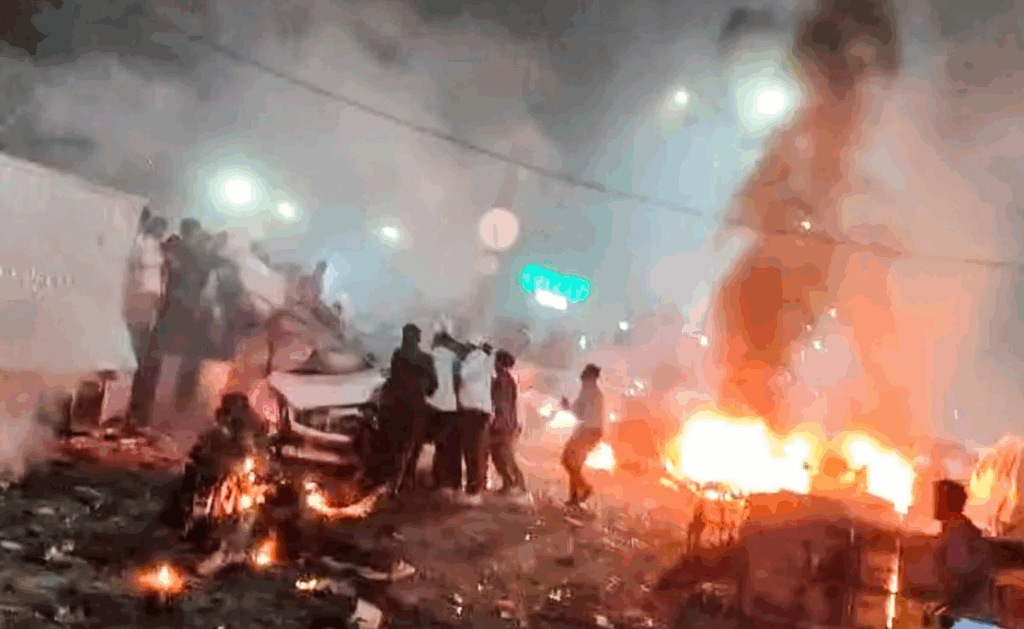
NEW DELHI, INDIA — The Indian capital was plunged into a state of high alert and shock late Monday evening after a powerful explosion ripped through a slow-moving Hyundai i20 car near the Red Fort Metro Station, leaving at least nine people dead and more than 20 injured. The blast, which occurred at approximately 6:52 PM local time, transformed the heavily congested area near the historic Red Fort—a major national landmark and busy commuter hub—into a scene of devastating chaos, scattered wreckage, and panicked crowds.
The sheer force of the explosion, the cause of which remains under intense investigation, immediately set fire to the primary vehicle and rapidly spread, engulfing several nearby cars, auto-rickshaws, and motorcycles. Eyewitness accounts, relayed through local media, described a terrifying scene where the immediate aftermath saw mangled bodies and debris strewn across the road, with the air thick with smoke and the terrified screams of pedestrians and commuters.
Delhi Police Commissioner Satish Golcha confirmed the details, stating, “The blast took place in a slow-moving vehicle that came to a halt at the Red Fort traffic signal. There were occupants in the car. The blast damaged cars nearby.” Golcha also confirmed that a high alert has been sounded across the national capital, with multiple agencies rushing to the scene to secure the area and begin the critical process of forensic analysis.
High Alert and Multi-Agency Response
Within minutes of the explosion, the Delhi Fire Services (DFS) deployed 20 fire engines to the spot, swiftly working to contain the intense blaze that followed the blast. The area was immediately cordoned off by Delhi Police.
The gravity of the incident prompted the rapid deployment of specialized anti-terror units, including the National Investigation Agency (NIA), the National Security Guard (NSG), and the Delhi Police Special Cell. These units are on the ground to assess the situation, collect forensic evidence, and determine definitively whether the blast was the result of a terrorist act, a targeted assassination, or an accidental explosion of illicit materials. Union Home Minister Amit Shah and Prime Minister Narendra Modi swiftly acknowledged the crisis, with Shah visiting the blast site and the injured at the Lok Nayak Jai Prakash Narayan (LNJP) Hospital, assuring a thorough and determined investigation into all possible angles.
Victims suffering severe injuries were rushed to LNJP Hospital, with medical superintendents confirming the deaths of several individuals upon arrival. The official death toll stands at nine, but given the intensity of the blast and the heavy presence of pedestrians and vendors in the area, authorities are working carefully to confirm the total number of casualties.
The Disturbing Precursor: Faridabad Explosives Haul
The timing of the Red Fort explosion has dramatically escalated the security concerns across India, coming just hours after a massive counter-terror operation in the neighbouring state of Haryana.
Earlier on Monday, a joint operation between the Jammu and Kashmir Police and Haryana Police successfully recovered an enormous cache of explosives and weapons from two residential buildings in Faridabad. The seizure included over 350 kg of ammonium nitrate—a fertilizer commonly and easily converted into a deadly improvised explosive device (IED)—along with an assault rifle, multiple magazines, live cartridges, timers, remote controls, and other bomb-making components.
This significant bust, which uncovered what officials described as a “white collar” terror module linked to proscribed outfits like Jaish-e-Mohammed (JeM), was based on intelligence gathered from the interrogation of an arrested J&K-based doctor, Adil Ahmad Rather. Rather’s confession led investigators to a second arrested doctor, Dr. Muzammil Ganaie, an assistant professor at a local university, in whose rented accommodation the massive stockpile was found.
The recovery of bomb-making materials, sufficient to cause large-scale devastation, has led security experts to draw immediate, albeit preliminary, links between the two events. The possibility that the Red Fort blast could be related to the same terror network or was a desperate, unplanned attack following the exposure of the Faridabad module has put the entire North Indian region on edge.
National Security Implications
The dual security incidents have triggered a panic and a massive multi-state high alert. Alerts have been issued not just in Delhi, but also in Mumbai, Uttar Pradesh, Punjab, and Haryana, with security being immediately ramped up at airports, railway stations, metro stations, and key religious and sensitive border areas.
The Red Fort, or Lal Qila, is not only a 17th-century Mughal monument but a potent symbol of Indian sovereignty, being the site of the Prime Minister’s annual Independence Day address. Targeting such a high-profile, heavily populated area underscores the extreme threat posed by the operatives responsible. The simultaneous occurrence of a deadly blast and the discovery of a large-scale terror plot has led investigators to believe they are dealing with a coordinated and potentially wide-ranging network aimed at destabilizing the region.
As forensic teams meticulously sift through the wreckage for bomb residue and attempt to trace the full chain of ownership of the exploded Hyundai i20, the nation awaits official confirmation regarding the exact nature and motive behind the attack that has left Delhi reeling. The investigation is expected to be lengthy and complex, focusing both on the immediate blast site and the dangerous network uncovered in Faridabad.