Second Chance for Celestial Show: Southern Lights Expected to Shine Over New Zealand Tonight
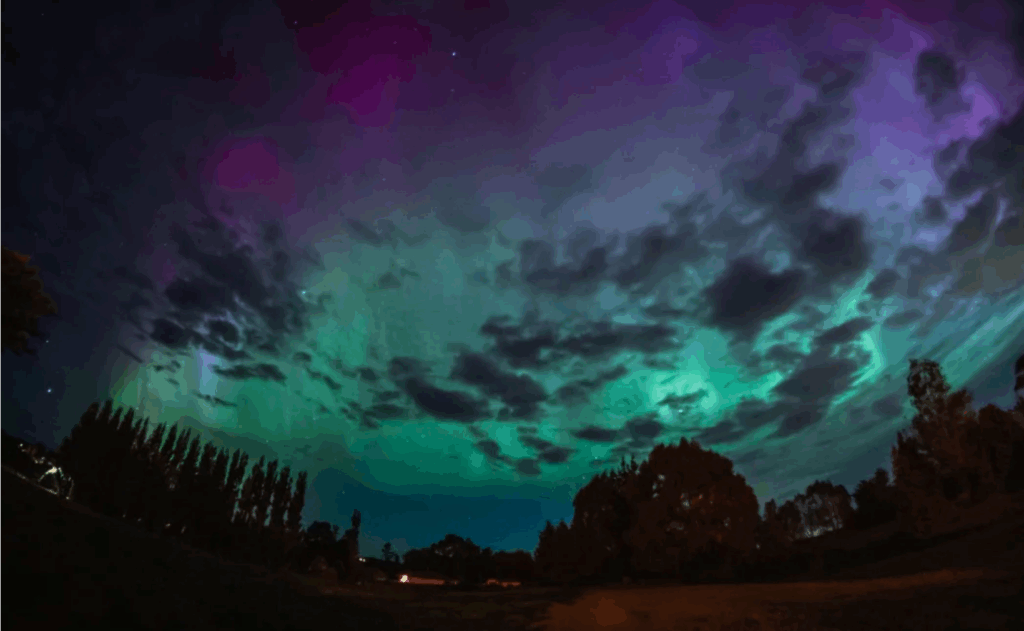
Auckland, New Zealand – November 13, 2025 – Following a spectacular light show that captivated stargazers across the lower South Island last night, there is heightened anticipation for a repeat performance of the Aurora Australis tonight. Experts suggest that New Zealanders, particularly those in the South Island, could be in for another breathtaking display of the Southern Lights as the residual effects of a severe solar storm continue to ripple through Earth’s magnetic field.
The stunning light show witnessed on Wednesday night was a result of a powerful G4-classified geomagnetic storm, which was itself caused by a rare collision of two coronal mass ejections (CMEs) from the sun. Dr. Ian Griffin, director of Tūhura Otago Museum, described the previous night’s event as particularly spectacular, noting that the collision “really boosted the visibility of the aurora.”
Where and When to Look Tonight
Dr. Griffin confirmed to Lions Roar News that there is a “good chance” the aurora will be visible again this evening, provided skies remain clear. The best viewing locations remain those with the least light pollution and the furthest south:
- Optimal Locations: Twizel, Southland (including Otautau and Woodlands), and Otago (including Middlemarch and Dunedin).
- Best Time: Auroras are typically most visible from sunset until the early hours of the morning. Last night’s display continued well into the small hours.
- Key Phenomenon: Those lucky enough to be directly under the phenomenon, such as Dr. Griffin in Middlemarch, may witness the incredible “aurora corona,” where beams of light appear to converge directly overhead.
Te Whatu Stardome astronomer Josh Aoraki reiterated that the current high solar activity period is directly responsible for the intense auroral displays. While the lights are notoriously difficult to predict in terms of brightness, Mr. Aoraki noted that even when not clearly visible to the naked eye, a long-exposure photograph taken with a camera can often capture the subtle greens and reds of the aurora. Interested skywatchers can track the space weather forecast via the NOAA website for the latest official predictions.
The Hidden Impact: Protecting the Power Grid
While the public was marveling at the cosmic phenomenon, New Zealand’s power infrastructure was on high alert. Transpower, the national grid operator, issued a grid emergency notice on Wednesday afternoon as a precautionary measure against the severe G4 geomagnetic storm.
These powerful solar storms can induce unwanted geomagnetically generated currents (GICs) into long electricity transmission lines. If these currents reach critical infrastructure like large transformers in substations, they have the potential to cause significant and costly damage, risking long-term outages.
As a safety measure, Transpower temporarily took several South Island electricity transmission lines offline. The grid operator confirmed that this action was standard protocol for space weather events reaching a particular level of severity, and thankfully, there was no impact on consumers’ electricity supply.
This proactive response is the result of a multi-year preparedness plan developed in collaboration with the University of Otago, international space agencies, and the electricity industry. By Thursday morning, Transpower lifted the grid emergency notice, confirming that the G4 storm had reduced in severity and all South Island lines had been safely returned to service.
National Preparedness in the Spotlight
The solar storm event has also highlighted the growing national focus on “space weather” preparedness. Just last week, the National Emergency Management Agency (NEMA) and other affected agencies conducted a test scenario of a major solar storm response from the Beehive’s bunker. Such exercises are essential to ensure New Zealand is adequately prepared for potential disruptions to critical infrastructure, including communications, satellite systems, and the power grid.
For now, the country looks south, hoping for a final encore from the cosmos tonight. The stunning photographs shared by starspotters from Clifden Bridge in Otautau to Blackhead in Dunedin serve as a powerful reminder of the incredible, yet occasionally disruptive, forces at play in our solar system.