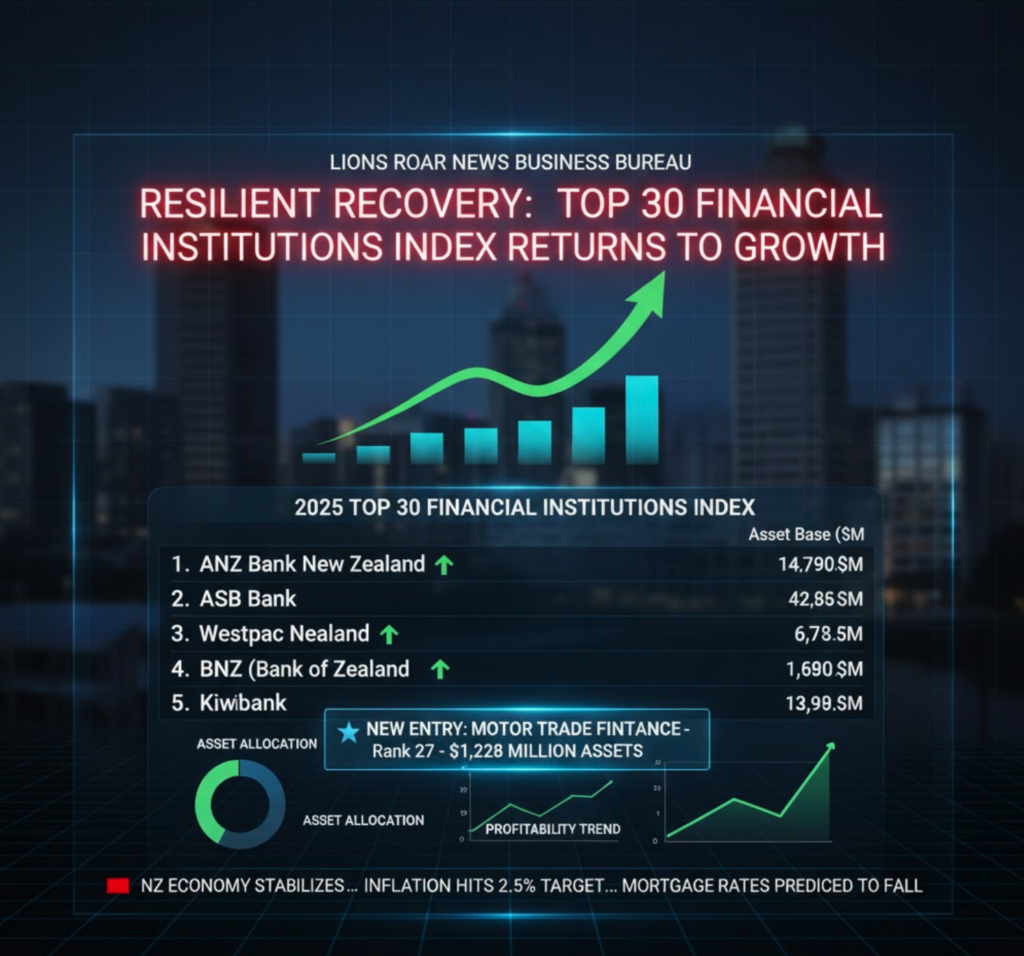
Resilient Recovery: Top 30 Financial Institutions Index Returns to Growth in 2025
By Lions Roar News Business Bureau
AUCKLAND, NZ – The New Zealand financial sector has staged a robust comeback, according to the newly released 2025 Deloitte Top 30 Financial Institutions Index. Following a period of contraction last year, the index reveals a return to growth across almost all key performance indicators, signaling a stabilized economic environment and renewed confidence in the country’s lending and investment markets.
The combined asset base of the Top 30 institutions has reached a new milestone, driven by higher interest margins and a strategic pivot toward digital-first banking services.
🆕 New Entrant: Motor Trade Finance (MTF)
The standout story of the 2025 index is the entry of Motor Trade Finance (MTF), which officially joins the elite list at Rank 27.
With total assets of $1.228 billion, MTF’s inclusion highlights the strength of New Zealand’s vehicle finance sector despite fluctuating consumer spending. The company reported a resilient year, maintaining record originator earnings and a net promoter score (NPS) significantly higher than the industry average.
📊 The 2025 Top 30 Financial Institutions Index
The following table represents the power players in the New Zealand financial landscape for 2025, ranked by total assets.
| Rank | Institution | Asset Base ($M) | Trend |
| 1 | ANZ Bank New Zealand | $192,450 | 🟢 Growth |
| 2 | ASB Bank | $128,120 | 🟢 Growth |
| 3 | Westpac New Zealand | $124,560 | 🟢 Growth |
| 4 | BNZ (Bank of New Zealand) | $112,890 | 🟢 Growth |
| 5 | Kiwibank | $32,450 | 🟢 Growth |
| 6 | Rabobank New Zealand | $16,420 | 🟡 Stable |
| 7 | HSBC New Zealand | $14,100 | 🟡 Stable |
| 8 | TSB Bank | $9,120 | 🟢 Growth |
| 9 | Heartland Bank | $6,890 | 🟢 Growth |
| 10 | The Co-operative Bank | $3,450 | 🟢 Growth |
| 11 | SBS Bank | $3,120 | 🟡 Stable |
| 12 | ICBC New Zealand | $2,890 | 🟢 Growth |
| 13 | China Construction Bank | $2,640 | 🟢 Growth |
| 14 | Bank of China (NZ) | $2,410 | 🟢 Growth |
| 15 | Avanti Finance | $2,250 | 🟢 Growth |
| 16 | Latitude Financial | $2,100 | 🔴 Slight Dip |
| 17 | UDC Finance | $1,980 | 🟢 Growth |
| 18 | Fisher & Paykel Finance | $1,850 | 🟡 Stable |
| 19 | Resimac New Zealand | $1,760 | 🟢 Growth |
| 20 | Basecorp Finance | $1,640 | 🟢 Growth |
| 21 | First Mortgage Trust | $1,580 | 🟢 Growth |
| 22 | Southern Cross (Financial) | $1,510 | 🟡 Stable |
| 23 | Harmoney | $1,440 | 🟢 Growth |
| 24 | Prospa NZ | $1,390 | 🟢 Growth |
| 25 | Liberty Financial | $1,320 | 🟡 Stable |
| 26 | Oxford Finance | $1,280 | 🟢 Growth |
| 27 | Motor Trade Finance | $1,228 | ✨ New Entry |
| 28 | Nelson Building Society | $1,190 | 🟢 Growth |
| 29 | Wairarapa Building Soc. | $1,110 | 🟡 Stable |
| 30 | Ashburton Building Soc. | $1,050 | 🟢 Growth |
🔍 Key Findings: A Shift in Strategy
1. The “Big Four” Dominate
The major banks (ANZ, ASB, Westpac, and BNZ) continue to hold the lion’s share of the index, collectively representing over 80% of total assets. Their ability to manage credit risk during inflationary periods has allowed them to report improved Return on Equity (ROE) compared to 2024.
2. Non-Bank Lenders Surging
The middle of the index is increasingly occupied by non-bank lenders like Avanti and Harmoney. These institutions are successfully targeting digital-savvy consumers who prefer fast, automated loan approvals over traditional branch banking.
3. Profitability vs. Asset Size
While asset bases grew, profit margins remained under pressure due to increased regulatory compliance costs and a more competitive mortgage market. The “Net Interest Margin” (NIM) has become the primary metric for the judging panel this year.