Projects, Procurement, and Trust: Why Auckland’s Next Council Election Matters
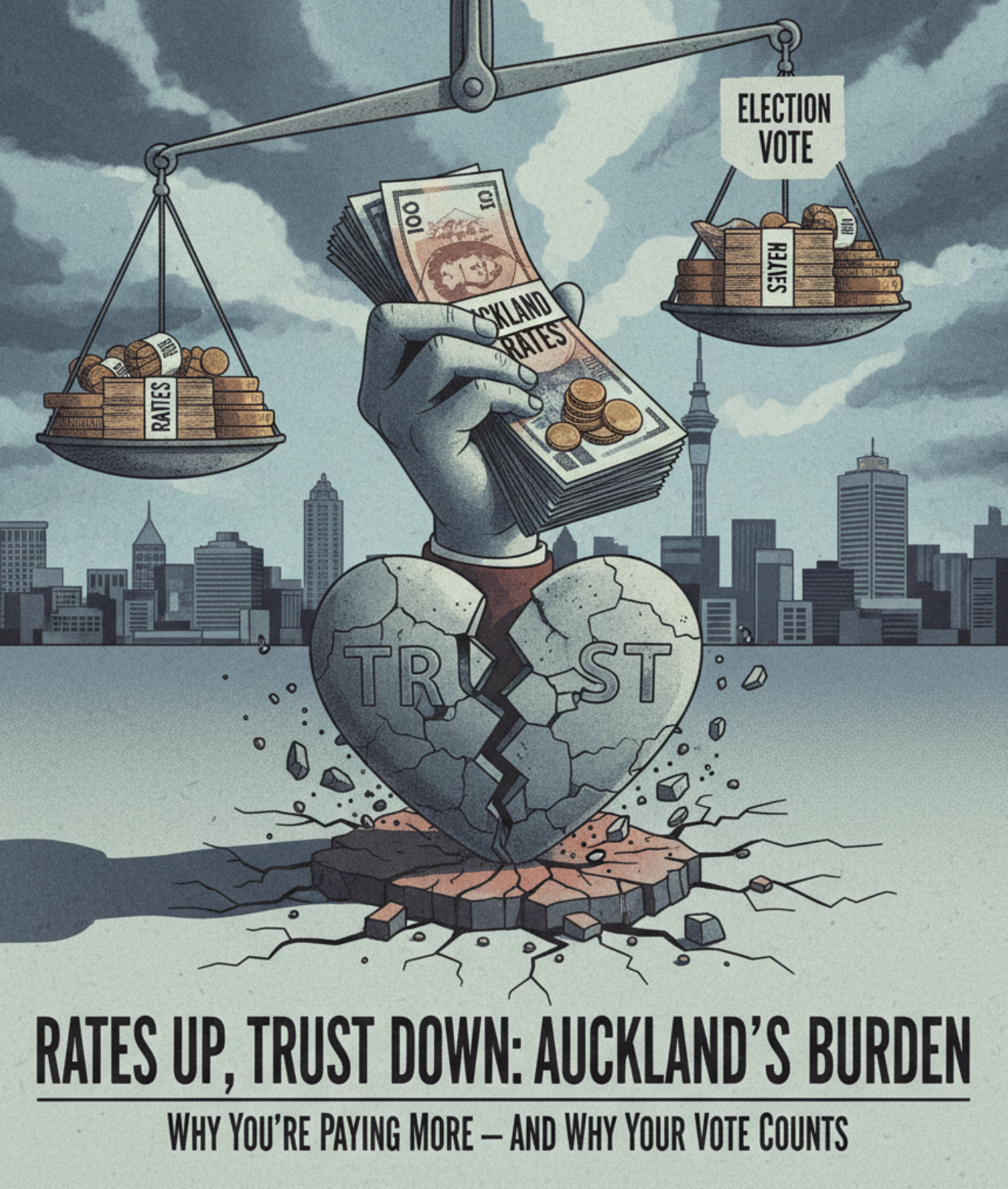
Auckland is a city of constant change. Cranes dominate the skyline, motorways stretch further each year, and multi-billion-dollar water projects promise to future-proof the region. But with all this growth comes a recurring question: are these projects being delivered wisely, or are weak systems turning public spending into private profit?
Behind the headlines about new tunnels, pipes, and community facilities lies a troubling pattern. Projects blow out, procurement scandals hit the news, and ratepayers are left wondering why their hard-earned money doesn’t seem to stretch as far as it should. For many Aucklanders, the issue isn’t whether the city should invest in infrastructure — it must — but whether those investments are managed in a way that truly delivers value.
When governance is weak, contractors benefit while communities pay the price. Projects that looked affordable at the planning stage can double in cost, deadlines slide into years, and promises of accountability dissolve into finger-pointing. At the end of the chain are households and businesses who see higher rates, fewer services, or delays to the amenities that make neighbourhoods liveable.
Cost Blowouts: A Familiar Story
One of Auckland’s most significant infrastructure projects, the Central Interceptor wastewater tunnel, is a clear example of how costs can escalate. Designed to improve water quality and protect the city’s harbours, the project is critical for Auckland’s long-term growth. But media reports have documented how costs have risen well beyond early projections (New Zealand Herald, n.d.). For residents, the frustration isn’t about the need for the tunnel — it’s about why budgets can’t seem to hold and why contractors often appear to benefit when costs climb.
Such blowouts are not just accounting issues. They represent real trade-offs. Every dollar spent above budget on one project means less available for libraries, parks, or local road repairs. It is here, in everyday services, that communities often feel the hidden cost of weak planning and poor contract oversight.
Watercare’s Multi-Billion-Dollar Commitment
Watercare Services Limited, the council-controlled organisation responsible for Auckland’s water infrastructure, has laid out a massive investment programme for the coming decade (Watercare, 2025). The programme includes new treatment plants, upgraded pipes, and major resilience projects to keep pace with population growth and environmental demands.
No one disputes the need for these investments. Auckland’s water infrastructure is aging, and the city’s growth requires forward planning. But the sheer scale — in the tens of billions of dollars — creates enormous risk. If governance or procurement falters even slightly, the costs can quickly spiral. Because Watercare’s budget is funded through household bills and, indirectly, ratepayer contributions, these risks translate directly into financial pressure on Aucklanders.
Procurement Scandals Undermine Trust
Beyond cost overruns, procurement scandals have highlighted vulnerabilities in the council’s systems. The Serious Fraud Office has prosecuted cases involving bribery, kickbacks, and corruption tied to contractors and, in some instances, council-related staff (Serious Fraud Office, n.d.). Examples range from IT service contracts manipulated for personal gain to construction inspections tainted by fraud.
These cases are not isolated headlines. They show how weak procurement controls — such as poor conflict-of-interest checks or insufficient contract monitoring — create real opportunities for abuse. When contractors inflate costs or staff misuse their roles, ratepayers are left paying more for less. Media coverage of these scandals (TVNZ 1News, n.d.) has only deepened public cynicism, reinforcing the perception that Auckland’s systems too often protect insiders rather than communities.
Warnings from Independent Oversight
The Office of the Auditor-General has consistently flagged risks in Auckland Council’s governance structures and delivery models. Its reviews highlight systemic weaknesses — including blurred lines of accountability between the council and its council-controlled organisations (CCOs), poor monitoring of performance, and insufficient transparency (Auditor-General, n.d.).
Such warnings matter because they show the issues aren’t simply about a few bad contracts. They are structural. Unless governance is tightened and accountability strengthened, the same problems are likely to repeat on future projects, no matter how well-intentioned.
The Council’s Own Acknowledgments
Even the council has admitted the need for improvement. Through its value-for-money initiatives, Auckland Council reported $43.2 million in savings across services and operations (Auckland Council, 2025b). While this shows awareness, the figure feels small compared to the scale of the challenge. With an annual budget exceeding $8 billion, and multi-billion-dollar projects looming, many residents see such savings as tinkering at the edges rather than systemic reform.
Why Contractors Benefit
The dynamics that drive cost blowouts and inefficiency are not accidental — they are baked into the way contracts are managed.
- Complex contracts with poor scoping: When projects aren’t clearly defined, contractors can claim variations and recover extra costs.
- Limited competition: A small pool of large firms wins repeated contracts, reducing price pressure.
- Procurement gaps: Weak checks and limited transparency create opportunities for inflated claims or worse.
- Fragmented accountability: With responsibilities spread across council departments, CCOs, and external contractors, it becomes easy to dodge responsibility when projects falter (Auditor-General, n.d.).
These structural issues explain why contractors often emerge unscathed, or even better off, while the public bears the burden.
The Impact on Communities
By now, Aucklanders have adjusted to the 2025/26 rate rise — an average $223 extra for households (Auckland Council, 2025a). The increase is no longer news. But it remains a powerful reminder that inefficiency and weak oversight have direct consequences for families and businesses.
Ratepayers don’t only pay for new infrastructure. They also pay for the systems that deliver it. When those systems underperform, households end up funding delays, inefficiencies, and, in some cases, outright fraud. This undermines not only trust in the council but also faith in Auckland’s ability to build a resilient and affordable future.
A Path Forward for Voters
The upcoming council election offers a chance to change direction. If communities want better results, they need to demand leaders who prioritise governance and accountability. Key commitments should include:
- Transparent procurement with rigorous conflict-of-interest checks.
- Independent cost-benefit and risk reviews for major projects.
- Plain-English dashboards showing project budgets, timelines, and changes.
- Stronger accountability when governance fails or misconduct occurs.
- Smaller, staged contracts that keep competition alive.
These measures won’t solve every problem overnight, but they would begin to close the gaps that turn projects into cost traps.
Conclusion: Systems, Not Slogans
Auckland’s challenges are clear. The city must build — but it must build wisely. Ratepayers have already absorbed higher bills, and while they may accept the need for investment, they will not accept waste or corruption.
The 2025/26 council election is not just about who sits around the table at Town Hall. It is about whether Auckland’s future will be shaped by transparency, accountability, and efficiency — or by repeating the same costly patterns. Communities now have the chance to demand better systems, not just better slogans.
References
Auckland Council. (2025a). Have your say on Auckland Council’s Annual Budget 2025/26. Retrieved September 20, 2025, from https://akhaveyoursay.aucklandcouncil.govt.nz
Auckland Council. (2025b). Value for money programme: Council reports savings. OurAuckland. Retrieved September 20, 2025, from https://ourauckland.aucklandcouncil.govt.nz
Auditor-General. (n.d.). Reports on Auckland Council and council-controlled organisations. Office of the Auditor-General New Zealand. Retrieved September 20, 2025, from https://oag.parliament.nz
New Zealand Herald. (n.d.). Central Interceptor cost increases draw scrutiny. NZ Herald. Retrieved September 20, 2025, from https://www.nzherald.co.nz
Serious Fraud Office. (n.d.). Media releases and case summaries. New Zealand Serious Fraud Office. Retrieved September 20, 2025, from https://sfo.govt.nz
TVNZ 1News. (n.d.). Coverage of procurement and fraud cases linked to Auckland Council. TVNZ. Retrieved September 20, 2025, from https://www.1news.co.nz
Watercare Services Limited. (2025). Watercare asset management and investment plan. Retrieved September 20, 2025, from https://www.watercare.co.nz
This article was submitted by an independent journalist