Peters Confronts Major Emitters at UN Climate Talks, Calls Out “Elephant in the Room”
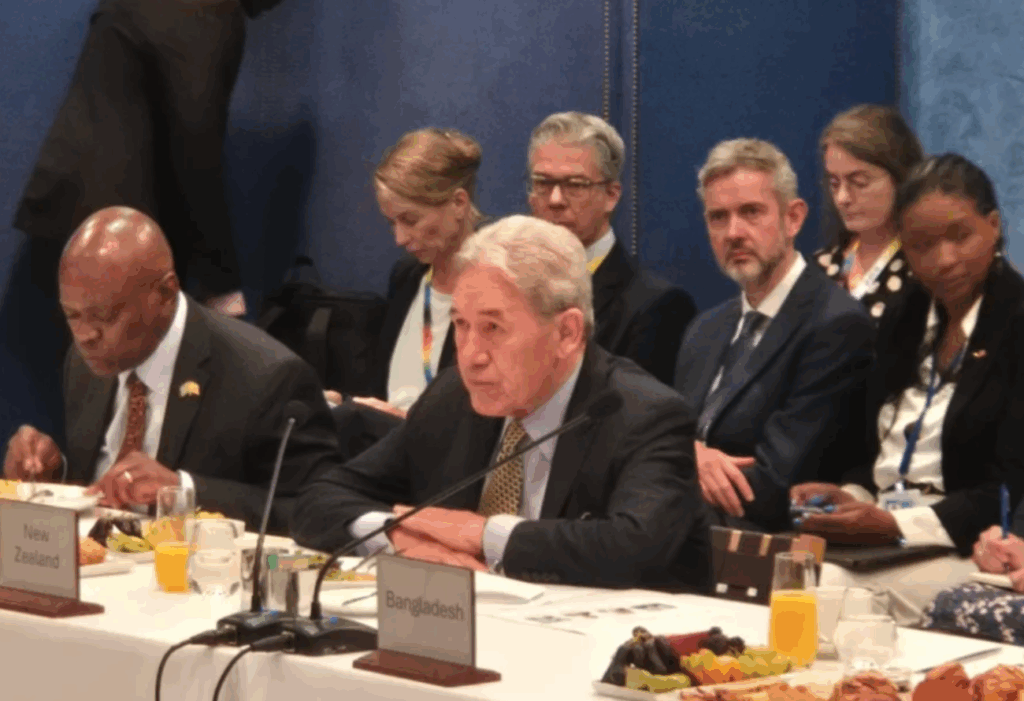
New York — New Zealand Foreign Affairs Minister Winston Peters has issued a blunt warning to world leaders at the United Nations, insisting that global climate talks cannot continue to ignore the “elephant in the room” — the world’s largest emitters.
Speaking at a UN leaders’ breakfast in New York, co-chaired by New Zealand’s Pacific neighbour Tuvalu, Peters said the survival of small island nations is at stake as sea levels rise. He emphasised that while nearly 200 countries are struggling to reduce emissions, four countries alone — China, India, Russia, and the United States — account for 60 percent of global emissions.
“We have to be honest and realistic here,” Peters told the gathering. “Four countries comprise 60 percent of the world’s emissions, and the rest of the 191 countries are wrestling with this problem. We have to face the fact, deal with it — we’re in a battle we can’t possibly win.”
Reporters were ushered out of the session after Peters’ remarks, but a UN staffer later confirmed that Valerie Hickey, the World Bank’s Global Director for Climate Change, commended Peters for “dropping a truth bomb” and highlighting the urgent need for major emitters to take responsibility.
Tension with Trump’s Dismissal of Climate Change
The New Zealand minister’s comments came in sharp contrast to US President Donald Trump’s address to the UN General Assembly earlier this week, in which Trump labelled climate change “the greatest con job ever perpetrated on the world.”
Tuvalu Prime Minister Feleti Teo condemned Trump’s remarks, describing them as “appalling.”
“We are firm and confident in the science — international science — that most of the countries around the world believe that climate change is a reality,” Teo said.
As one of the nations most vulnerable to rising seas, Tuvalu has long pushed for stronger climate action at the UN. Teo expressed hope that a dedicated summit on sea-level rise, scheduled for next year, will deliver a declaration that acknowledges the existential threat faced by low-lying nations.
Peters’ Challenge to the Global Community
When asked about the United States’ refusal to act, Peters said the issue goes beyond Washington.
“Even if it wasn’t the United States involved, there are still three other countries — China being the leading one — and other economies where no contribution in terms of emissions reduction is being made. So let’s face the elephant in the room and stop kidding ourselves that all this effort and all this money is going to get us any outcome without [an agreement].”
New Zealand has been contributing to UN efforts to clarify the legal status of Exclusive Economic Zones (EEZs) for island nations as their territories shrink due to climate impacts. Peters’ intervention at the UN underscores Wellington’s attempt to amplify Pacific concerns at the highest levels of international diplomacy.
Diplomatic Agenda Beyond Climate
While in New York, Peters also held several bilateral meetings. He received a humanitarian update on Gaza from World Food Programme executive director Cindy Hensley McCain, confirming that New Zealand has already contributed $37.5 million in aid to the region over the past two years. Further assistance is under consideration as the government debates recognising Palestinian statehood.
Peters also met with United Arab Emirates Deputy Prime Minister and Foreign Affairs Minister Sheikh Abdullah bin Zayed Al Nahyan to discuss Middle East developments.
He is expected to expand on New Zealand’s position on both climate action and Palestinian statehood during his speech in the UN General Assembly’s general debate on Saturday (NZT).