New Zealand’s Monetary Tightrope: Fragile Economy Persists Despite OCR Cuts
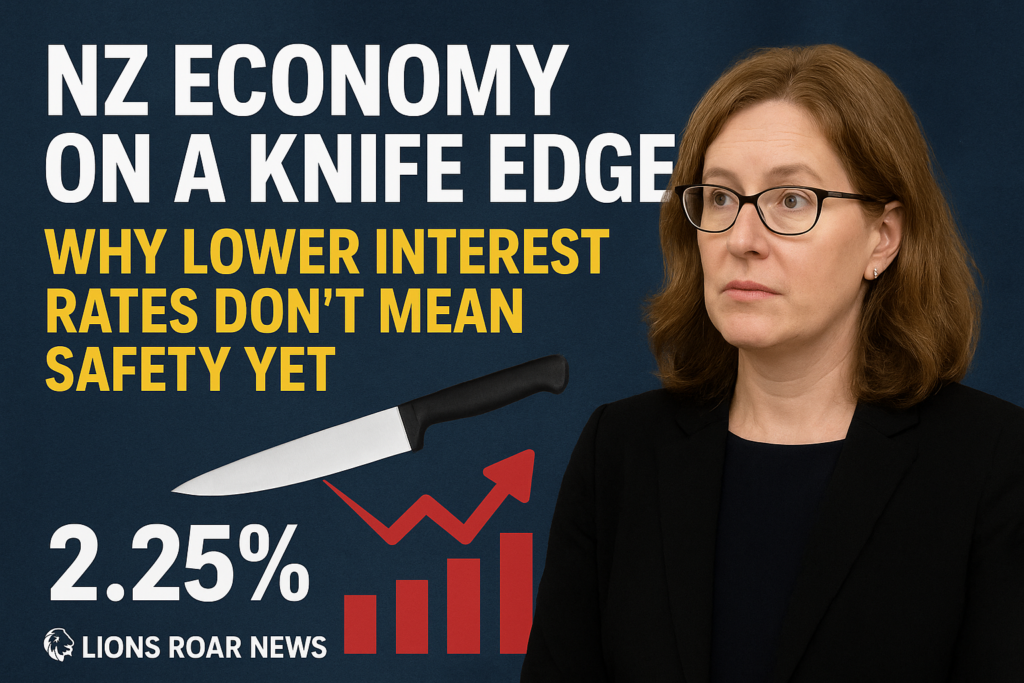
Wellington, New Zealand — In late November 2025, the Reserve Bank of New Zealand (RBNZ) delivered its ninth cut to the Official Cash Rate (OCR), lowering it to a three-year low of 2.25 %, yet the country’s economic situation remains surprisingly fragile. What would normally be celebrated as monetary policy support for growth has instead raised questions about the strength of the economic recovery.
Newly sworn-in Governor Anna Breman emphasised there is “no predetermined policy path” for future rate changes, signalling that future decisions will hinge critically on evolving data on inflation and growth. This shift in mindset reflects a central bank walking a policy tightrope—a balancing act between encouraging growth and containing inflation risks in an economy beset by structural and external challenges. Reuters
Understanding the OCR Cuts: A Necessary Response to Weak Growth
The RBNZ’s series of rate cuts represents an aggressive attempt to stimulate demand by reducing borrowing costs for households and businesses. The OCR has now been trimmed by more than 300 basis points since mid-2024 as inflation eased from elevated levels and economic momentum faltered. Reserve Bank of New Zealand
Lower interest rates typically encourage spending and investment by making loans cheaper, boosting consumption and business activity. They also soften mortgage costs for existing borrowers and can spark activity in interest-sensitive sectors such as housing, retail, and construction.
But despite almost a full year of monetary easing, the signs of a self-sustaining recovery remain weak. Key indicators of economic health—such as consumer demand, business investment, and employment growth—have shown only glimmers of improvement. The labour market, while stable, remains weak with unemployment elevated, and firms continue to report cautious demand outlooks. Reserve Bank of New Zealand
The Fragile Growth Picture: Weak Demand Amid Global Headwinds
Even though inflation is now within the RBNZ’s target band (1–3 %), the underlying economic momentum remains uneven. Export sectors like dairy, meat and horticulture have received a temporary lift from higher global prices, but activity in domestic sectors such as retail, construction, and services continues to lag. Reserve Bank of New Zealand
There are several reasons for this fragility:
1. Global Uncertainty and Trade Pressures
New Zealand’s economy is small and highly open, making it vulnerable to global developments. International policy uncertainty, including trade tensions and slowing growth in major partner economies, has dampened export demand and business confidence. The RBNZ has explicitly flagged uncertainty stemming from global geopolitical developments as a downside risk. Reserve Bank of New Zealand
2. Spare Capacity and Weak Domestic Demand
The Monetary Policy Committee has observed “spare productive capacity” across the economy—meaning that many resources (such as labour and capital) are underutilised. This slack suppresses inflation pressure but also reflects weak demand conditions. Businesses in many sectors are reluctant to expand or hire aggressively until they see clearer signs of sustained demand growth. Reserve Bank of New Zealand
3. Labour Market Softness
While the official unemployment rate has shown signs of stabilising, it remains higher than desired. Consumer confidence is under pressure, and households are still repairing balance sheets after years of high borrowing costs. With job security not yet robust, consumer spending—another engine of growth—is subdued. Reserve Bank of New Zealand
4. Lagged Effect of Monetary Policy
Lowering interest rates helps, but it takes time—often many months—for these cuts to flow through to broader economic activity. Given the depth of previous monetary tightening in the years prior to 2024, the full stimulatory effect of the current low OCR is still playing out. Reserve Bank of New Zealand
Inflation Near Target But Not a Certainty
Although headline inflation has moderated to around **3 %—the top end of the RBNZ’s target band—technical definitions mask underlying complexity. Tradable inflation (prices of imported goods) has been volatile due to exchange rate swings and global supply dynamics, while non-tradable inflation (services and domestically produced goods) continues to adjust slowly. Reserve Bank of New Zealand
This divergence complicates the central bank’s job: achieving stable inflation near the midpoint (2 %) without prematurely tightening policy that could choke off early signs of growth.
As Governor Breman has stressed, future policy moves won’t be set in stone—they will depend on incoming data. Markets are already pricing the possibility of rate increases in 2026, should inflation persist above target or growth strengthen unexpectedly. Reuters
Why Some Economists See “Fragility” Despite Lower Rates
Lower interest rates often bring relief, but many analysts argue New Zealand’s economy remains structurally fragile for several reasons:
Consumption and Investment Are Not Fully Rebounding
Household spending is cautious. Even with cheaper loans, families are mindful of debt levels and uncertainties about future interest rate settings. Likewise, businesses are hesitant to make major capital investments in an unclear demand environment.
Global Growth Slowdown
Growth prospects in key markets like Australia, China, and parts of Europe are weaker than previously expected. As a result, New Zealand exporters cannot rely on strong external demand to drive a broad economic recovery.
Debt and Housing Market Dynamics
While the OCR cuts have lowered borrowing costs, the lag in banks passing on these cuts to all types of lending (especially longer-term fixed mortgages) means many households don’t yet feel the full benefit. Meanwhile, the housing market shows patchy strength, with prices and sales varying significantly by region.
Policy Uncertainty
With global and domestic risks evolving rapidly, businesses and consumers face challenges planning for investment and consumption. Policy flexibility is necessary, but it also means that markets and households may delay decisions until there is greater clarity about the direction of monetary policy.
RBNZ’s Path Forward: Data-Driven, Not Pre-Set
Governor Breman’s emphasis on data dependency reflects the central bank’s cautious stance. Rather than promising further cuts or signaling a commitment to hold rates for an extended period, the RBNZ is effectively saying—we will act where data warrants it. Reuters
This approach has both advantages and risks:
- Advantage: It allows flexibility to respond to unforeseen shocks or shifts in inflation and growth dynamics.
- Risk: It can foster uncertainty among markets and households if expectations about future policy become too fluid.
Financial markets today show this tension clearly: while some investors expect future rate hikes in 2026 if inflation pressures resurface, others see the OCR as remaining low for longer to support a tepid recovery. Reuters
Conclusion: A Recovery That Is Not Yet Secure
Despite a series of significant OCR cuts and a cautious policy stance, New Zealand’s economy still exhibits significant fragilities. Growth remains uneven, global risks cloud the outlook, and inflation dynamics are not yet fully aligned with the central bank’s ideal medium-term goals.
Governor Anna Breman’s cautious messaging reflects this reality: the road ahead is uncertain, and the RBNZ is prepared to adapt as new economic data arrives. For policymakers, businesses, and everyday Kiwi households, this means staying alert to changing conditions—and recognising that the journey to a resilient, self-sustaining recovery may take longer than hoped.