New Zealand Economy Rebounds: GDP Surges 1.1% in September Quarter, Defying Recessionary Drag1
By Lions Roar News Economic Correspondent
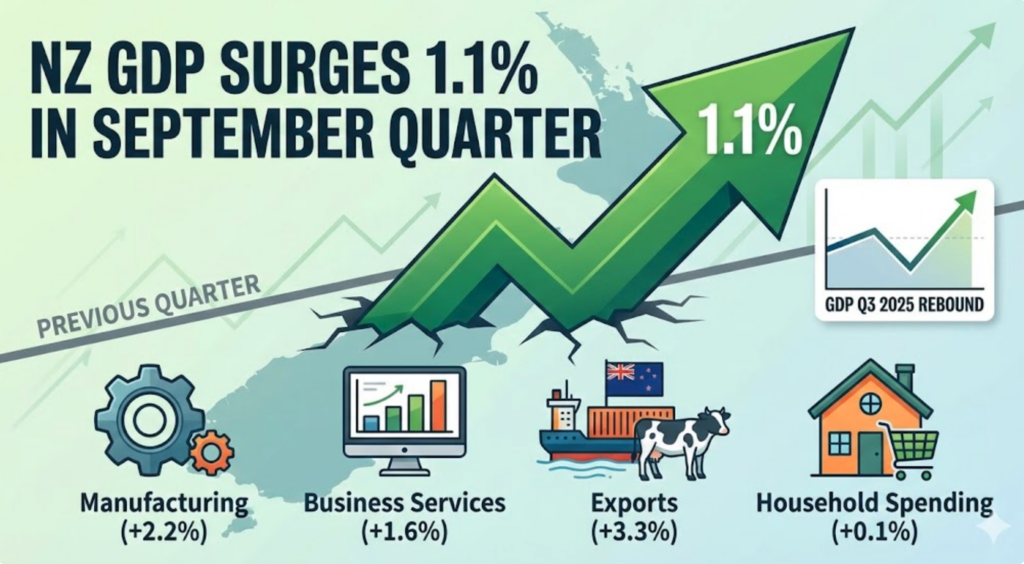
WELLINGTON, NZ – New Zealand’s economy staged a significant recovery in the September 2025 quarter, with Gross Domestic Product (GDP) rising by 1.1 percent, according to data released today by Stats NZ.2 The result provides a much-needed reprieve for the Government and businesses alike, effectively cancelling out the 1.0 percent contraction seen in the June quarter and signaling that the nation may finally be emerging from a protracted period of stagnation.3
The growth was surprisingly broad-based, with activity increasing in 14 out of 16 industries.4 However, while the quarterly figures are positive, economists warn that the recovery remains fragile, with annual growth still sitting in negative territory at -0.5 percent for the year ended September 2025.5
🏗️ Industry Breakdown: Manufacturing and Business Services Lead the Charge
The 1.1 percent jump was fueled primarily by a resurgence in the goods-producing and service sectors. After a dismal June quarter where manufacturing was a major drag on the economy, the sector bounced back with a 2.2 percent increase.6
Key Sector Performers:
- Business Services (up 1.6%): This was the largest upward contributor to the GDP rise, driven by professional, scientific, and technical services, specifically in computer system design and advertising.7
- Manufacturing (up 2.2%): A sharp reversal from the previous quarter’s 3.9 percent fall, led by food, beverage, and tobacco production.8
- Construction (up 1.7%): Showing signs of stabilization despite high interest rates, supported by an uptick in infrastructure projects.
- Agriculture, Forestry, and Fishing (up 1.0%): Benefiting from strong dairy production and improved export returns.9
Conversely, the Information Media and Telecommunications sector was the primary laggard, dropping 2.1 percent due to a slowdown in internet service providers and data processing services.10
🛍️ The Consumption Gap: Strong Exports vs. Cautious Households
A deeper look at the expenditure measure of GDP, which rose 1.3 percent, reveals a stark divide in the New Zealand economy.11 While the “big engines” of trade and investment are firing, the average Kiwi household remains under significant pressure.
Exports of goods and services surged by 3.3 percent, bolstered by a “bumper” dairy season and a steady recovery in travel and tourism services.12 Business investment also saw a healthy lift of 3.2 percent, particularly in transport equipment and machinery—a sign that firms are beginning to look toward future productivity gains.13
However, household consumption rose by a mere 0.1 percent.14 While Kiwis spent more on durables like electronics (up 9.8%) and motor vehicle parts, spending on essential services and non-durable goods declined.15
“Households are still in a ‘wait-and-see’ mode,” says Westpac senior economist Michael Gordon. “While the headline growth is impressive, the fact that private consumption is flat suggests that the cost-of-living crisis and high interest rates are still very much a reality for most families.”
📊 GDP at a Glance: September 2025 Quarter
| Indicator | Percentage Change (QoQ) | Annual Average Change |
| Headline GDP | +1.1% | -0.5% |
| GDP Per Capita | +0.9% | -2.1% |
| Manufacturing | +2.2% | -2.3% |
| Business Services | +1.6% | -0.2% |
| Exports | +3.3% | +1.3% |
| Household Spending | +0.1% | +1.0% |
🗣️ Political Fallout: “Priority Number One” vs. “The Christmas Grinch”
Prime Minister Christopher Luxon was quick to hail the results as proof that his government’s economic plan is bearing fruit. Taking to social media, Luxon stated, “Going for growth is without a doubt priority number one. This means more jobs, higher wages, and more opportunity for Kiwis.”
Finance Minister Nicola Willis echoed this optimism, noting that businesses are feeling more confident despite global trade uncertainties, particularly around US tariff policies.16 “We are growing. I feel for everyone who has been through a tough time, but the basics—getting inflation and interest rates down—are working,” Willis said.
The Opposition, however, remains skeptical. Labour Leader Chris Hipkins accused the Government of “sugar-coating” a lumpy economy. He pointed out that while the quarterly figure is high, GDP per person is still significantly smaller than it was two years ago, and unemployment has climbed to a nine-year high of 5.3 percent.
“You can’t call it a ‘Growth Budget’ when the annual reality is still a contraction,” Hipkins argued. “The Government is cutting support for vulnerable New Zealanders while celebrating a volatile data print that many Kiwis don’t feel in their back pockets.”
🔭 The Road to 2026: Noise or Signal?
Economists are divided on whether this 1.1 percent rise is a genuine turning point or merely “statistical noise.” BNZ Head of Research Stephen Toplis cautioned against over-optimism, noting that the economy has “swung wildly” over the last five quarters.17
“Does anyone feel this is a true reflection of what happened to them?” Toplis questioned, suggesting that seasonal adjustments and global volatility might be inflating the figures.18
For the Reserve Bank (RBNZ), the result is an “upside surprise.” With the output gap narrowing faster than expected, financial markets are already speculating that the RBNZ may be slower to cut interest rates in 2026 than previously hoped.19
As New Zealand enters the final weeks of 2025, the “Thrive in ’25” mantra has largely been replaced by a more cautious “Stay in the mix until ’26.” While the September quarter offers a glimmer of hope, the path to a sustained, high-growth economy remains steep