Nationwide “Mega Strike” Brings New Zealand to a Standstill
Auckland, October 23, 2025 –
New Zealand is witnessing one of the largest coordinated industrial actions in recent history, as more than 100,000 public-sector workers across education, health, and government services have walked off the job today. The unprecedented “mega strike” has brought schools, hospitals, and public offices to a near halt, sending a powerful message to the government about long-simmering frustrations over pay, staffing, and working conditions.
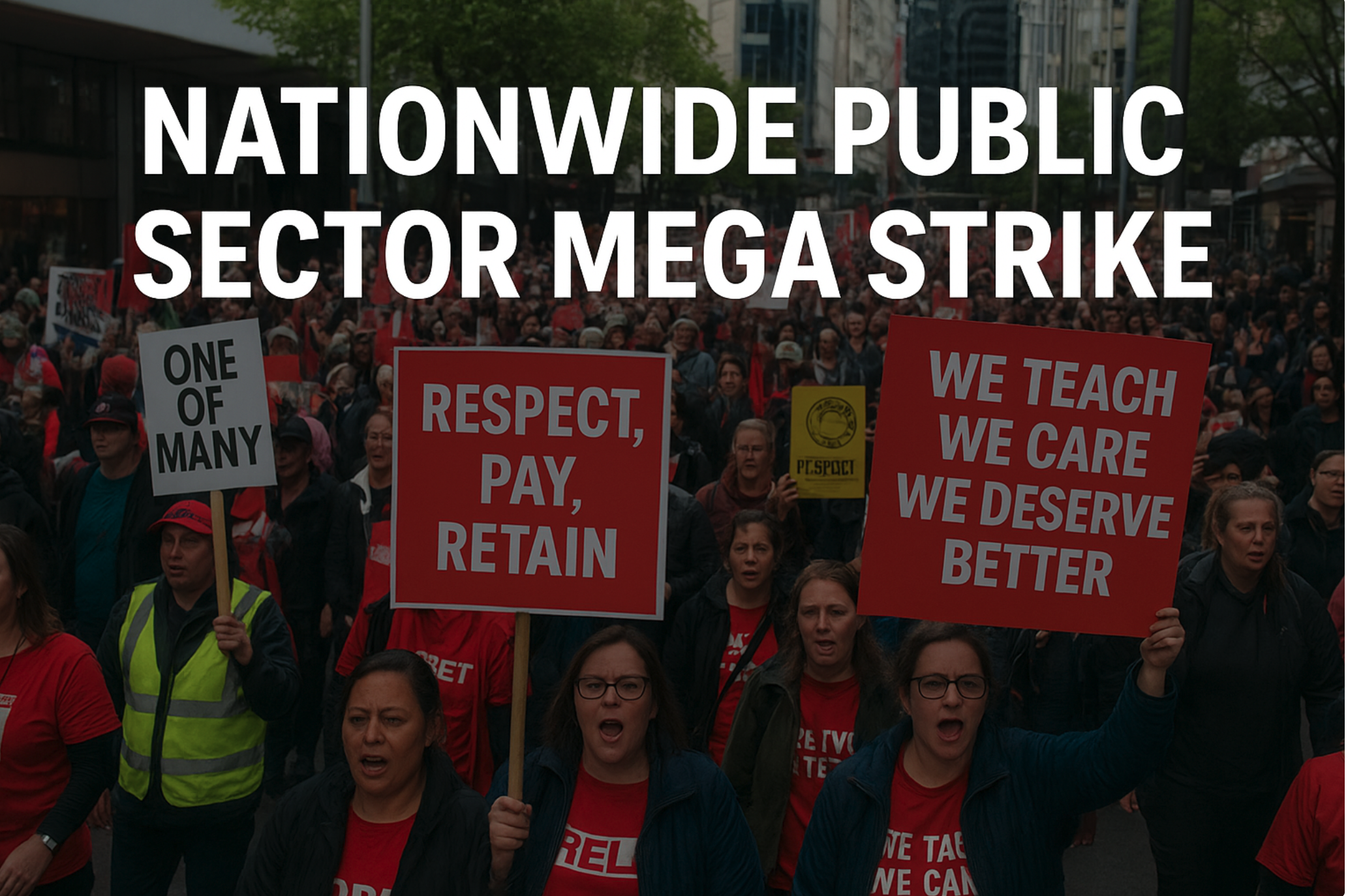
From early morning, thousands of teachers, nurses, midwives, laboratory technicians, and public servants took to the streets in every major city and regional centre — waving placards, chanting slogans, and demanding fairer treatment. The unified show of force underscores growing discontent among workers who say they’ve been “pushed to the limit” by rising living costs, burnout, and government underfunding.
A Historic Day of Protest
In Auckland, long lines of educators filled Queen Street, their banners reading “Respect, Pay, Retain” and “We Teach, We Care, We Deserve Better.” Similar scenes unfolded in Wellington, Christchurch, Dunedin, and Hamilton, as the sound of whistles and drums echoed outside government buildings and district health boards.
“This is not just a strike — it’s a cry for help,” said one Wellington teacher who has worked in public education for over 15 years. “We love our jobs, but love doesn’t pay the bills. Many of us are struggling to survive, and our classrooms are overcrowded.”
Healthcare workers mirrored the same concerns. Nurses and midwives, already facing chronic staff shortages, warned that current conditions are unsustainable. One nurse at Auckland City Hospital described her ward as “on the edge of collapse,” saying that short staffing has become routine rather than exceptional.
“We’re exhausted,” she said. “We’re being asked to do the work of two or three people. The system is breaking down, and patients are suffering because of it.”
Impact Across the Nation
The effects of the strike are being felt everywhere. Thousands of schools closed their doors, forcing parents to make last-minute childcare arrangements. Outpatient appointments, non-urgent surgeries, and diagnostic tests have been postponed nationwide. Public offices and local council services are operating at minimal capacity, and long queues formed outside some essential facilities still open under skeleton staffing.
Public transport in several regions was also affected, as support staff and service contractors joined the action in solidarity. Major roads in central Wellington and Auckland experienced temporary closures during rallies, as thousands gathered outside Parliament and civic squares.
Police maintained a visible but restrained presence, ensuring peaceful demonstrations. So far, the day has remained largely calm, marked by speeches, music, and a sense of unity among diverse professions that rarely strike together.
The Workers’ Demands
Union leaders say this coordinated action became inevitable after months of stalled negotiations with the government. The key demands include:
- A substantial cost-of-living pay increase to match inflation and housing costs.
- Immediate staffing increases in critical services such as hospitals and classrooms.
- Greater investment in public infrastructure to support overburdened teams.
- Fairer pay structures across departments to address long-standing inequities.
“Public-sector workers have kept this country running through crises — from the pandemic to economic recovery,” said a union spokesperson in Wellington. “They deserve more than just words of appreciation. They deserve dignity, security, and fair pay.”
Many unions argue that while the government speaks of fiscal restraint, it is ordinary workers who are paying the price through stagnant wages and staff shortages.
Government’s Response
The government has urged restraint and described the strike as “disappointing.” In a statement, the Minister for the Public Service said that negotiations remain open and that officials are “working towards sustainable outcomes that balance worker wellbeing with fiscal responsibility.”
However, the statement has done little to calm tensions. Union leaders say the government’s offers to date fall far short of what’s needed to retain experienced staff and attract new talent.
“Calling this strike disappointing is an understatement of how deeply people are hurting,” said a health-sector representative. “We’ve reached a breaking point. The government must listen, not lecture.”
Economic and Social Ripples
Analysts say today’s strike highlights a broader economic reality — inflation and living costs have outpaced wage growth for much of the public sector. The average pay for teachers and nurses has risen modestly in recent years, but rent, groceries, and fuel prices have climbed far faster.
For many professionals, especially those in cities like Auckland and Wellington, making ends meet has become increasingly difficult. Surveys show rising attrition across key services, with skilled workers migrating to Australia or the private sector for better pay and work-life balance.
Economists warn that prolonged industrial unrest could further strain the national economy. Productivity losses, delayed public projects, and decreased consumer confidence are potential consequences if a resolution isn’t reached soon.
Voices from the Crowd
At the Christchurch rally, speakers took turns sharing personal stories of stress, exhaustion, and underappreciation. “When you have to work double shifts just to afford rent, something is deeply wrong,” said a young nurse holding a sign that read “Caregivers Deserve Care.”
A secondary school teacher in Hamilton said morale is at an all-time low: “We’ve lost brilliant colleagues to burnout. If the government doesn’t act, we’ll lose more.”
In Dunedin, hundreds of students joined their teachers in solidarity marches, chanting “Fair pay for our future.” Parents across the country have expressed mixed reactions — frustration over school closures, but also empathy for the workers’ struggle.
A Defining Moment for Labour Relations
This strike is being seen as a defining moment for the country’s labour movement. Not since the public-sector disputes of the early 1990s has New Zealand seen such large-scale coordinated industrial action across multiple essential services.
Observers believe it could reshape the political landscape if the government fails to respond decisively. With local elections approaching and cost-of-living pressures dominating public debate, how leaders handle this crisis may determine their long-term credibility.
Looking Ahead
As the marches wind down and the country counts the cost of a day without its essential workers, one message rings loud and clear: the people who educate, heal, and serve New Zealand are demanding respect.
Union leaders have hinted at further action if talks do not progress. “This is only the beginning,” warned one representative outside Parliament. “We will not back down until our voices are heard.”
For now, the nation stands at a crossroads — between austerity and fairness, between rhetoric and reform. Whether today’s “mega strike” becomes a turning point or a missed opportunity will depend on what happens next in the negotiating rooms of Wellington.
By Lions Roar News Team
Lions Roar Aotearoa – Giving Voice to New Zealand’s Communities