National Plunge Below 30%: Curia Poll Confirms Coalition Majority Lost as Hipkins Edges Luxon
Auckland, New Zealand – Wednesday, October 8, 2025
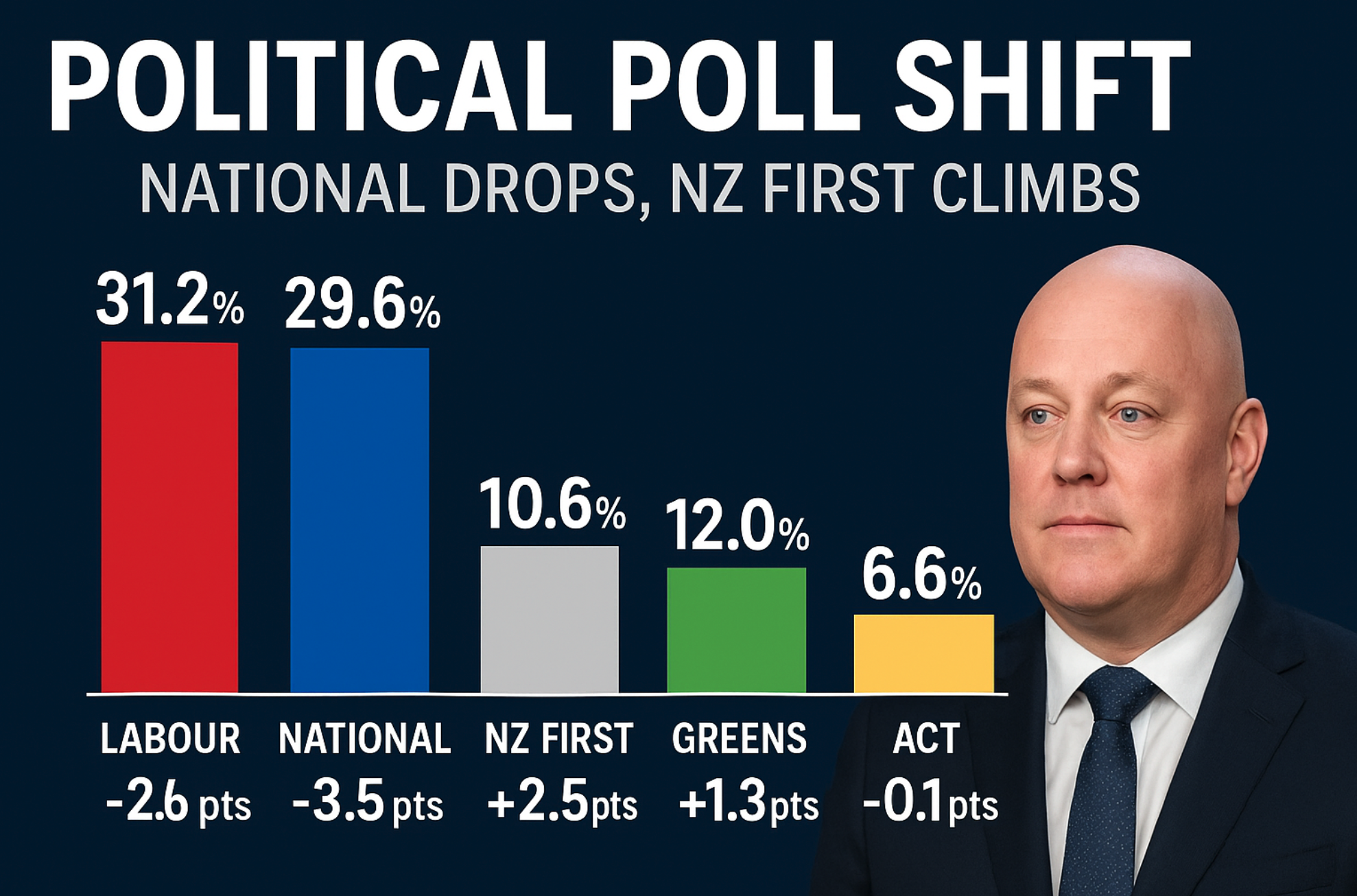
The governing National-led coalition has suffered a major setback, losing its parliamentary majority in the latest Taxpayers’ Union-Curia poll. The dramatic results, collected between October 1 and 5, show support for the National Party plunging below the 30% mark and confirming the opposition centre-left bloc could now theoretically form a government.
The poll signals a period of high instability for Prime Minister Christopher Luxon’s government as it enters the second year of its three-year term, with the public citing the persistent cost of living crisis and economic stagnation as primary drivers of discontent.
The Collapse of the Right-Wing Majority
The poll results indicate the combined support for the current government—National, ACT, and NZ First—now sits behind the opposition Labour, Green, and Te Pāti Māori bloc.
Party Vote Breakdown:
| Party | Polling % | Change | Seats (Projected) |
|---|---|---|---|
| Labour | 31.2% | Down 2.6% | 39 |
| National | 29.6% | Down 3.5% | 37 |
| Green | 12.0% | Up 1.3% | 15 |
| NZ First | 10.6% | Up 2.5% | 13 |
| ACT | 6.6% | Down 0.1% | 8 |
| Te Pāti Māori | 4.4% | Up 0.1% | 6* |
*Te Pāti Māori holds electorate seats, securing their presence in Parliament.
Based on these numbers, the centre-left bloc (Labour, Greens, Te Pāti Māori) would command 60 seats plus a potential overhang seat, enough to form a government, assuming they could secure the support of Te Pāti Māori. The National-led coalition (National, ACT, NZ First) would be relegated to 58 seats.
The sharp 3.5-point drop for National, placing them below 30% support, is the most significant finding. This indicates that the government’s core strategy—focused on reducing inflation, delivering tax relief, and simplifying regulation (like the fast-track Resource Management Act reform)—has not resonated with voters still struggling with the highest cost of living pressures in decades. Recent data showing GDP contraction has further amplified the sense that the economic promised land the government campaigned on remains elusive.
The Unexpected Resurgence of NZ First
In a remarkable turn, New Zealand First (NZ First), led by Deputy Prime Minister Winston Peters, has surged into double digits at 10.6%. This is the party’s highest mainstream polling result in years, effectively leapfrogging the coalition partner, the ACT Party, which sits at 6.6%.
The analysis suggests NZ First’s success stems from two key factors:
- Stability in Government: Unlike previous coalition terms where the party often struggled to maintain 5% support, NZ First has found unusual stability in the current environment.
- The Independent Streak: Winston Peters has demonstrated a capacity to critique and push back against National, even while sitting in Cabinet. This is viewed by his rural and regional base as him “standing up” for traditional New Zealand values and prioritizing regional development through initiatives like the Regional Infrastructure Fund (RIF). The party appears to be harvesting the votes of disaffected former National voters who feel alienated by the current government’s perceived corporate focus.
Hipkins Takes the Preferred PM Lead
Adding to Christopher Luxon’s woes, the poll confirms Labour leader Chris Hipkins has surpassed the Prime Minister as the country’s preferred leader:
- Chris Hipkins (Labour): 20.9% (Up 3.2%)
- Christopher Luxon (National): 19.8% (Down 1.9%)
- Winston Peters (NZ First): 9.9% (Down 1.0%)
While both major party leaders have relatively muted popularity—with both recording negative approval ratings in previous surveys—Hipkins’ narrow lead is hugely symbolic. It is highly unusual for an Opposition Leader to be the country’s preferred choice mid-term. This suggests a growing segment of the electorate is actively seeking an alternative to the current government, rather than merely being satisfied with the opposition. The findings align with earlier polls that showed voters increasingly blaming the current coalition for the struggling economy over the previous Labour government.
The Road Ahead: A Deadlocked Parliament?
With the next general election looming in 2026, the political landscape is now deadlocked. The coalition government faces a serious challenge:
- Internal Pressure: Luxon must find a way to reassure National’s base while navigating the increased internal pressure from Winston Peters, who now commands significantly greater leverage due to NZ First’s double-digit support.
- Economic Turnaround: The government’s immediate political future hinges almost entirely on whether its economic policies can successfully tame inflation and return the country to positive GDP growth before the election cycle formally begins. Failure to demonstrate tangible improvements in the cost of living could see National’s support erode further.
The Curia poll serves as a stark warning to the government: the electorate’s patience is wearing thin, and the political ground beneath the current coalition is shifting rapidly back towards the left. The question for the next year is whether Prime Minister Luxon can stabilize his party and the economy before the opportunity slips entirely into the hands of the opposition.