National Emergency: Sri Lanka Declares Special Government Holiday as Cyclone Ditwah’s Death Toll Rises
Colombo, Sri Lanka – November 28, 2025
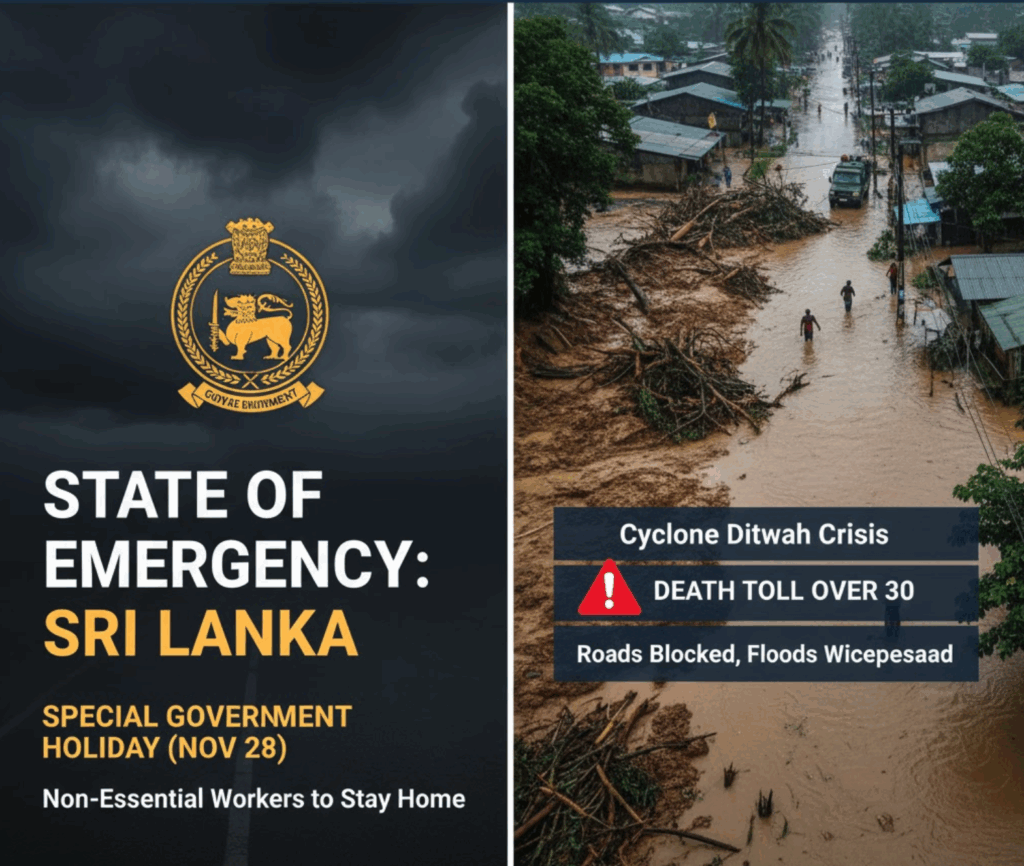
In a drastic move to prioritize public safety and facilitate emergency response, the Sri Lankan government has declared a special public holiday for all non-essential government sector employees on Friday, November 28, 2025. The decision comes as the country grapples with the escalating crisis caused by Cyclonic Storm ‘Ditwah’, which has left a trail of death, displacement, and infrastructural devastation across the island.
The directive mandates that only personnel engaged in essential services—including health, law enforcement, disaster management, and key infrastructure repair—are required to report to duty. The measure is intended to minimize civilian movement on heavily flooded and landslide-affected roads, thereby freeing up first responders and reducing the risk of further casualties.
The Cyclone’s Current Status and Impact
The special holiday announcement underscores the severity of the ongoing weather crisis. Cyclone Ditwah, which formed in the Bay of Bengal, has been skirting the eastern and southern coast of Sri Lanka for the past 48 hours.
As of the latest bulletin from the Department of Meteorology (DoM), the system, which initially made landfall near the southeastern coast, is centered approximately 60km south of Batticaloa. The storm is currently tracking north-northwestwards and is expected to continue moving across the waters adjoining the Sri Lankan coast before making its decisive push towards the Indian coast (Tamil Nadu/Puducherry) by November 30.
The DoM has issued a nationwide Red Alert, warning that the continued influence of Ditwah will bring extremely heavy rainfall exceeding 200 mm in parts of the Northern, North Central, Central, and North Western provinces, as well as the Trincomalee district, over the next 24 hours. Strong winds of $60 \text{–} 70 \text{ km/h}$ with higher gusts are also forecast across several regions.
Rising Death Toll and Widespread Destruction
The decision to shut down the non-essential government sector reflects the catastrophic human and physical toll exacted by the storm and associated weather events.
- Human Toll: The death toll has tragically climbed, with reports confirming at least 31 fatalities and 14 people still missing as of Thursday. The worst-hit areas are the central mountainous districts.
- Landslides: The tea-growing regions of Badulla and Nuwara Eliya have been severely affected by fatal landslides. Badulla alone recorded a significant number of the reported deaths, with saturated mountain slopes collapsing onto homes.
- Displacement: Over 4,000 families (totaling more than 5,800 individuals) across 17 districts have been affected, with over 1,100 families forced to evacuate to temporary shelters. In Kandy, a single landslide incident left several people missing, prompting a local state of emergency.
- Infrastructure: Major roads and railway lines in the mountainous regions have been closed due to extensive damage from fallen trees, rock, and mud. Authorities had already suspended passenger trains in some areas as safety concerns mounted.
- Education: As a precautionary measure, the government had already suspended nationwide final-year school examinations for two days, recognizing the impossibility of ensuring student safety and travel during the severe weather.
The Government’s Response and Focus
The immediate priorities for the government and the Disaster Management Centre (DMC) are search-and-rescue operations and relief coordination. By declaring a special holiday, the government aims to:
- Reduce Road Congestion: Clear major routes of unnecessary traffic, allowing emergency vehicles, military personnel, and relief trucks unimpeded access to affected areas.
- Ensure Civilian Safety: Prevent non-essential workers from attempting dangerous commutes through flooded roads, active landslide zones, and areas with downed power lines.
- Bolster Relief Efforts: Direct available resources, including local government personnel in essential roles, towards emergency relief and management duties.
The government has committed to providing immediate relief and support to the displaced families, with President Ranil Wickremesinghe ordering relief payments for the victims. The ongoing nature of the severe weather, however, means that authorities must remain focused on preventative evacuations, particularly for communities in low-lying areas and under red-alert landslide warnings.
The extraordinary measure of granting a special government holiday highlights the scale of the crisis and the government’s determination to mitigate further damage as Cyclone Ditwah, or its remnants, continue to threaten the stability of the island’s infrastructure and the safety of its inhabitants.