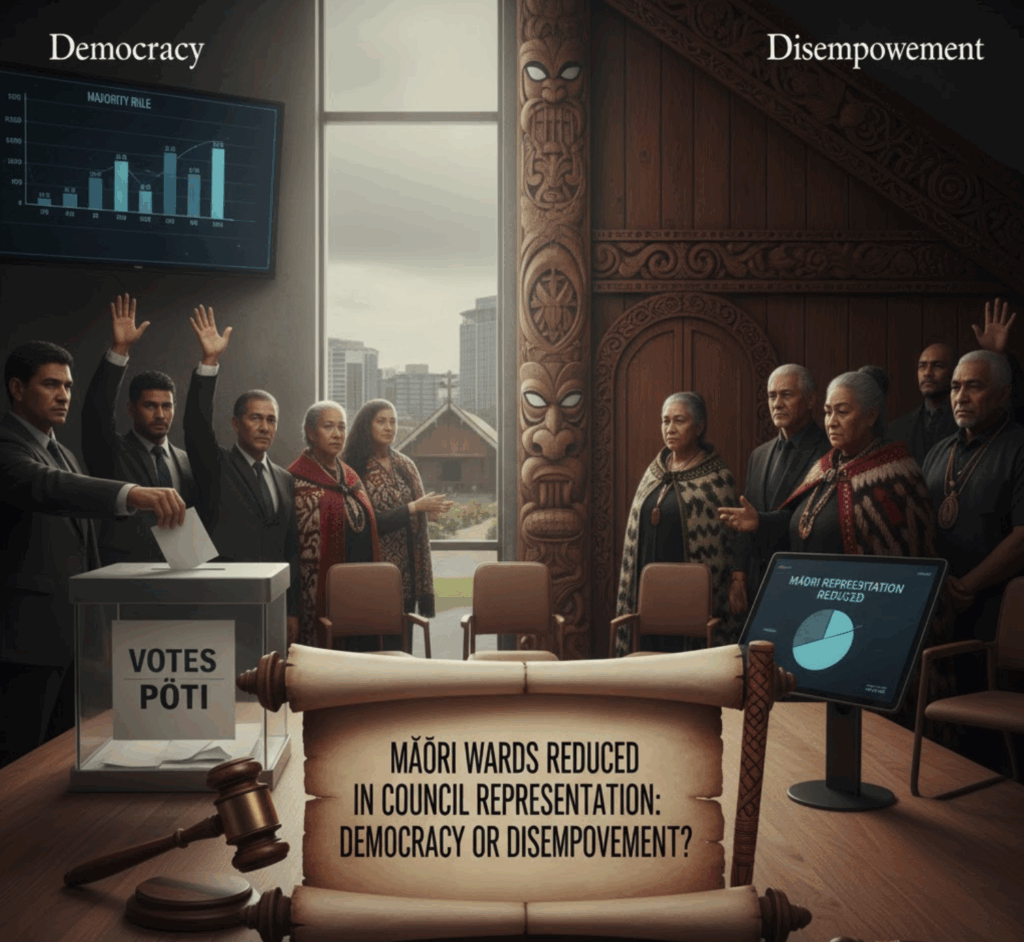
Māori Wards Reduced in Council Representation: Democracy or Disempowerment?
Wellington | October 16, 2025
By Lion’s Roar News Staff Writer
A major shift has taken place in New Zealand’s local governance landscape as more than half of the country’s councils have now voted to remove their Māori wards, following a new law requiring local referendums to determine their future.
According to recent reports, 42 councils across Aotearoa held referendums in recent months. Of those, only 17 councils decided to retain Māori wards, while 25 chose to abolish them — effectively reducing guaranteed Māori representation in local decision-making.
Background: What Are Māori Wards?
Māori wards were established to ensure that Māori communities — who make up about 17% of New Zealand’s population — had a direct voice in local government. These wards function similarly to general electoral wards but are specifically designated for voters on the Māori electoral roll.
The concept was strengthened under the previous government in 2021, which removed the need for binding referendums before establishing Māori wards. This move was widely hailed by Māori leaders as a step toward honouring Te Tiriti o Waitangi (The Treaty of Waitangi) and improving representation in local governance.
However, the new coalition government led by Prime Minister Christopher Luxon reversed that change earlier this year, reinstating the requirement for councils to hold a referendum to either confirm or abolish Māori wards.
Government’s Justification: “Restoring Democratic Choice”
The government argues that the policy is about democratic fairness and returning the power to local voters.
Local Government Minister Simeon Brown said the law ensures “New Zealanders, not politicians, decide how their councils are structured.”
Supporters of the reform maintain that it restores equal treatment between Māori and non-Māori voters, claiming that local representation should be determined by community consensus rather than central government directives.
They also argue that Māori voices are still present through advisory boards, partnerships, and consultation mechanisms, even without dedicated Māori wards.
Critics Say It Silences Māori Representation
Opponents, however, call this a setback for Māori rights and representation.
Māori leaders, iwi organisations, and human rights groups have condemned the move as an attempt to dilute Māori influence in decision-making, particularly on issues like resource management, housing, and environmental protection — areas where Māori perspectives have traditionally played a key role.
Te Pāti Māori co-leader Debbie Ngarewa-Packer described the decision as “a deliberate step backward,” saying it undermines decades of progress in recognising Māori as partners under Te Tiriti o Waitangi.
She added, “This isn’t about democracy — it’s about denying Māori a fair voice in their own communities. When 17% of the population consistently ends up with less than 5% representation, that’s not equality.”
Community Reactions Across the Country
The referendums drew mixed results depending on local demographics and community attitudes.
In some regions with strong Māori populations — such as Bay of Plenty, Northland, and Waikato — voters chose to retain Māori wards, citing the importance of cultural balance and shared governance.
In contrast, smaller or rural councils, especially in the South Island, voted overwhelmingly to abolish the wards. Many of those areas reported that voters viewed Māori wards as “divisive” or “unnecessary.”
What Happens Next?
Councils that voted to abolish Māori wards will see those changes come into effect for the 2028 local elections.
However, several iwi organisations and rights groups are reportedly preparing legal challenges, arguing that the government’s law breaches Te Tiriti o Waitangi obligations.
The Human Rights Commission has also expressed concern, warning that the reforms could widen the gap in civic participation between Māori and non-Māori citizens.
Political analysts say the issue could become a flashpoint in the 2026 general election, particularly as debates over co-governance, identity, and equality continue to dominate New Zealand’s political discourse.
A Question of Balance
At the heart of the issue lies a profound question:
Should democracy be measured by numerical equality, or by ensuring that all communities have a meaningful voice?
While the government insists it is defending the right of local voters to decide, many Māori see the decision as a betrayal of partnership and inclusion promised under Te Tiriti.
For now, Māori representation in local government stands at a crossroads — and the outcome may shape the nation’s democratic character for years to come.