Kiwi Agencies Had Warned: Bondi Beach Attack Underscores NZ’s Own Extremist Threat to Crowded Spaces
By Lions Roar News National Security Correspondent
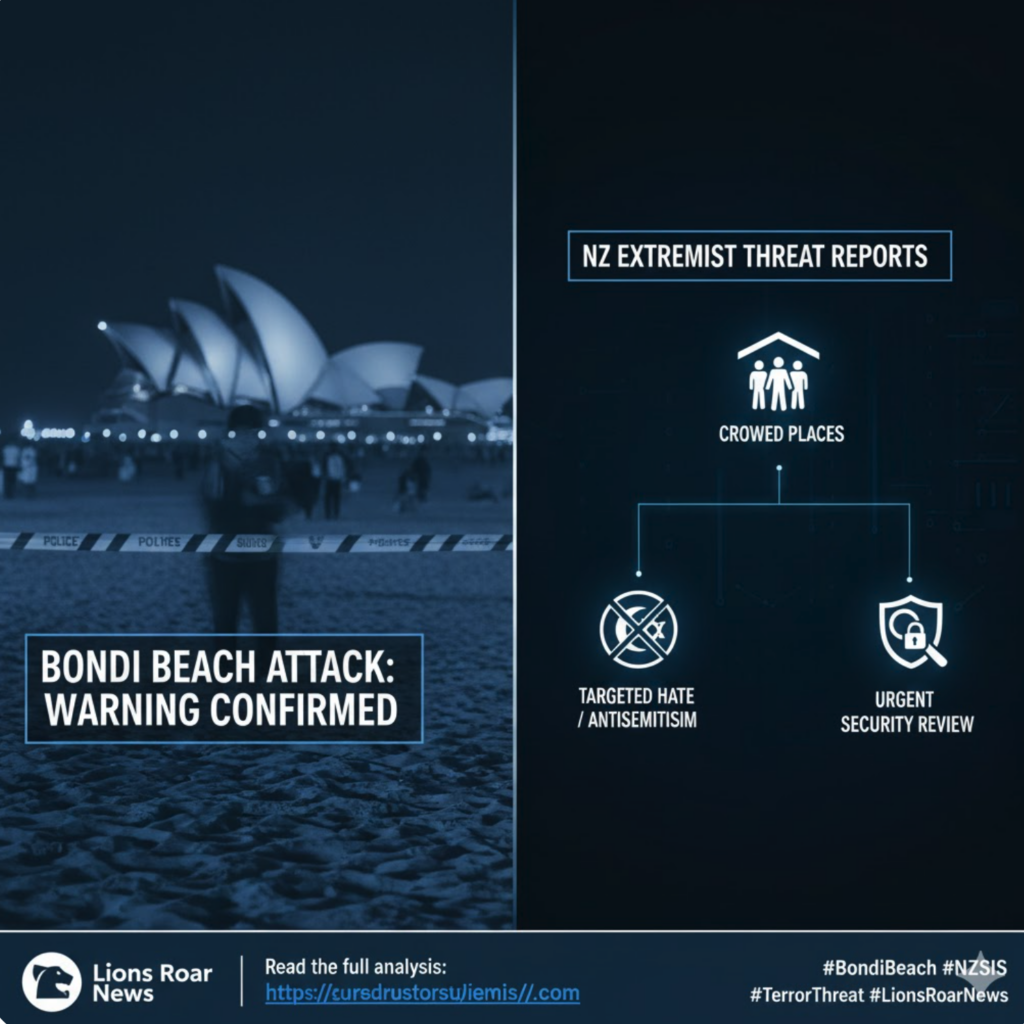
AUCKLAND/WELLINGTON – The devastating antisemitic terrorist attack at Sydney’s Bondi Beach, which claimed 16 lives on Sunday, has cast a grim new light on a series of warnings issued by New Zealand Police and intelligence agencies just months earlier. The chilling proximity of the two nations, coupled with the nature of the targeted attack on a Jewish community gathering, highlights the real and present danger acknowledged in New Zealand’s own security assessments.
The latest threat analysis from the New Zealand Security Intelligence Service (NZSIS), released in late August 2025, and a subsequent New Zealand Police public safety campaign launched in September, directly addressed the threat of violent extremist attacks in “crowded places.”
The Bondi massacre—an attack on a soft target at a public beach, deliberately targeting a religious community during a major celebration—mirrors the very scenario security officials in Wellington had been warning local councils, businesses, and communities about.
⚠️ September Warning: Extremism a “Realistic Possibility”
In September 2025, New Zealand Police ramped up public messaging, launching the “Escape. Hide. Tell.” campaign, designed to educate the public and venue operators on how to respond to an active armed attack. This campaign was the direct result of the NZSIS’s most recent Threat Environment Report, which reaffirmed that a violent extremist attack remains a “realistic possibility” in New Zealand.
Assistant Commissioner Mike Johnson, speaking at the time of the campaign’s launch, stressed that while the risk was generally low, authorities considered crowded places particularly vulnerable targets.
“The goal is that none of us will ever need to use this information,” Johnson stated in September, “But it’s about being prepared.”
The report detailed that the security environment in New Zealand is confronting its most complex landscape in decades, driven by three key factors:
- Strategic Competition: Global instability influencing local dynamics.
- Polarised Online Rhetoric: Grievances and divisive issues driving support for violent extremism.
- Youth Radicalisation: Young and vulnerable people are noted as being “particularly at risk of radicalisation, especially while online.”
Crucially, the NZSIS warned that the most likely attack scenario in New Zealand would involve a lone actor radicalised online, using basic weapons like a knife or a vehicle, and targeting public spaces. The Bondi attack, while involving two gunmen, used semi-automatic rifles and targeted a highly visible community event, demonstrating the evolution of the threat against which both New Zealand and Australia are now actively hardening their defenses.
🤝 A Shared Threat Environment
New Zealand’s intelligence services work closely with their Australian counterparts, including ASIO (Australian Security Intelligence Organisation) and the Australian Federal Police (AFP). The terror designation of the Bondi attack confirms the two countries share a common and accelerating challenge, especially concerning identity-motivated and faith-motivated violent extremism, which has been exacerbated by global conflicts.
The NZSIS has consistently noted that while New Zealand may seem geographically distant, “access to the violent extremist narratives that emerge from these situations is only a click away.” The online radicalisation of the Bondi attackers—one of whom, the son, was known to Australian security services—underscores the transnational nature of this digital threat, which pays no heed to borders.
Focus on Anti-Semitism and Extremist Ideologies
The fact that the Bondi attack explicitly targeted a Jewish community event on the first night of Hanukkah is of paramount concern to New Zealand’s Jewish and Muslim communities alike, who have been urged to be on high alert. The NZSIS’s assessment notes that there is an “even spread of violent extremist ideologies present among the individuals who come to our attention, including identity-motivated and faith-motivated violent extremism.”
New Zealand’s Crowded Places Strategy, first launched in response to the 2019 Christchurch Mosque shootings, places responsibility not just on government agencies, but on a “collective responsibility” model involving local councils, businesses, and venue operators. These groups received specific guidance in September to implement better protective security measures—to deter, detect, delay, and respond to an attack.
The Bondi tragedy is now the ultimate, brutal case study for these warnings. Venue operators and community leaders across New Zealand, from Auckland’s major shopping centres (Westfield’s operators Scentre Group, who supported the “Escape. Hide. Tell.” campaign) to Wellington’s stadiums and tourist sites, will be urgently reviewing their security postures in light of the scale and specific targeting of the Sydney attack.
🇳🇿 Security Implications for Aotearoa
New Zealand authorities will now be reviewing two main areas in the aftermath of Bondi:
- Threat Assessment Protocols: Like ASIO, the NZSIS was aware of the type of individual who might perpetrate such an attack. The review will focus on whether intelligence could have been better shared or whether the threat level of known individuals needs to be rapidly re-evaluated.
- Protective Security: Immediate steps will likely be taken to increase the visibility of police presence and private security around key public spaces and, critically, around Jewish community centres and places of worship across Auckland, Wellington, and Christchurch.
The September warning was designed to avoid a moment like this. Now that it has occurred so close to home, the message is chillingly clear: New Zealand’s security agencies were right to raise the alarm, and the threat of extremist violence in crowded public places is a grim reality the nation must actively confront.