India Shatters 10-Year Export Record: $38.13 Billion Surge Defies Trump’s 50% Tariffs
By Lions Roar News Global Economics Desk
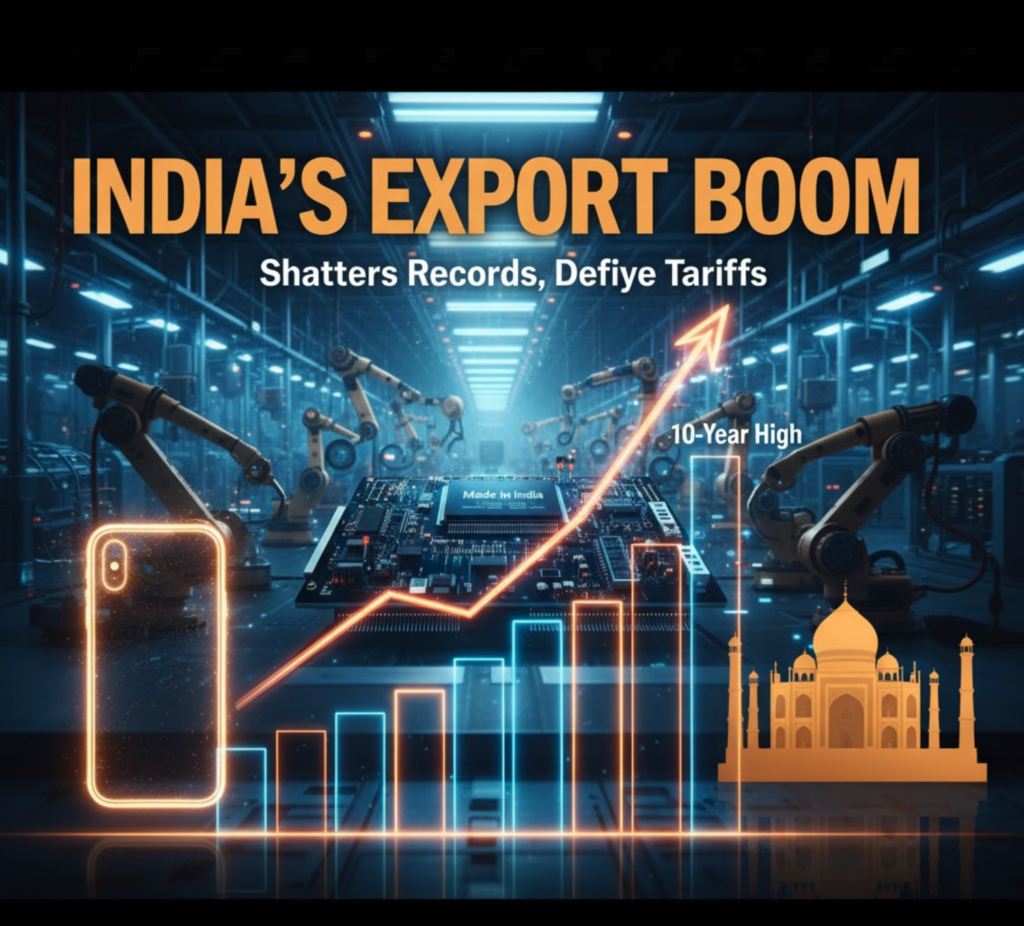
NEW DELHI – In a stunning display of economic resilience, India has recorded its highest monthly goods exports in over a decade, defying a hostile global trade environment and aggressive new tariff regimes. According to official data released by the Ministry of Commerce and Industry, India’s merchandise exports surged to $38.13 billion in November 2025—a 19.37% year-on-year increase—marking a historic milestone for the world’s fastest-growing major economy.
The achievement is particularly significant as it comes amidst the “Year of Tariffs.” Earlier in 2025, the Trump administration imposed a staggering 50% total duty on a wide range of Indian goods, combining a 25% “reciprocal” tariff with a 25% penalty linked to India’s energy ties with Russia. Despite these punitive measures, Indian exporters have not only maintained their momentum but have accelerated it by pivoting toward high-value electronics and diversifying their global footprint.
📱 The “Apple” Effect: iPhones and Electronics Lead the Charge
A major driver behind this record-breaking performance is India’s rapidly maturing electronics manufacturing ecosystem. Bloomberg and industry analysts point to the explosive growth of Apple iPhone exports as the crown jewel of India’s “Make in India” initiative.
Electronic goods exports jumped by 39% in November alone, reaching $4.81 billion. With the full-scale operation of new mega-factories—including Tata Electronics’ Hosur plant and Foxconn’s Bengaluru unit—India has transitioned from a mere assembly base to a global export hub.
“India is no longer just making products for India; it is making them for the world,” noted a Bloomberg economic analyst. “The integration of Indian manufacturing into the global supply chain for high-end electronics like the iPhone 17 series has provided a structural cushion against traditional trade volatility.”
The shift is visible in the data: while traditional sectors like textiles faced pressure from US tariffs, the “New India” sectors—engineering goods (up 24%) and electronics—carried the weight of the growth.
🌏 Market Diversification: The Strategic Pivot to China
Perhaps the most surprising element of the November data is the strategic diversification of India’s export destinations. While the US remains India’s top destination (with exports actually rising 21% to $6.92 billion despite the 50% tariffs), Indian businesses have successfully expanded into other major markets to mitigate geopolitical risks.
Exports to China skyrocketed by 32.83% during the April–November 2025 period, peaking at a monthly high in November. This surge indicates that China is increasingly sourcing high-end components and intermediates from Indian suppliers, marking a rare narrowing of the trade imbalance between the two Asian giants.
Other regions recording solid gains include:
- The UAE: Benefiting from the Comprehensive Economic Partnership Agreement (CEPA).
- The Netherlands & Spain: Emerging as key gateways into the European market.
- Tanzania & Saudi Arabia: Signifying India’s growing influence in the Global South and the Middle East.
📉 Trade Deficit Narrows to Lowest Since June 2022
The export boom has had a direct and positive impact on India’s national balance sheet. The merchandise trade deficit narrowed to $24.53 billion in November, a significant drop from the record $41.68 billion seen in October. When services—which consistently show a surplus—are included, the overall trade deficit reached its lowest point since June 2022.
This narrowing of the deficit is also attributed to a sharp decline in “unproductive” imports. Gold imports plummeted by nearly 60%, and crude oil and coal shipments also saw a reduction, suggesting that India is becoming more efficient in its energy and luxury consumption as domestic manufacturing scales up.
⚖️ Navigating the “Trump Tariff” Storm
The 50% tariff imposed by Washington was designed to pressure New Delhi on two fronts: its reciprocal trade duties on US products and its continued purchase of Russian crude oil. However, the November figures suggest that the “America First” policy may have underestimated the agility of Indian exporters.
Commerce Secretary Rajesh Agrawal stated that the November shipments more than offset the losses incurred during a sluggish October.
“Exporters have been incredibly swift in adapting to the evolving global situation,” Agrawal told reporters. “By shifting toward products less affected by specific tariff lines and improving operational efficiencies, they have managed to keep Indian goods competitive even in a high-duty environment.”
Furthermore, reports suggest that India and the US are nearing a “Phase 1” trade deal that could see these tariffs eased in 2026, providing further optimism for the New Year.
🔭 The Road to 2026: A Global Manufacturing Powerhouse?
As 2025 draws to a close, India is positioned as a resilient outlier in an otherwise fractured global trade landscape. With cumulative exports for the fiscal year already nearing $300 billion, the country is on track to hit its highest-ever annual export target.
The challenge ahead will be maintaining this momentum as global demand remains fragile. However, with the successful rollout of the Production Linked Incentive (PLI) schemes and a renewed focus on “Ease of Doing Business,” the “Lion” of the Indian economy is roaring louder than ever in the global marketplace.