Expert Panel Urges New Ministerial Portfolio to Combat Organised Crime, Calling It New Zealand’s “Number One Security Threat”
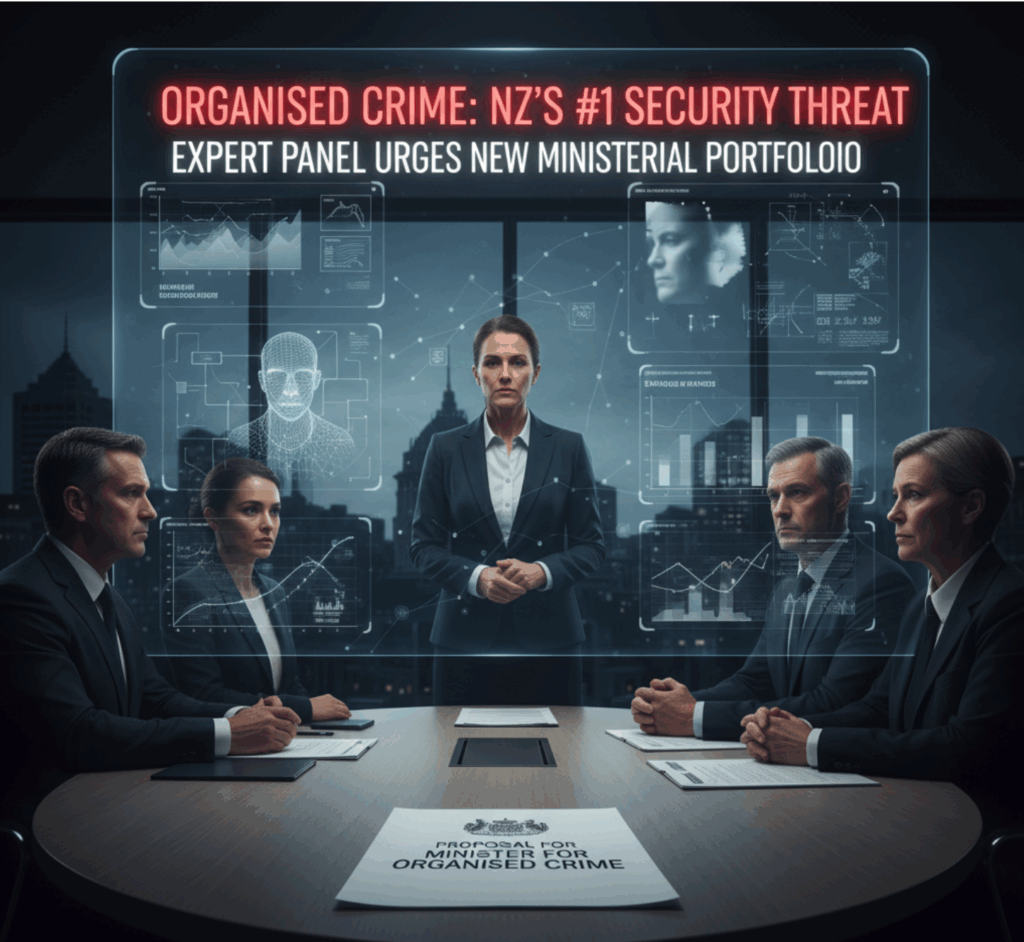
In a move that has already stirred political debate and public concern, an expert panel has called on the New Zealand government to create a dedicated ministerial portfolio to tackle organised crime, declaring it the country’s “number one national security threat.” The recommendation comes amid growing concerns about the rising power, reach, and sophistication of transnational criminal groups operating in New Zealand.
The proposal highlights the seriousness with which experts now view organised crime—not as a peripheral policing matter but as a central issue threatening economic security, community well-being, and national stability.
Rising Tide of Organised Crime in New Zealand
Over the past decade, organised criminal activity has grown at an alarming pace. Police data and independent research show that New Zealand has become a lucrative market for international cartels and a hub for gang operations that extend across the Pacific. Methamphetamine, cocaine, firearms trafficking, cybercrime, and money laundering remain at the top of the list of criminal enterprises.
Officials say that the volume of methamphetamine entering New Zealand has surged dramatically, with seizures at ports and airports revealing the scale of smuggling operations. “These are not backyard operations anymore. They are run with the same sophistication as major global businesses,” one law enforcement source commented.
In addition, cybercrime linked to organised groups has targeted New Zealand companies, local councils, and even health services, creating cascading disruptions. Experts argue that the line between traditional drug gangs and technologically savvy international syndicates is becoming increasingly blurred.
Why a New Ministerial Portfolio?
The expert panel’s recommendation is to establish a Minister for Organised Crime, tasked solely with overseeing a cross-agency response to criminal networks. Currently, responsibility is spread across the Police, Justice, Customs, Immigration, and Internal Affairs, often leading to fragmentation and duplication.
“Organised crime doesn’t operate in silos—our government shouldn’t either,” the panel’s report states. By centralising oversight, New Zealand could develop a more coordinated approach, aligning enforcement, intelligence, social services, and international partnerships.
Supporters argue that a standalone portfolio would elevate organised crime to a national priority, ensuring dedicated funding and parliamentary oversight. It would also send a clear signal internationally that New Zealand is no longer content to be seen as a “soft target” for global syndicates.
Links to Global Criminal Networks
One of the most troubling aspects of organised crime in New Zealand is its deepening connections with transnational syndicates. Authorities have documented links between local gangs and cartels in South America, Southeast Asia, and Eastern Europe.
Recent cases have exposed how foreign crime bosses use New Zealand as a distribution hub for drugs destined for Australia, where street prices are even higher. Experts warn that these networks are not only about drugs—they also involve arms trafficking, financial fraud, and human exploitation.
Interpol has repeatedly urged New Zealand to strengthen its resilience, warning that organised crime is now as much a threat as terrorism in terms of destabilising national institutions.
The Social Toll: Beyond Law and Order
The expert panel emphasised that organised crime is not only a law enforcement issue but also a social and economic crisis.
- Communities across the country face increased violence as gangs expand their turf wars.
- Families are torn apart by drug addiction, with methamphetamine-related harm estimated to cost New Zealand billions annually.
- Businesses face extortion, cyberattacks, and theft linked to organised groups.
- Housing and welfare services are pressured by criminal exploitation of vulnerable people.
The report warns that unless the state intervenes decisively, organised crime will continue to embed itself in everyday New Zealand life, creating a cycle of dependency and fear.
Political Reactions
Reactions from across the political spectrum have been mixed.
Government ministers acknowledged the seriousness of the issue but stopped short of committing to a new portfolio. The Prime Minister said the government is “carefully considering the recommendations,” but also noted that significant structural changes in government take time.
Opposition parties, meanwhile, have seized on the report to criticise what they call “years of underinvestment in law enforcement and intelligence.” One opposition leader said:
“When experts are telling us organised crime is the number one threat to New Zealand’s security, we cannot afford to sit on our hands. A ministerial portfolio is not just symbolic—it’s about accountability and focus.”
Community groups, particularly those working in addiction recovery and youth support, broadly welcomed the idea. They argue that unless there is stronger political leadership, gangs and cartels will continue to recruit vulnerable young people faster than social services can intervene.
Balancing Enforcement with Prevention
The panel also stressed that a new ministerial portfolio must not only expand enforcement but also strengthen prevention. Critics of purely punitive approaches argue that decades of aggressive policing have not dismantled the criminal economy, but in some cases have driven it further underground.
Instead, experts suggest a “dual strategy”:
- Hard enforcement – strengthening Customs surveillance, police intelligence, and financial tracking to disrupt major syndicates.
- Community prevention – investing in youth education, job pathways, addiction treatment, and family support to stop the next generation from being drawn into crime.
“Organised crime feeds off inequality, addiction, and alienation,” the report notes. “If we fail to address those root causes, no amount of police crackdowns will solve the problem.”
Lessons from Overseas
Other countries have taken bold steps in recent years. Australia has established dedicated organised crime taskforces that combine police, military, and intelligence services. The United Kingdom has a National Crime Agency with ministerial-level oversight.
Experts argue New Zealand should not wait until the problem spirals further out of control before implementing similar structures. “If we do not modernise our response, we risk being permanently behind the curve,” one panellist warned.
What Comes Next?
The government is expected to release a formal response to the expert panel’s recommendations in the coming months. In the meantime, the public debate is likely to intensify, particularly as headlines about gang violence and large-scale drug busts continue to dominate the news cycle.
Whether or not a Minister for Organised Crime is created, the message from experts is clear: organised crime is no longer just a police problem—it is a national security crisis demanding urgent, coordinated action.
Conclusion
The call for a dedicated ministerial portfolio reflects a turning point in how New Zealand views organised crime. No longer confined to backstreets or gang patches, it has become a complex, transnational, and deeply embedded challenge affecting every layer of society.
For New Zealanders, the stakes are high. Will the government take bold structural action, or will incremental reforms continue to leave gaps for criminal networks to exploit? The answer may determine not just public safety in the coming years, but the integrity of New Zealand’s democracy, economy, and social fabric.