Darfur’s Silent Genocide: Thousands Flee as RSF Siege Tightens Around El-Fasher, War Crimes Allegations Mount
By Lions Roar News Humanitarian Bureau
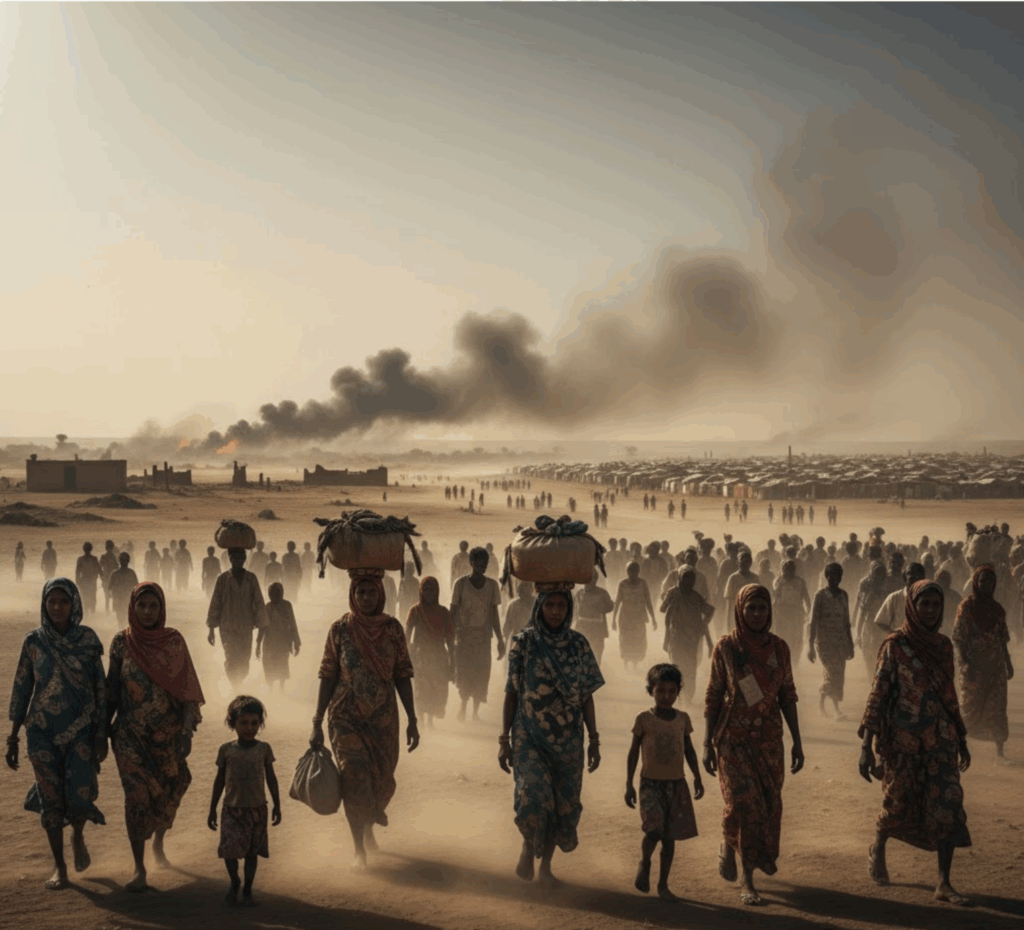
GENEVA, SWITZERLAND — The Darfur region of Sudan is once again teetering on the precipice of a full-blown humanitarian catastrophe, as the paramilitary Rapid Support Forces (RSF) tighten their grip around el-Fasher, the last major stronghold of the Sudanese Armed Forces (SAF) and a vital humanitarian hub in North Darfur. Reports from aid agencies and displaced persons paint a grim picture of escalating violence, targeted ethnic cleansing, and a deepening crisis that is driving tens of thousands of terrified civilians into overcrowded, under-resourced displacement camps.
Medics and human rights observers on the ground, speaking anonymously due to extreme security risks, have accused the RSF of committing systematic war crimes, including indiscriminate shelling of civilian areas, extrajudicial killings, and widespread looting. These allegations mirror the atrocities committed during the original Darfur genocide two decades ago, stirring profound fears that history is tragically repeating itself.
“The situation in and around el-Fasher is beyond critical,” stated Dr. Fatima Ali, a Sudanese physician working with a local NGO, via satellite phone to Lions Roar News. “We are seeing mass movements of people, mainly from the Zaghawa and Fur ethnic groups, fleeing south towards Zamzam camp or across the border into Chad. The RSF controls all routes in and out of the city, restricting food, water, and medical supplies. People are dying from preventable causes, from starvation, from injuries, and from direct attacks.”
The fall of el-Fasher would mark a significant strategic victory for the RSF, giving them control over all five states in Darfur and cementing their dominance in the region. However, the cost in human lives and suffering is immeasurable. Satellite imagery analyzed by international monitoring groups shows entire villages around el-Fasher have been razed, and large-scale destruction is evident within the city itself.
The United Nations Office for the Coordination of Humanitarian Affairs (OCHA) has warned that over 1.2 million people in el-Fasher are trapped, with limited access to aid. Zamzam camp, already one of the largest and most desperate internally displaced person (IDP) camps in the world, is now struggling to cope with a fresh influx of thousands of new arrivals, compounding an already dire situation of malnutrition, disease, and lack of sanitation.
International efforts to mediate a ceasefire and provide humanitarian access have largely failed. The African Union, the Intergovernmental Authority on Development (IGAD), and the UN have all issued strong condemnations of the violence and called for an end to hostilities, but their diplomatic efforts have yielded little tangible change on the ground. Both the SAF and RSF have been accused of obstructing aid and violating human rights.
The conflict, which erupted in April 2023 between the SAF led by General Abdel Fattah al-Burhan and the RSF led by General Mohamed Hamdan Dagalo (Hemedti), has already claimed tens of thousands of lives and displaced over 10 million people across Sudan. However, the ethnic dimension of the violence in Darfur—with reports of RSF and allied Arab militias targeting non-Arab communities—is particularly alarming, evoking the specter of a return to genocidal violence.
“The world cannot afford to look away from Darfur again,” warned Michelle Bachelet, the UN High Commissioner for Human Rights, in a recent statement. “The patterns of violence, the deliberate targeting of specific ethnic groups, the mass displacements—these are chilling echoes of the past. We need immediate, unimpeded humanitarian access and an international mechanism to ensure accountability for these grave violations.”
As the siege of el-Fasher intensifies, the international community faces a critical moral test: to act decisively to prevent a further deepening of the crisis in Darfur or risk presiding over another chapter of mass atrocities in Sudan.