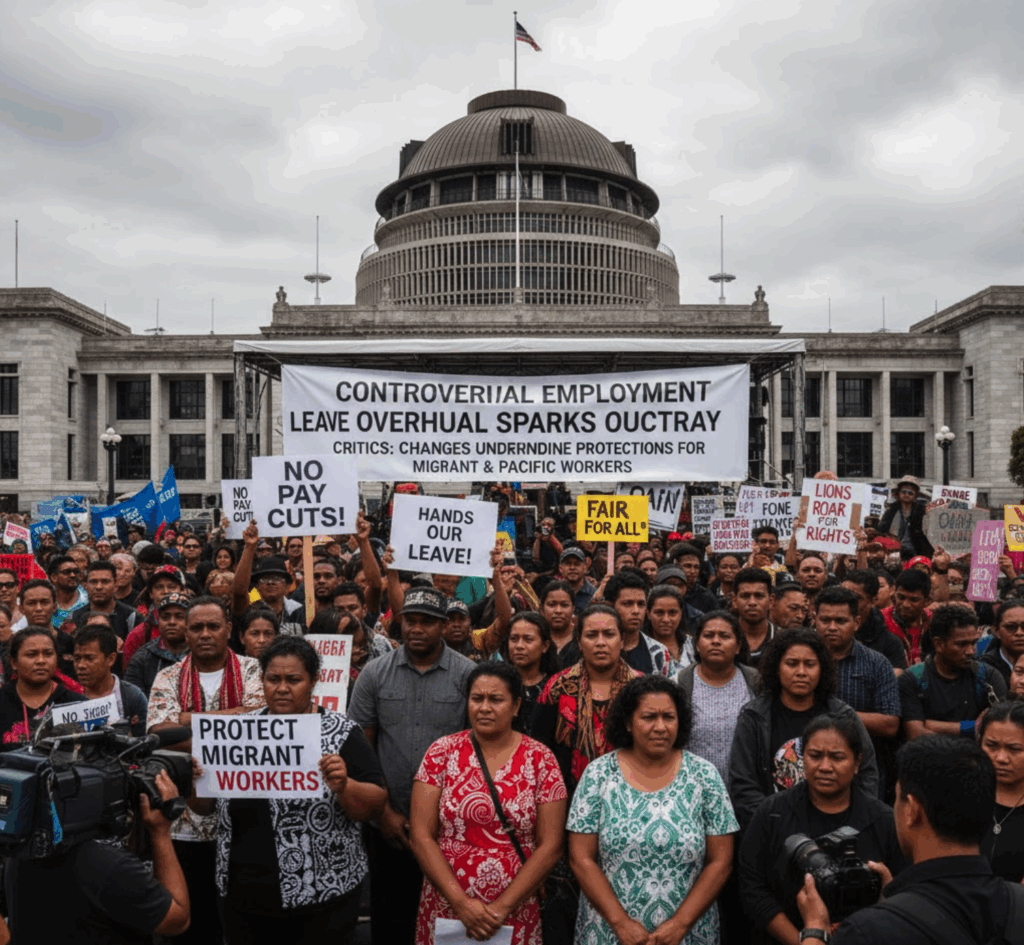
Controversial Employment Leave Overhaul Sparks Outcry: Critics Warn Changes Will Undermine Protections for Migrant and Pacific Workers
By Lions Roar Employment & Rights Desk
WELLINGTON — A proposed overhaul of New Zealand’s core employment leave legislation has ignited a fierce political debate, with unions and migrant rights advocates warning the changes could unfairly strip away critical protections and compensation for some of the country’s most vulnerable workers.
The government maintains the reforms are necessary to “modernize and balance the system,” but critics argue the proposed amendments threaten to entrench disparities, particularly for Pacific and migrant communities who often navigate complex employment contracts and precarious work arrangements.
The Core of the Controversy
The specifics of the proposed amendments, which have been introduced under the banner of regulatory efficiency, have drawn fire from across the rights sector. While the government frames the changes as simplifying the entitlements framework, groups like the Council of Trade Unions (CTU) and various migrant advocacy organizations contend that simplicity comes at the expense of equitable treatment.
A central concern revolves around the calculation of entitlements, particularly annual leave and sick leave compensation. Advocates are warning that changes to the definition of “relevant daily pay” or average weekly earnings could result in reduced compensation for workers whose hours or pay rates fluctuate—a common reality for many workers in seasonal, contract, or shift-based employment, sectors heavily reliant on migrant labour.
“We were promised a ‘balanced system,’ but this looks dangerously weighted against the worker,” stated a spokesperson for the Migrant Rights Advocacy Network. “Any reduction in the legal floor of protection will disproportionately hit those workers who are already less likely to challenge an unfair pay slip, including many Pacific and temporary migrant workers.”
Unions Raise Alarm Over Reduced Protections
The trade union movement has mobilized rapidly, arguing that the changes are not about modernization but about reducing compliance burdens for employers at the expense of workers’ rights.
“This is a dangerous erosion of hard-won employment standards,” stated a CTU representative. “When a worker loses an entitlement, or their leave is calculated in a way that financially disadvantages them, that’s not balance—that’s a pay cut disguised as bureaucracy. The cumulative effect of these changes is a significant reduction in the social safety net, making it harder for workers to take necessary sick leave or annual breaks without financial stress.”
There is particular concern about the potential impact on workers with multiple jobs or those who frequently move between short-term contracts. Unions fear that the complexity of the new calculation methods will create loopholes that employers, wittingly or unwittingly, exploit, leading to systemic underpayment of leave entitlements.
Government Defends ‘Modernisation’ Goal
The government, in response to the growing backlash, has firmly defended the legislation. A government spokesperson stated that the goal of the reform is to create a more straightforward, easier-to-administer system that benefits both employers and employees by reducing ambiguity.
“These changes are designed to reflect the realities of the modern workforce, which is far more flexible and varied than when the current laws were drafted,” the spokesperson said. “The government is committed to maintaining fair minimum standards while ensuring that employment law does not place an unnecessary burden on businesses, especially small and medium enterprises.”
They emphasized that the core entitlement to annual leave and sick leave is not being removed, merely the mechanism of calculation is being adjusted to be more consistent. However, this assurance has done little to soothe the fears of rights groups, who believe the ‘consistency’ will be applied across the board, overlooking the unique vulnerabilities faced by marginalized groups.
The Human Rights Perspective
The controversy has drawn the attention of international organizations, with the Business & Human Rights Resource Centre noting that any reform must strictly adhere to international labour standards and non-discrimination principles.
Advocates point out that many migrant workers, particularly those on temporary visas, often feel unable to raise disputes for fear of jeopardizing their visa status. Reducing the clarity or value of their statutory entitlements only heightens their vulnerability to exploitation.
“For a migrant worker, the risk of challenging an employer over a few days’ missed pay is simply too high,” noted a legal expert specializing in employment law. “If the law itself is seen to weaken their position, that worker is effectively stripped of the confidence to assert their rights. This isn’t just an economic issue; it’s a fundamental human rights issue concerning equality and dignity in the workplace.”
The proposed employment leave law changes are now set to proceed through the parliamentary select committee process, where the intensity of the debate is expected to significantly increase. Unions and rights advocates are preparing to submit strong testimony, demanding that the government amend the legislation to ensure that “modernisation” does not become synonymous with the marginalisation of New Zealand’s diverse workforce.