The Great Disconnect: Why NZ Mortgage Rates Are Rising Even as the OCR Falls—With Westpac Leading the Hike
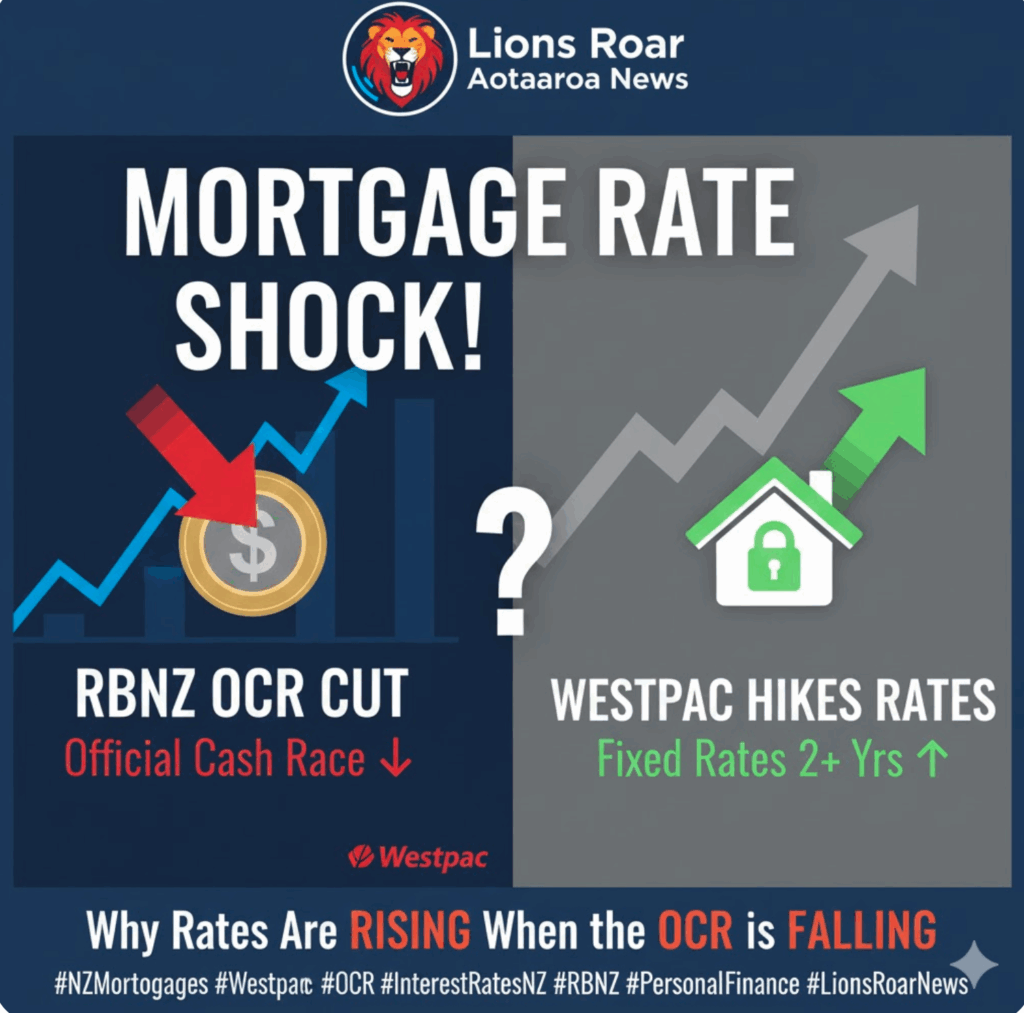
AUCKLAND, NZ — For weeks, homeowners and market commentators have been grappling with a phenomenon that seems to defy basic economic logic: while the Reserve Bank of New Zealand (RBNZ) has been cutting the Official Cash Rate (OCR) to stimulate the economy, the cost of fixed-term mortgages offered by commercial banks has simultaneously begun to climb.
This counter-intuitive trend has left many borrowers confused and frustrated, undermining the RBNZ’s efforts to ease financial conditions. The disconnect is not a sign of simple profit-taking by banks, but rather a complex interplay of forward-looking market expectations, global wholesale funding costs, and the RBNZ’s own forward guidance—specifically, the signal that the rate-cutting cycle may be reaching its limit.
The standard expectation is that a cut to the OCR, the benchmark for the overnight interbank lending rate, should translate into cheaper borrowing costs across the board. However, this article, informed by the latest market movements and expert analysis, dives deep into the multiple factors that are overriding the RBNZ’s official signal, pushing fixed mortgage rates higher. The action taken by a major lender, Westpac New Zealand, in hiking its longer-term rates, demonstrates the severity of this market shift.
The Central Role of Wholesale Swap Rates and Bank Action
The single most critical factor driving the increase in fixed mortgage rates is the movement in wholesale interest rate swap rates. Unlike floating mortgage rates, which track the OCR very closely, fixed-term rates (for one, two, or three years) are primarily priced off these wholesale rates.
What are Swap Rates?
Swap rates represent the cost at which banks and other large financial institutions can borrow or hedge money for set periods in the interbank market. They are essentially a forward-looking measure of where the market expects the OCR and, more broadly, interest rates to be over that fixed period.
When the RBNZ recently announced an OCR cut to 2.25%, it was accompanied by a clear, non-committal stance, suggesting that the hurdle for any further cuts was now “high.” This seemingly subtle shift in language had an immediate and dramatic impact on the wholesale market.
- Market Reversal: Before the RBNZ meeting, the market had priced in a significant probability of one or more further OCR cuts.
- The RBNZ Signal: When the RBNZ communicated that the rate-cutting cycle was likely near its end, and that the next move might even be a hike in the medium term, the market instantly reversed its expectations.
- Swap Rate Surge: This reversal led to a sharp increase in swap rates, particularly for the two- and three-year terms. Some reports indicated that these wholesale rates jumped by 40 basis points (0.40%) or more in the days following the OCR announcement.
This market reversal was made tangible by one of New Zealand’s major lenders. Westpac New Zealand was the first of the big five banks to publicly reflect this shift. The bank announced an increase of 30 basis points (0.30%) to its fixed mortgage rates for terms of two years and longer, effective shortly after the RBNZ’s OCR announcement. Westpac management explicitly attributed the decision to the sharp rise in their wholesale borrowing costs.
- Fixed Rate Pressure: This surge directly increases the cost of funds for banks that are locking in money to offer fixed mortgages, thereby forcing them to increase their retail rates to maintain an acceptable lending margin. The action taken by Westpac underscores the market’s conviction that the risk for longer-term rates is now to the upside.
The End of the Easing Cycle: A Predictive Market
The current situation highlights the predictive, rather than reactive, nature of the financial market. Fixed rates often move in anticipation of the OCR, not just in response to it.
Pricing in the Future
The RBNZ has, in effect, signaled that New Zealand’s interest rate cycle has likely hit its trough or “terminal rate.” When markets believe the lowest point of the cycle has been reached, the incentive to wait for cheaper rates disappears, and the focus shifts entirely to when rates will begin to rise again.
- Longer-Term Rate Pressure: As financial institutions start pricing in the eventual rate-hiking cycle (which many now predict could start as early as late 2026 or 2027), the cost of borrowing for longer terms (two years and beyond) is pushed up immediately. Westpac’s move demonstrates the necessity of this market adjustment.
- The Floating Rate Exception: This explains why short-term rates, such as the six-month fix and the floating rate, often react differently. Westpac, for instance, simultaneously cut its six-month special rate, showing that the OCR cut did flow through to the very short end of the market, where pricing is less influenced by long-term future expectations. However, this is proving to be a short-term anomaly, as even the floating rate strategy is now being questioned by economists who believe the bottom has been reached.
International and Domestic Funding Pressures
While the OCR is the most visible lever for monetary policy, it is only one component of a bank’s total cost of funding. New Zealand banks rely on a mix of domestic and international sources for the capital they lend, and both sources are currently under pressure.
1. The Cost of Domestic Deposits
Following the Global Financial Crisis (GFC) and subsequent regulatory tightening, New Zealand banks have been mandated to rely more on stable, domestic funding, primarily customer deposits (savings and term deposits). This is a more resilient, but often more expensive, source of money than short-term wholesale markets.
- Term Deposit Competition: To retain term deposit funds, banks have been reluctant to cut deposit rates by the full extent of the OCR reduction. Savers have also begun to withdraw funds from term deposits at an increased clip as rates fall, forcing banks to keep these rates relatively high to maintain their core funding base. Westpac also raised its term deposit rates for one year and longer in a concurrent move to its mortgage hike, explicitly to “support savers.”
- Rates Margin Compression: Since banks are paying a higher rate to savers than they might expect given the OCR cuts, their net interest margin (the profit difference between what they lend at and what they borrow at) is being compressed, limiting their ability to pass on the full OCR cut to mortgage holders.
2. International Wholesale Markets
A significant portion of New Zealand bank funding still comes from international wholesale markets. These markets are influenced by global factors, particularly the interest rate outlook in major economies like the United States and Australia.
- Global Sentiment: If global economic outlooks are strong, or if central banks in other major nations are holding or raising their rates, this creates upward pressure on the cost of international borrowing for NZ banks, irrespective of the RBNZ’s domestic policy.
- The Exchange Rate Hedge: Banks often borrow offshore and then convert these funds to New Zealand dollars, a process that requires hedging the currency risk. The cost of this hedging can fluctuate based on the strength of the New Zealand dollar, adding another layer of complexity and cost to the fixed-rate equation.
Competition, Cashbacks, and the Homeowner’s Dilemma
Another subtle factor is the competitive dynamics within the New Zealand banking sector, which is dominated by a few major players.
Avoiding a “Mortgage War”
Commentators have observed that following periods of intense competition (dubbed the “great mortgage war”), banks appear reluctant to engage in aggressive price competition that drastically cuts into profit margins.
- The Cost of Customer Acquisition: Banks are instead competing fiercely on non-price factors, such as large cashback offers for new customers. These cashbacks represent a significant upfront cost that banks must amortise (recover) over the life of the loan. This recovery cost is often built into the carded interest rate, putting a floor under how low the rates can drop, even with falling funding costs.
- Margin Maintenance: Despite public perceptions, the overall net interest margins of the main banks have been generally stable, indicating they are carefully managing their lending rates to ensure profitability without triggering an expensive price war that proved unprofitable in the past.
Implications for Homeowners
For the average New Zealand homeowner, this complicated environment presents a difficult decision, especially as a large volume of existing mortgages are due to be refixed in the coming months.
The rising long-term fixed rates, led by Westpac, coupled with the RBNZ’s less ‘dovish’ outlook, suggest that mortgage rates are at or very near their cyclical low. This has led many economic advisors to shift their guidance:
- Floating Rate Risk: The strategy of fixing on a high floating rate now in the hope of fixing lower later is now seen as increasingly risky, as the potential for future cuts has diminished.
- Fixing for Certainty: Many borrowers are now being advised to seriously consider longer fixed terms (two or three years) to lock in certainty, even if the rate is slightly higher than the lowest one-year option, to avoid the risk of much higher rates when the eventual hiking cycle begins.
In conclusion, the paradoxical rise in fixed mortgage rates despite a falling OCR is a function of the sophisticated financial machinery that sits behind the headline central bank rate. It is the market’s immediate and forward-looking interpretation of the RBNZ’s guidance—made clear by the actions of banks like Westpac—combined with the real-world costs of wholesale funding and deposit competition—that is now calling the shots, proving once again that the OCR is an influential driver, but not the sole determinant, of the cost of a home loan in New Zealand.