Crisis Alert: Matara Battles Severe Chikungunya Outbreak as Sri Lanka Faces Dual Mosquito-Borne Threat
By Lions Roar News Desk November 19, 2025
The Southern Province of Sri Lanka is grappling with a rapidly escalating public health crisis, as the Matara District confirms a severe and alarming outbreak of Chikungunya virus (CHIKV). This resurgence is unfolding during a high-risk period for Dengue fever, creating a dangerous scenario where two potent, mosquito-borne diseases are co-circulating, threatening the health and mobility of thousands of citizens.
The gravity of the situation was underscored by the Public Health Inspectors’ Association of Sri Lanka (PHIASL). Mr. Nijith Sumanasena, President of the PHIASL, confirmed the intense spread, warning that while the country remains under a high-risk Dengue alert, Chikungunya poses a health condition that is proving to be “more debilitating” to the general public.
“We are currently experiencing a heavy rainfall period across Sri Lanka, coupled with an already high-risk period for Dengue. Within this context, we are now seeing a disease that is causing more hardship to people being reported from the Matara area,” Mr. Sumanasena stated. “The Chikungunya situation in Matara is propagating in an extremely serious manner. While we were successful in controlling this disease in areas like Colombo and Narahenpita in the recent past, the condition has been spreading in Matara for several months now.”
The PHIASL President emphasized the crucial link between the two viruses: the main carrier for Chikungunya is a mosquito species that is virtually identical to the one responsible for Dengue. This shared vector amplifies the risk and complexity of controlling the current epidemic.
Chikungunya: The ‘Bent-Over’ Disease Re-Emerges
Chikungunya, a name derived from the Kimakonde language meaning “that which bends up” or “contorted,” is notoriously named for the debilitating symptom that sets it apart from Dengue: severe and persistent joint pain (arthralgia).
While Dengue fever is often associated with high fever and the potential for life-threatening hemorrhagic complications, Chikungunya patients frequently experience intense, crippling joint pain that can last for weeks, months, or even years, progressing to chronic arthritis and significantly impacting quality of life and earning capacity. The World Health Organization (WHO) and the US Centers for Disease Control and Prevention (CDC) have noted the severity of the 2025 outbreaks, issuing warnings as the disease has established itself once again in the island nation after a period of quiescence spanning over 16 years.
The current outbreak is considered a re-emergence, with genomic investigations revealing that the strain circulating in Sri Lanka belongs to the highly transmissible Indian Ocean Lineage (IOL). Researchers have identified key viral mutations that enhance the virus’s fitness, making it exceptionally effective at replicating and spreading via its mosquito hosts.
The Dual Threat: A Perfect Storm for Aedes
The most dangerous aspect of the Matara crisis is the co-circulation of both Chikungunya (CHIKV) and Dengue (DENV). Both viruses are transmitted by the same primary vectors: the Aedes aegypti and Aedes albopictus mosquitoes.
Shutterstock
These vectors are known for their diurnal (daytime) biting habits and their preference for breeding in small collections of stagnant, clear water found near human habitation—such as flower pots, discarded containers, and clogged gutters.
The co-existence of these two viruses creates a dual threat for several reasons:
- Diagnostic Difficulty: Clinically, both diseases present with similar initial symptoms like high fever, headache, and muscle pain. Co-infection is possible, making accurate and timely differential diagnosis critical but challenging for clinicians.
- Increased Severity: Studies indicate that co-infection with both DENV and CHIKV can sometimes lead to altered disease severity and complicates patient management.
- Overwhelmed Healthcare System: A rapid increase in cases of two distinct, yet similarly transmitted, arboviral diseases places an immense strain on public hospitals and healthcare resources across the Southern Province.
Urgent Call for Community-Led Vector Control
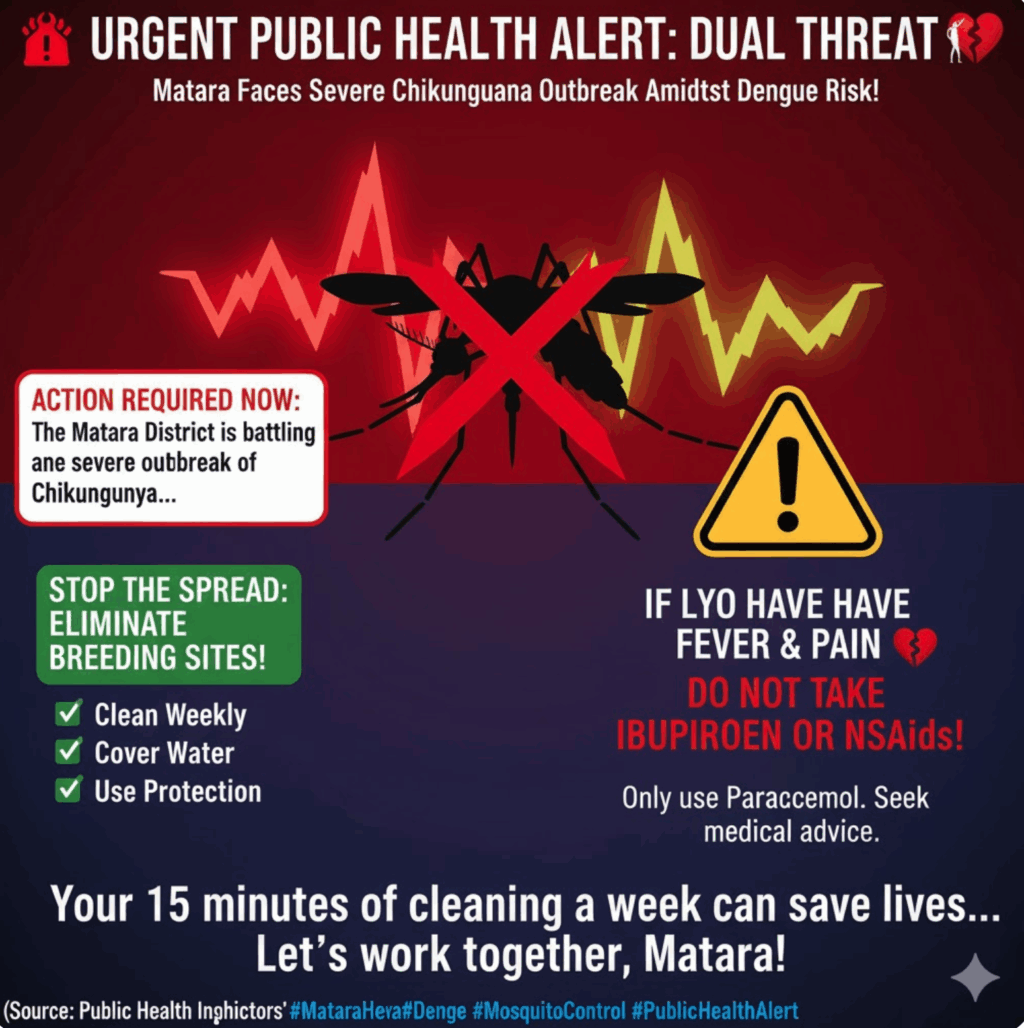
Given the severe nature of the Chikungunya outbreak and the accompanying Dengue risk, PHIASL and health authorities are stressing that prevention is the only immediate defense. Since there is currently no specific antiviral treatment for Chikungunya (treatment focuses solely on supportive care, mainly using Paracetamol to manage fever and pain), the entire public health strategy rests on vector control.
The key to flattening the infection curve lies in community cooperation to eliminate the Aedes mosquito’s breeding sites. Citizens are strongly urged to dedicate time daily to inspect their homes and surroundings for any stagnant water. Removing standing water from discarded tires, flowerpot saucers, roof gutters, and other potential reservoirs is paramount.
Health authorities also issue a critical clinical warning: individuals presenting with fever and joint pain, characteristic of both Dengue and Chikungunya, must strictly avoid Non-Steroidal Anti-Inflammatory Drugs (NSAIDs) like Ibuprofen. NSAIDs can increase the risk of bleeding in Dengue patients, which must be definitively ruled out before such pain relief is administered.
The Matara district now stands at the forefront of this emerging crisis. Prompt action, public vigilance, and rigorous sanitation are essential to suppress the mosquito population and protect the community from this debilitating re-emerging disease.