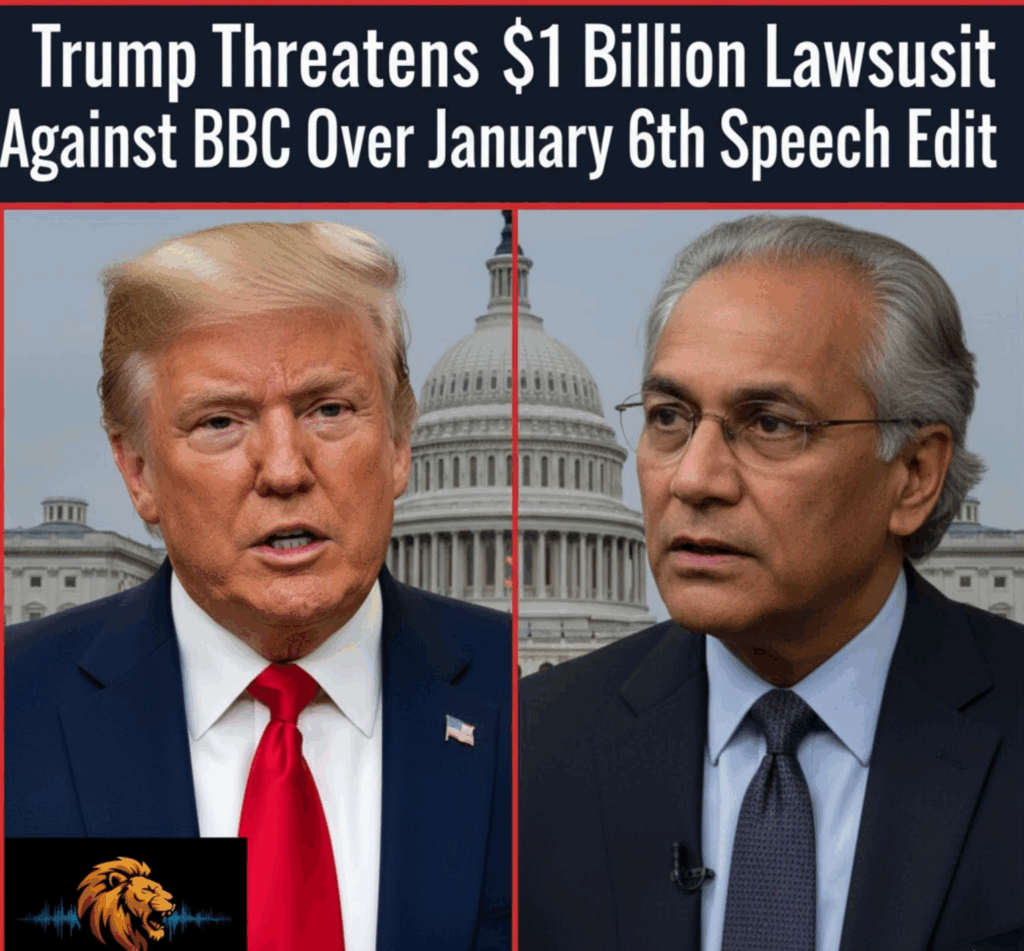
MEDIA TITANIC CLASH: Trump Threatens $1 Billion Lawsuit Against BBC Over January 6th Speech Edit
By Lions Roar News Global Media & Politics Bureau
LONDON, UK — The crisis engulfing the British Broadcasting Corporation (BBC) has escalated into a high-stakes international legal and political showdown, with US President Donald Trump officially threatening a $1 billion (USD) legal action against the venerable public broadcaster. The unprecedented legal threat comes directly in the wake of the resignations of BBC Director-General Tim Davie and BBC News Chief Deborah Turness over a documentary that allegedly misleadingly edited a clip of President Trump’s speech delivered before the January 6, 2021, attack on the US Capitol.
President Trump’s legal team, led by counsel Alejandro Brito, submitted a formal notice to the BBC’s leadership, including Chairman Samir Shah, on Sunday, demanding an immediate retraction of the controversial segment from the flagship documentary, Panorama. The letter, details of which were obtained by several US media outlets, calls for the retraction of what it terms “false, defamatory, disparaging, and inflammatory statements” made about the President.
The BBC has been given a strict Friday deadline to respond to the ultimatum. The legal notice warns that should the Corporation fail to comply, President Trump will be “left with no alternative but to enforce his legal and equitable rights… including by filing legal action for no less than 1,000,000,000 dollars in damages.” The letter concludes with the blunt statement: “The BBC is on notice.”
The Core of the Controversy: A Spliced Speech
The source of this institutional and diplomatic crisis is an episode of the current affairs program Panorama, titled Trump: A Second Chance?, which aired shortly before the 2024 US Presidential election. The broadcast included a highly condensed and edited segment of President Trump’s January 6, 2021, speech to supporters.
The central allegation, initially raised in a leaked internal report by former external standards advisor Michael Prescott, is that the documentary spliced together two separate excerpts from the nearly hour-long speech—excerpts that were delivered approximately 54 minutes apart. By combining a line about walking to the Capitol with the instruction to “fight like hell,” critics argue the edit was designed to create the false and inflammatory impression that President Trump was issuing a direct and immediate call for violent action at the US Capitol building.
Crucially, President Trump’s legal team contends that the edit deliberately omitted a section of the speech in which he told supporters “to peacefully and patriotically make your voices heard,” thereby violating standard journalistic ethics and, they claim, Florida defamation law by creating a false impression.
BBC Apology and Institutional Capitulation
The pressure created by the leaked dossier, followed by intense scrutiny from UK lawmakers and a furious response from the White House, proved unsustainable for the BBC’s leadership.
On Sunday, both Director-General Tim Davie and BBC News Chief Deborah Turness announced their immediate resignations. Davie, in his statement, acknowledged that “there have been some mistakes made and as director-general I have to take ultimate responsibility.” Turness stated that the ongoing controversy “is causing damage to the BBC—an institution that I love.”
The crisis deepened on Monday when BBC Chairman Samir Shah issued a public apology for the editorial error. In a letter to the Parliamentary Culture, Media and Sport Committee, Shah conceded that the way the speech was edited for the documentary had given “the impression of a direct call for violent action,” acknowledging it as an “error of judgment.” However, Shah defended the wider integrity of the institution, rejecting claims of “systemic bias” within BBC News.
A High-Stakes Legal Precedent
The threatened $1 billion lawsuit is among the largest legal actions ever threatened against a major news organization and places the BBC in a perilous position. While it is notoriously difficult for public figures to win defamation cases under US law—requiring proof that the defendant acted with “actual malice” (knowing the information was false or acting with reckless disregard for the truth)—President Trump has established a recent pattern of successfully negotiating settlements in similar cases with US media companies.
In recent years, several US media organizations, including CBS News and ABC News, have agreed to significant settlements with President Trump or entities associated with him to resolve defamation claims. This track record suggests that the BBC will face immense pressure to negotiate a resolution, rather than risk a protracted and costly legal battle in a US court.
President Trump, welcoming the resignations and thanking The Telegraph for exposing what he called “Corrupt ‘Journalists,'” leveraged the crisis to attack the institution’s integrity. “These are very dishonest people who tried to step on the scales of a Presidential Election… What a terrible thing for Democracy!” he posted on his social media platform.
The BBC has confirmed receipt of the legal letter and stated it is “now considering how to reply” to the President. This entire episode represents a seismic moment for the 103-year-old Corporation, testing its commitment to editorial independence against an unprecedented level of political and financial pressure from a sitting US President.