US Government Shutdown Enters Uncharted Waters: Air Travel Chaos Looms as Senate Scrambles for a Solution
By Lions Roar News Global Affairs Desk
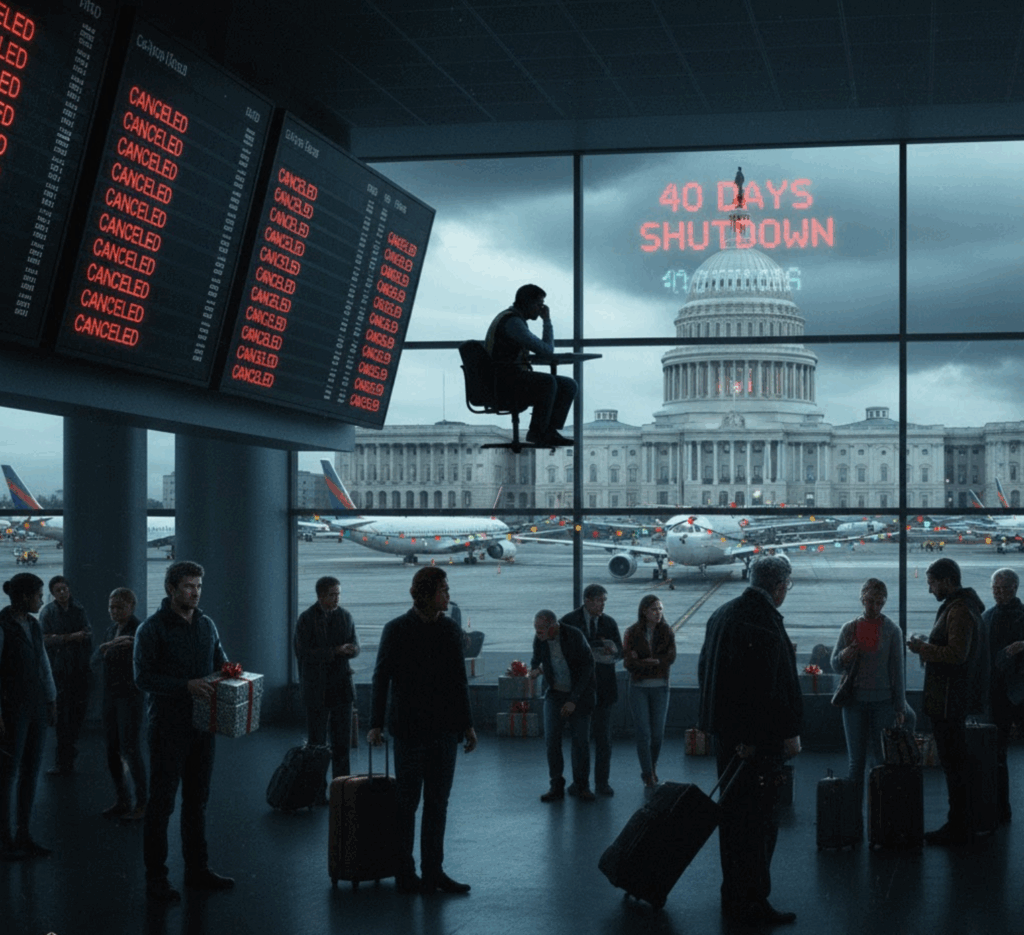
WASHINGTON D.C., USA — The United States government is navigating an unprecedented crisis, as a partial federal government shutdown grinds past its 40th day, shattering previous records and pushing critical public services to the brink of collapse. The stalemate, primarily rooted in deep partisan divisions over federal spending and immigration policy, is now visibly manifesting in daily life, with the nation’s air travel system facing severe disruptions and mounting fears of widespread holiday travel chaos.
Late on Monday, a flicker of hope emerged from Capitol Hill, as the US Senate initiated crucial procedural steps to advance a bipartisan funding bill. This development, while tentative, suggests that the political will to end the prolonged impasse might finally be coalescing. Senate Majority Leader Mitch McConnell’s office confirmed that the legislative manoeuvre would set up a potential vote later in the week, but the path to a comprehensive agreement remains fraught with political landmines.
The direct impact of the shutdown is most acutely felt by the hundreds of thousands of federal employees working without pay or furloughed, and by the ripple effects across various sectors. However, it is the Federal Aviation Administration (FAA) that has become the latest, and perhaps most alarming, casualty. Facing critical staffing shortages, particularly among air traffic controllers who have been forced to work without regular pay, the FAA has been compelled to implement widespread flight cancellations and delays across major hubs.
“This isn’t just an inconvenience; it’s a looming national security issue and an economic disaster for the airline industry,” stated former FAA Administrator Michael Huerta, speaking to Lions Roar News. “Air traffic controllers are highly skilled professionals, under immense pressure. Working indefinitely without pay, dealing with the uncertainty for their families, it’s not sustainable. Fatigue and low morale directly translate to safety risks.”
Major airlines, including American, Delta, and United, have reported thousands of flight cancellations over the past week, citing “unforeseen staffing challenges” at key air traffic control facilities. O’Hare International Airport in Chicago, Hartsfield-Jackson Atlanta International Airport, and Los Angeles International Airport have been particularly affected, with cascading delays impacting connecting flights nationwide. With the crucial Thanksgiving and Christmas travel periods fast approaching, industry analysts are warning of a potential “travel apocalypse” if the shutdown continues.
The core of the dispute remains a congressional battle over President Trump’s demands for border security funding, particularly for a wall along the U.S.-Mexico border. Democrats have consistently refused to allocate the requested billions, viewing it as an ineffective and costly measure. The current funding bill under consideration in the Senate reportedly includes provisions for various government agencies but does not fully meet the President’s border wall demands, setting up a potential veto showdown if it passes both chambers.
President Trump, despite the growing pressure from within his own party and from a frustrated public, has shown little sign of backing down. His administration continues to assert that national security overrides the inconvenience caused by the shutdown. However, the economic toll is undeniable: preliminary estimates suggest the shutdown is costing the US economy billions of dollars each week in lost productivity, deferred spending, and direct financial strain on federal workers.
“Beyond the immediate economic costs, this shutdown erodes trust in government and creates significant operational backlogs that will take months, if not years, to resolve,” commented Dr. Emily Carter, a political economist at Georgetown University. “Agencies like the IRS, EPA, and FDA are falling behind on essential work, which has long-term implications for public health, safety, and economic regulation. The true cost is far greater than the immediate figures.”
The current Senate effort, if successful, would represent a significant step towards reopening the government. However, even if a bill passes the Senate, it would still need to clear the Democrat-controlled House of Representatives and secure the President’s signature. House Speaker Nancy Pelosi has maintained a firm stance against funding the border wall, making a swift resolution far from guaranteed.
As holiday decorations begin to appear in homes and businesses across the nation, the specter of a crippled air travel system and an unresponsive government casts a long shadow over the festive season. The coming days will be pivotal in determining whether Washington can finally find a way out of this unprecedented crisis.