The Great Education Divide: Government Move to Scrap Treaty Requirement and Seize Control of Teaching Council Sparks National Outcry
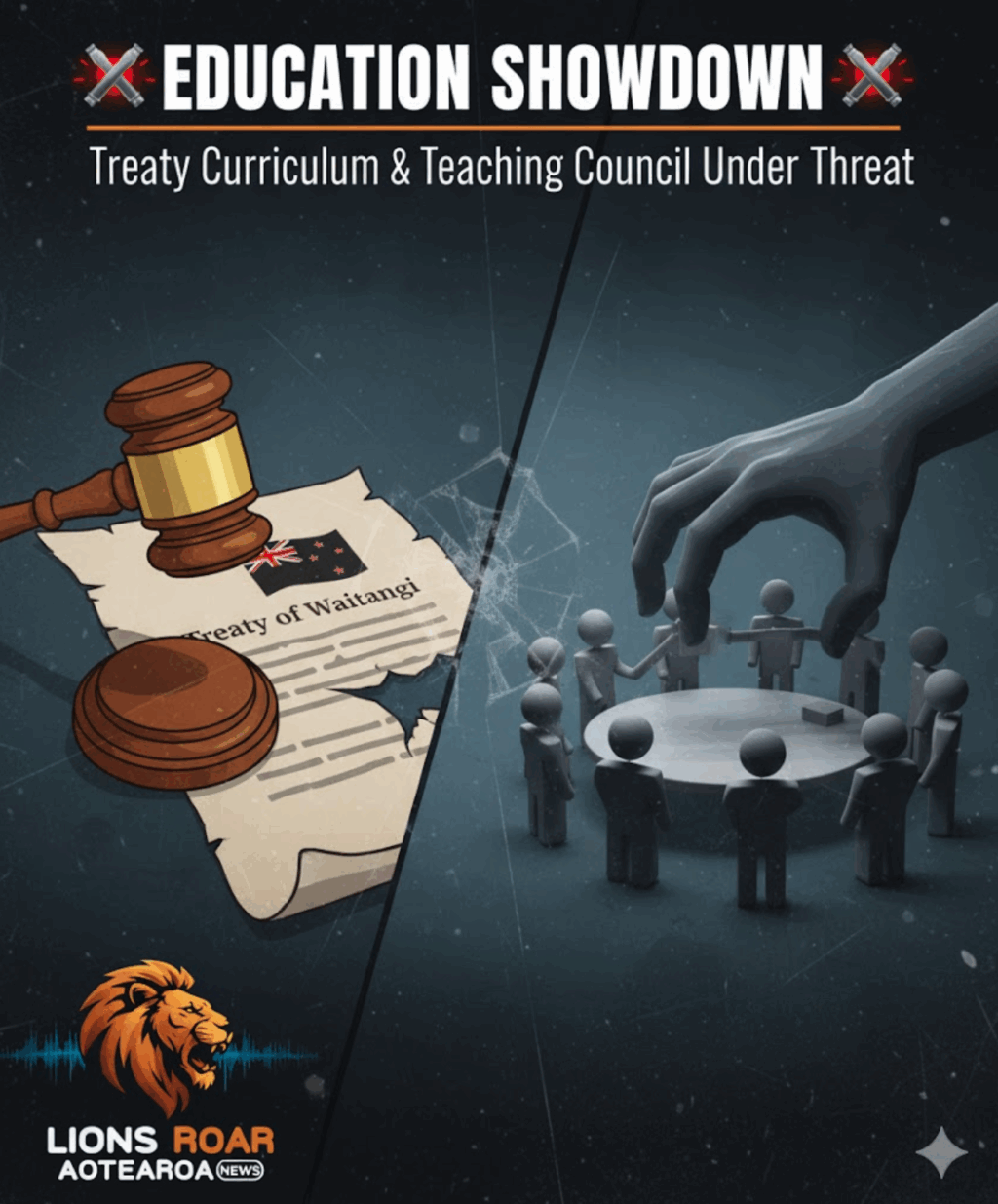
By The Lion’s Roar News International Desk
WELLINGTON— New Zealand’s education sector is currently navigating its most significant political and ideological fault line in decades. A dual assault on the sector’s governance and core curriculum—spearheaded by the Minister of Education—has ignited a nationwide controversy, pitting the government against a unified front of teachers, unions, school boards, and cultural advocates.
The two key policy shifts involve the reported plan to axe the mandatory requirement for schools to integrate Te Tiriti o Waitangi (the Treaty of Waitangi) into their curriculum, and a radical move to restructure the Teaching Council of Aotearoa New Zealand, stripping its independence and handing control to ministerial appointees. Critics are united in condemning the initiatives as a severe step backwards for biculturalism and a blatant undermining of professional autonomy.
📜 Curriculum Conflict: The De-Tiriti-fication of Schools
At the heart of the curriculum debate is the government’s intention to remove the explicit requirement, enshrined in the Education and Training Act 2020, for school boards to “give effect to Te Tiriti o Waitangi” by ensuring their local curriculum reflects local tikanga Māori, mātauranga Māori, and te ao Māori (Māori customs, knowledge, and world view).
This clause was seen as a major milestone, forcing schools to actively embed the nation’s founding document into their policies and teaching practices, thus moving beyond symbolic acknowledgment to practical implementation.
The immediate backlash has been profound. School boards, including the New Zealand School Boards Association (NZSBA), have expressed shock and dismay, arguing the removal “undermines the legal and practical” framework for working with local communities. NZSBA President Meredith Kennett stated that the clause had been a “practical and unifying influence,” and its removal would “cause plenty of harm, including to social cohesion.”
Opposing groups, such as Hobson’s Pledge, have celebrated the move as a victory, arguing that the requirement was merely “political theatre” that placed an “unfair burden on board of trustee volunteers,” and that schools should instead “focus on educating kids.”
However, education leaders, including the PPTA Te Wehengarua (Secondary Teachers’ Union), contend that stripping the Treaty requirement risks perpetuating systemic racism and ongoing inequity by limiting students’ ability to understand the complex history and bicultural foundations of New Zealand society. Indigenous rights scholars warn that controlling the curriculum is a powerful mechanism for social control, allowing for the “erasure of histories and languages.”
🏛️ Council Contention: The “Blatant Power Grab”
In parallel with the curriculum changes, the Minister of Education announced urgent plans to radically restructure the Teaching Council of Aotearoa New Zealand. The professional body, responsible for registering teachers, setting professional standards, and upholding the Code of Conduct, is to be immediately reconstituted.
The change reverses the democratic model, shifting the board makeup from a majority of elected members to a majority of seven ministerially appointed members and only six elected members, with further plans to permanently reduce the overall size and limit elected teacher representation. Crucially, the plan involves moving the professional standard-setting functions for Initial Teacher Education (ITE) from the Council directly to the Ministry of Education.
Teacher unions were unified in their condemnation, labelling the move a “blatant power grab.” PPTA Te Wehengarua President Chris Abercrombie called it an “attack on the professionalism and independence of teachers.” He argued that the separation between the professional body and the government is critical to ensure teachers can advocate for their students without fear of political reprisal or compromising their registration.
The Minister justified the drastic action by citing reports, including data from the OECD’s TALIS survey, which suggested a significant percentage of graduate teachers lacked confidence. However, unions accuse the Minister of “cherry-picking” data, pointing to the same surveys that show beginning teachers are satisfied with their ITE and that government changes are a major cause of stress for the NZ teaching workforce.
The NZ Council of Deans of Education expressed deep concern, warning that shifting key professional functions to the Ministry politicises what should be independent processes, setting a dangerous precedent that is “at odds with arrangements for all other independent statutory professional bodies,” such as those for law and medicine.
🗣️ The Road Ahead: Instability and Uncertainty
The twin reforms signal an aggressive ideological push to refocus education on what the government terms “core knowledge” and “streamlined governance.” However, the sheer speed and breadth of the changes—often implemented without extensive consultation—have created significant instability.
Critics warn that alienating educators by removing their professional autonomy and undermining bicultural foundations will not solve teacher preparedness issues or boost achievement. Instead, they fear the reforms will further destabilise a system already struggling with workforce shortages and compliance pressures, potentially leading to a demoralised teaching profession and an education system less capable of fostering a truly inclusive and informed New Zealand society.