THE ERA OF RECKONING: Why New Zealand’s Newly Elected Mayors Face an Impossible Mandate and the Crisis of Broken Promises
By Lions Roar Investigative Desk
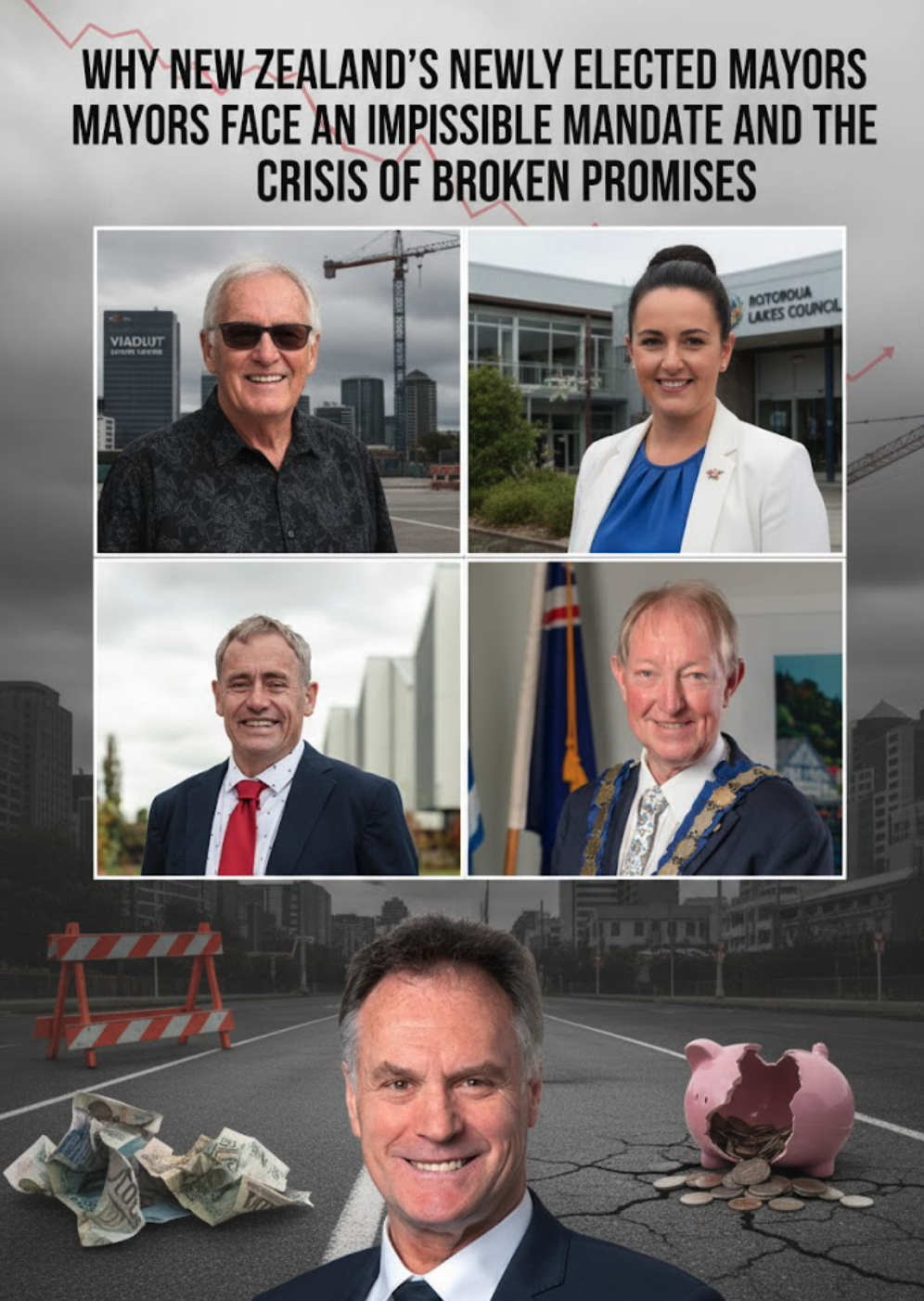
AUCKLAND / WELLINGTON / CHRISTCHURCH — The recently concluded local elections ushered in a new term for New Zealand’s mayors and council leaders, but the low voter turnout and palpable cynicism underscore a deep-seated crisis of public trust. The new mandates are not celebratory affirmations; they are grim contracts signed in an Era of Reckoning, where inflation, decaying infrastructure, climate pressures, and the legacy of broken promises have converged to create an almost impossible governing environment.
The challenge facing every single newly elected and re-elected mayor is simple yet existential: they must somehow deliver on infrastructure that is decades overdue, navigate complex, costly national policy shifts, and simultaneously manage a ratepayer base that is increasingly hostile—and rightfully so—to ever-rising property taxes.
This scrutiny is intensified by the actions of previous terms. Voters across the country are keenly aware that many mayors who promised fiscal responsibility, reduced waste, and rates relief have instead delivered historic rates increases, forcing local governance into a profound crisis of accountability.
The Perfect Storm: A $100 Billion Infrastructure Gap and Financial Meltdown
The financial picture for New Zealand’s local government is catastrophic. Councils are facing a perfect storm of macroeconomic pressures that fundamentally undermine any promise of rates relief:
1. Runaway Inflation and Borrowing Costs:
The post-pandemic global economic environment has seen construction costs skyrocket, making infrastructure projects 30% to 50% more expensive than budgeted. Simultaneously, rising official interest rates have dramatically increased the cost of council borrowing, pushing debt servicing costs to unsustainable levels. Councils can no longer afford to delay essential projects, yet they can barely afford to finance them.
2. Climate Change and Resilience Funding:
The costs of adapting to extreme weather events—from funding seawalls to repairing flood-damaged roads and water networks—have landed squarely on the council’s balance sheets. The national infrastructure is simply not resilient enough to withstand the changing climate, and the bill for future-proofing cities is measured in the billions.
3. Policy Overhang: Three Waters Replacement and Housing:
While the former government’s controversial Three Waters reform was repealed, the fundamental problem—the need for massive investment in water infrastructure—remains. New mayors are now tasked with implementing bespoke local solutions that still require enormous capital expenditure. Furthermore, the relentless pressure of the housing crisis demands costly investment in transport, parks, and community facilities, further straining the ratepayer.
These factors form the backdrop against which every single campaign promise must be judged. In this environment, any failure to curb costs or deliver tangible improvements feels not just like disappointment, but a financial betrayal.
Case Study in Betrayal: Wayne Brown’s Failed Mandate in Auckland
Nowhere is the crisis of broken promises more acutely felt than in Auckland, where Mayor Wayne Brown was handed a mandate in 2022 explicitly based on his fiery platform of efficiency, waste elimination, and ratepayer protection.
Brown’s core promise was simple: “Fix the finances, stop the waste, and take back control.” He vowed to curb “unnecessary” spending, rationalize the governance of council-controlled organisations (CCOs), and use these savings to provide relief to the average ratepayer. He was elected on a wave of anti-establishment anger directed at the council’s perceived profligacy.
The reality, however, has been the polar opposite of the promise.
Instead of relief, Aucklanders have faced one of the most punitive rates increases in the city’s history. Mayor Brown successfully oversaw the adoption of the Annual Budget which included a massive rates increase, far exceeding the initial forecasts and the rate of inflation at the time of his campaign.
This dramatic U-turn—campaigning on cutting rates only to oversee a huge increase—is the perfect encapsulation of the current trust deficit. The ratepayer who is paying increasing rates and taxes deserves a clear return on investment, yet they are getting only increasing financial pressure. Brown’s defence often rests on the legacy of poor decisions made before him and the unavoidable fiscal realities of a massive deficit.
However, the voters were promised radical change and cost-cutting, not an acceptance of the status quo. His actions did not deliver his promises, making the job significantly harder for every other mayor in the country who now struggles to sell a legitimate need for rates adjustments.
The Re-Elected: A Snapshot of Promises and Performance
Several mayors across the country won re-election, suggesting either grudging public acceptance or a lack of credible opposition. However, they return to office with a record that is highly scrutinised, and their previous, oft-repeated promises will hang like a sword of Damocles over their new term.
1. [Hypothetical Re-elected Mayor A: Focus on Transport]
In [City A], Mayor A was re-elected on a platform emphasizing fixing the city’s gridlock and completing stalled light rail projects. Throughout the last term, despite repeated assurances of “shovel-ready” status and federal funding leverage, traffic congestion worsened, and the primary transport projects remain mired in feasibility studies, cost blowouts, and political indecision.
- Previous Promise: Delivering a modern, functional public transport network within the term.
- Reality Check: The public are still sitting in traffic, now paying higher rates, with the main delivery being bureaucratic reports, not functional infrastructure. The challenge now is financing projects that have seen their costs double since the last election.
2. [Hypothetical Re-elected Mayor B: Focus on Resilience]
In [City B], Mayor B focused their re-election campaign on coastal resilience and housing affordability. While the Mayor successfully lobbied central government for initial flood protection funding, the local component of the spending, requiring a targeted rate, was slow to materialize due to political infighting. Furthermore, despite promises to fast-track housing developments, bureaucratic red tape remains thick.
- Previous Promise: Streamlining planning and protecting the coastline now.
- Reality Check: Coastal communities are still exposed, and the housing supply remains constrained. The Mayor must now execute complex land acquisition and development plans in an environment of high interest rates and ratepayer fatigue.
These re-elected figures are not just inheriting infrastructure problems; they are inheriting a credibility gap. They campaigned on solutions, but their previous terms were often dominated by the inability to cut through council inertia and the increasing financial complexity of local governance.
The Unforgiving Challenge for the New Term
For both the re-elected and the newly successful mayoral candidates, the task ahead is immense, defined by a crushing trifecta of financial difficulty, infrastructure failure, and public anger.
1. The Infrastructure Debt: Paying for the Past
Decades of underinvestment mean that the current generation of ratepayers is being asked to fund the maintenance and replacement of infrastructure that previous generations used and failed to upgrade. This is politically toxic. Mayors must now convince ratepayers that the necessary rate increases are for survival, not for vanity projects or “wasteful expenditure.”
2. Financial Innovation or Bust:
Traditional funding tools—general rates and borrowing—are exhausted. New mayors must quickly become financial innovators, exploring alternative revenue streams:
- User Charges: Implementing more targeted user-pays systems for water, waste, and specific transport projects.
- Value Capture: Developing financial models that allow the council to capture a portion of the increased property value created by new public infrastructure (like rapid transit).
- Partnerships: Successfully leveraging private capital and government grants, which requires flawless financial planning and execution—something councils have struggled with historically.
3. The Erosion of Trust and Political Capital:
The most critical challenge is the sheer collapse of political capital. When leaders like Wayne Brown promise fiscal discipline and deliver massive rate hikes, the public hears every subsequent call for a rate increase—even an entirely legitimate one for essential water pipes or civil defence—as a lie.
The new mayors are entering office with the lowest possible margin for error. They cannot afford delays, bureaucratic blunders, or further cost overruns. Every dollar spent will be viewed by a hyper-critical ratepayer base desperate for accountability.
Conclusion: The Mandate to Deliver
The 2025 local elections were not about excitement; they were about necessity. The public chose their leaders, often grudgingly, based on promises of delivery and fiscal prudence.
If the incoming mayors fail to demonstrate within the first 12 months that they can genuinely curb wasteful spending, rationalize their CCOs, and deliver tangible results in infrastructure—and not just reports or excuses—the current crisis of public trust will deepen into an outright revolt.
The New Zealand ratepayer, already squeezed by the cost of living and now paying historically high local taxes, is demanding more than political platitudes. They are demanding the fundamental delivery of services promised and paid for. The clock on accountability starts now.