RBNZ’s Sharp 50bps Rate Cut Signals Deepening Economic Concerns
Wellington, October 12, 2025 —
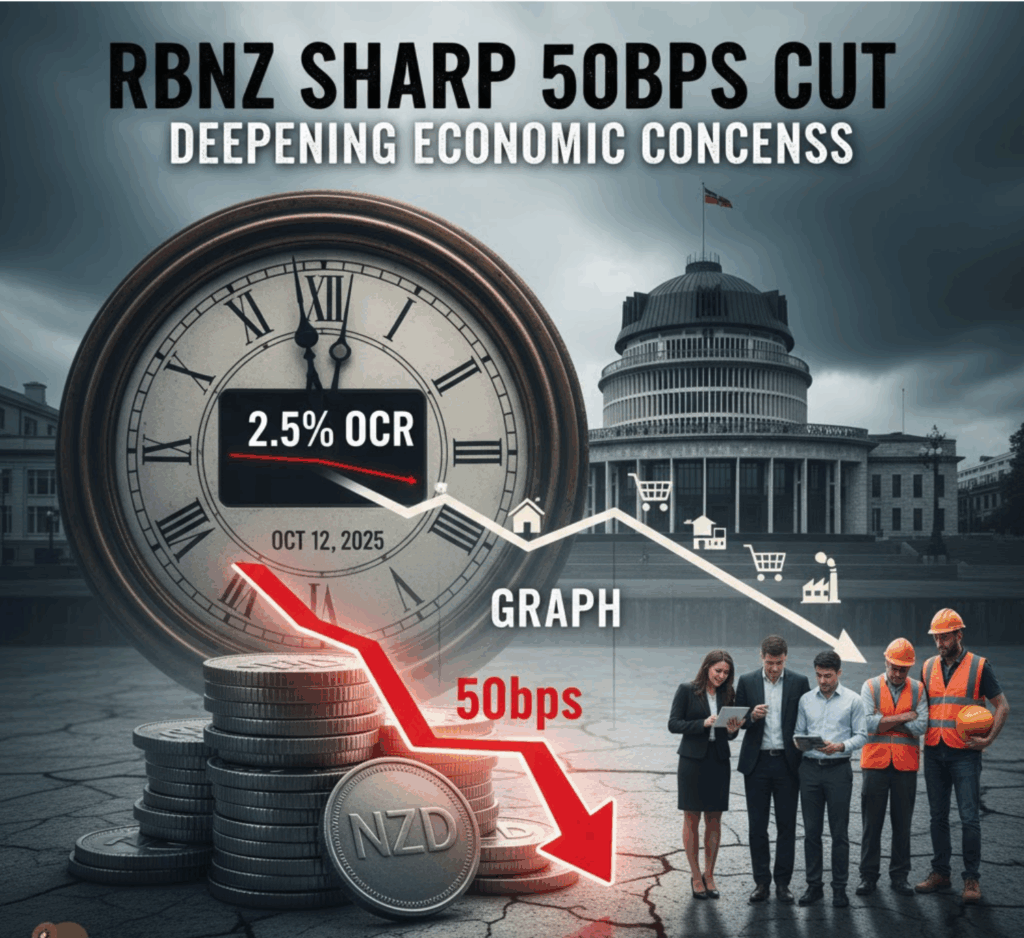
In a surprising move that has caught financial markets and analysts off guard, the Reserve Bank of New Zealand (RBNZ) slashed the Official Cash Rate (OCR) by 50 basis points, bringing it down to 2.5% — the lowest level in three years. The decision underscores growing anxiety about the slowing New Zealand economy amid persistent cost-of-living pressures and signs of weakening domestic demand.
This marks the first half-percentage-point cut since the pandemic recovery phase and signals a more aggressive stance by the central bank to stimulate growth and maintain price stability.
Economic Context: Balancing Growth and Inflation
The RBNZ’s Monetary Policy Committee said the rate cut was a response to a “significant cooling in household spending and subdued business investment,” driven by tighter credit conditions, falling export revenues, and declining consumer confidence.
While inflation has been trending lower, currently hovering around 2.8%, it remains above the central bank’s mid-point target of 2%. However, officials emphasized that the balance of risks has shifted — with recessionary pressures now outweighing inflation risks.
“The domestic economy has slowed more sharply than anticipated,” the RBNZ statement read. “With inflation expectations anchored and capacity pressures easing, monetary policy now needs to support demand and employment.”
The move signals a shift from the RBNZ’s cautious stance earlier in 2025, when it maintained a ‘wait-and-see’ approach amid lingering inflationary fears. Analysts now say the bank is prioritizing economic momentum over inflation containment.
Market Reaction: Relief for Borrowers, Jitters for Investors
The markets reacted swiftly to the decision. The New Zealand dollar (NZD) dropped by nearly 1.2% against the US dollar immediately after the announcement, reflecting expectations of a prolonged low-rate environment.
Stock markets, on the other hand, welcomed the move. The NZX 50 index climbed 0.8% in afternoon trading as investors anticipated improved liquidity and lower borrowing costs for corporates.
Mortgage holders and small businesses, who have faced months of elevated lending rates, are expected to benefit directly from the OCR reduction. Major banks, including ANZ and Westpac, quickly announced corresponding cuts to their floating mortgage rates, passing on relief to borrowers.
“This decision will give much-needed breathing room to households and businesses who have been under strain from higher loan repayments,” said Sarah Tait, Chief Economist at KiwiBank. “However, it also confirms that the RBNZ sees a darker economic outlook than previously forecast.”
Underlying Economic Concerns
Behind the RBNZ’s aggressive cut lies a growing list of economic challenges.
Domestic demand has fallen sharply in recent months, with retail sales contracting for two consecutive quarters. The construction sector — once a key growth driver — is experiencing a slump due to declining new home consents and rising building costs.
Business confidence surveys reveal declining optimism, with many firms citing policy uncertainty, high energy prices, and slower export demand, particularly from China and Australia.
New Zealand’s export-led economy has also been hurt by weaker global demand and falling commodity prices. Dairy, meat, and forestry exports — traditional pillars of the economy — have all recorded year-on-year declines.
“The rate cut is a clear acknowledgment that the economy is losing steam,” said Dr. James Thornton, a senior economist at Victoria University. “It’s an attempt to pre-empt a deeper downturn before unemployment starts rising more rapidly.”
Inflation and the Cost of Living
While the RBNZ’s move was primarily aimed at stimulating demand, it also reflects confidence that inflationary pressures are now manageable.
Consumer price growth has been moderating since mid-2024, helped by lower fuel prices and easing global supply chain disruptions.
However, households continue to face cost pressures in key areas such as food, rent, and energy. The average grocery bill remains up 7% compared to last year, while average rents in major cities like Auckland and Wellington have risen by nearly 5%.
The central bank’s statement acknowledged this hardship but said monetary easing would eventually support wage growth and household income stability.
“Lower interest rates will take time to filter through the economy,” the RBNZ noted. “Our objective is to ensure that inflation continues to moderate without causing unnecessary harm to employment and living standards.”
Political and Public Reaction
The government cautiously welcomed the rate cut, framing it as an independent but necessary response to evolving economic realities.
Finance Minister Nicola Willis said the RBNZ’s move “aligns with the government’s commitment to supporting growth and easing pressure on households,” while reaffirming respect for the bank’s operational independence.
However, opposition parties were quick to criticize the move as evidence of failed economic management.
“The need for such a sharp rate cut shows just how weak our economy has become,” said Labour finance spokesperson Grant Robertson. “Families are struggling, businesses are cutting back, and the government has no coherent growth plan.”
Public sentiment has been mixed. Homeowners and first-time buyers largely welcomed the decision, hoping for relief on mortgage repayments. In contrast, savers and retirees expressed concern over declining returns on deposits and term investments.
Banking Sector Outlook
Commercial banks are expected to adjust their lending portfolios in response to the new OCR. While lower rates should boost credit demand, there are concerns about rising risk exposure in property and consumer lending.
Financial analysts warn that while the OCR cut may stabilize short-term growth, it could fuel asset price inflation, particularly in the housing market, if not accompanied by broader fiscal reforms.
“The RBNZ is walking a fine line,” said Michael Cunningham, head of strategy at Westpac NZ. “They’re trying to stimulate growth without reigniting inflation or speculative activity. It’s a delicate balance.”
Global Context and Future Path
The RBNZ’s decision mirrors similar trends in other advanced economies. Central banks in Australia, Canada, and the UK have all recently signaled dovish shifts as inflation cools and growth slows.
Internationally, investors now expect New Zealand to maintain a low-rate trajectory into mid-2026, barring any resurgence in inflation.
The next Monetary Policy Statement, due in December, will be closely watched for indications of whether the RBNZ plans further cuts. Some economists predict another 25-basis-point reduction if current economic indicators continue to weaken.
Conclusion: A Turning Point for the Economy
The 50-basis-point cut marks a major turning point in New Zealand’s monetary policy — from inflation containment to growth support. It reflects a sobering reality: the economy is under pressure, and decisive action is required to prevent stagnation.
While borrowers will feel immediate relief, the longer-term effectiveness of this policy will depend on whether it successfully revives investment, spending, and job creation without reigniting inflation.
As global uncertainty and domestic challenges persist, the RBNZ’s latest move signals not just a tactical adjustment, but a deeper acknowledgment of a changing economic landscape — one that demands flexibility, prudence, and renewed confidence in the path ahead.