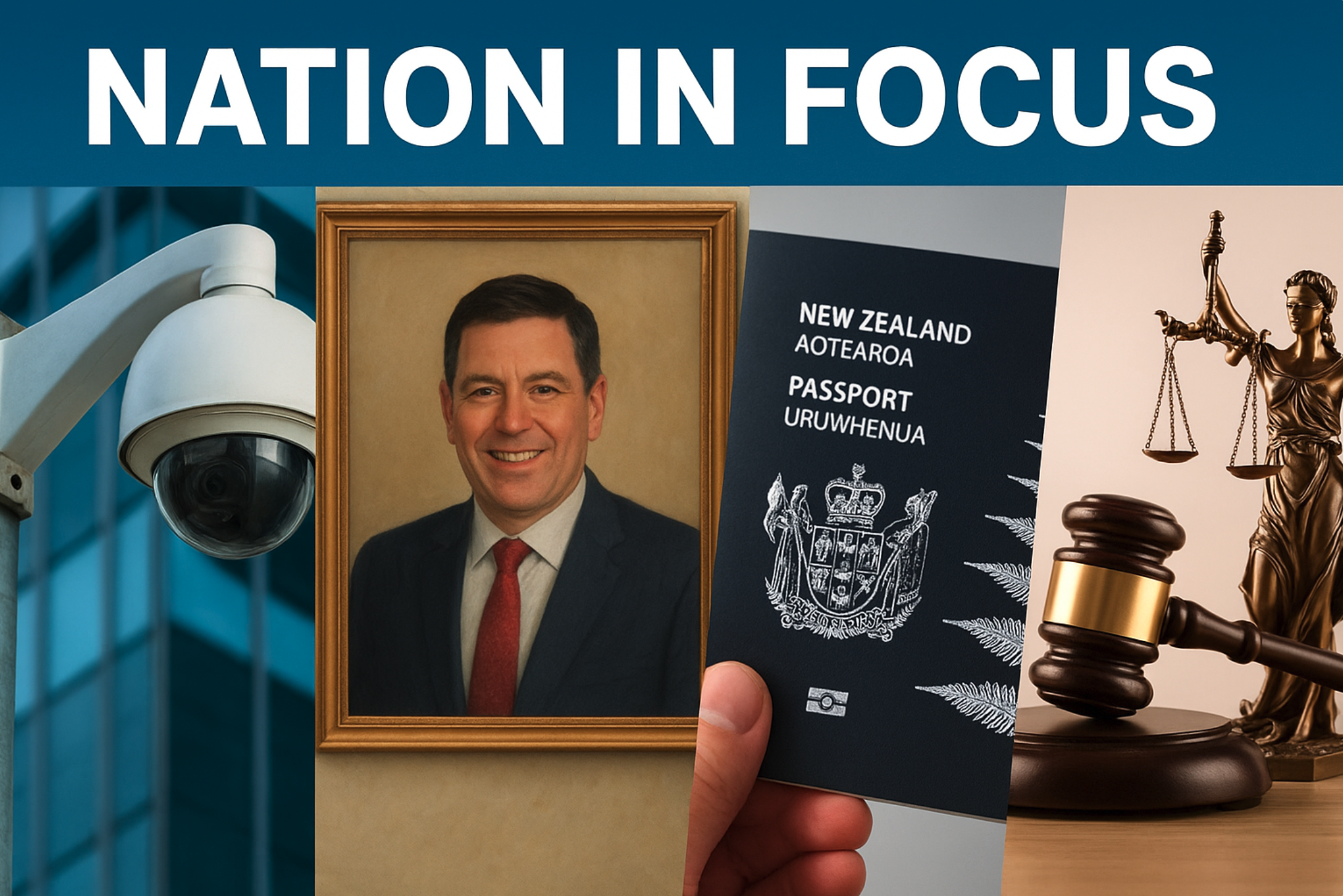
🇳🇿 Nation in Focus: New Zealand’s Week of Policy, Politics, and Public Controversy
By Lion’s Roar News Desk
Wellington | October 9, 2025
It has been a politically charged and eventful week across New Zealand, with developments spanning from police surveillance reforms and a costly artistic blunder at Wellington City Council to a major criminal case and a medical breakthrough in women’s health.
Each of these stories, while distinct in nature, reflects a nation in transition — grappling with the complex intersections of governance, technology, justice, and public accountability.
Below, Lion’s Roar News unpacks this week’s most discussed national and public policy headlines.
1. Government Moves to Expand Police Surveillance Powers
A controversial set of legislative amendments is being tabled in Parliament that could significantly expand the powers of the New Zealand Police to collect and use imagery in public spaces — including through advanced camera systems, drones, and AI-driven video analytics.
The proposed reforms, part of a broader “Public Safety and Surveillance Modernisation Bill,” seek to update outdated laws that currently limit how law enforcement can monitor and store visual data from public areas such as streets, transport hubs, and events.
Balancing Security and Privacy
Government ministers argue the changes are necessary to keep pace with modern threats, citing the growing role of technology in both crime prevention and investigation. Officials point to the increasing sophistication of organised criminal networks and the need for real-time intelligence to respond effectively.
Under the proposed legislation, police would have the authority to:
- Use facial recognition technology in certain high-risk or investigative contexts;
- Deploy mobile and drone-based cameras for live monitoring of major public gatherings;
- Retain captured footage for longer periods when linked to ongoing investigations; and
- Integrate footage with other government systems for faster criminal identification.
However, the announcement has drawn criticism from civil liberties advocates, who warn of a potential slide toward mass surveillance and erosion of privacy rights.
Digital rights organisations have voiced concern that the bill could normalise state monitoring of citizens, even when no criminal activity is suspected. The absence of clear limits on data retention and oversight mechanisms has become a focal point of public debate.
Public Reaction and Opposition Pushback
Opposition parties have already signalled they will challenge the bill unless stronger safeguards are added. One spokesperson described the proposal as “well-intentioned but dangerously broad,” cautioning that without strict oversight, the technology could be misused.
Community reactions have been mixed. Some see the reforms as overdue, especially amid rising concerns about gang-related violence and public disorder. Others fear that the cost of increased security could be a loss of privacy and trust between citizens and police.
The government maintains that transparency will remain central to implementation, promising that any new systems will be governed by independent review panels and data protection frameworks. Yet, with New Zealand’s history of upholding civil freedoms, the debate over surveillance powers is likely to intensify before any law is passed.
2. $7,000 Mayoral Portrait Error Leaves Wellington Red-Faced
In an incident that has captured both amusement and outrage, Wellington City Council has been forced to explain how a bureaucratic miscommunication led to the commissioning of a $7,000 painted portrait of outgoing Mayor Tory Whanau — instead of the intended photographic portrait that council policy allows.
The blunder, described by insiders as a “costly misstep,” has reignited public debate about local government accountability and spending priorities at a time when ratepayers are facing financial strain and service cutbacks.
A Miscommunication That Became a Public Controversy
Traditionally, Wellington’s outgoing mayors are commemorated with framed photographs displayed in the council chambers. However, due to a clerical misunderstanding, a staff member reportedly interpreted an internal memo as an instruction to commission an oil painting rather than a photograph.
The commissioned portrait — reportedly completed by a professional artist in Auckland — was delivered weeks later, much to the surprise of the council’s executive office.
By then, the artist had been paid in full, leaving the council with little option but to accept the costly mix-up. When the story surfaced, public reaction was swift, with social media users questioning how such an error could pass through multiple levels of approval without anyone noticing.
Council Admits Mistake but Defends Staff
Wellington City Council has acknowledged the error and apologised, calling it an “unfortunate miscommunication” rather than a misuse of funds. In an official statement, the council noted that no disciplinary action would be taken, citing the staff member’s honest mistake and good service record.
The outgoing mayor herself has reportedly taken the situation with good humour, though some critics argue that the incident reflects a deeper culture of inefficiency within local government bureaucracy.
“Ratepayers are struggling to afford housing and transport costs,” said one Wellington resident, “yet our council can accidentally spend $7,000 on a painting no one asked for. It’s not just funny — it’s frustrating.”
Despite the embarrassment, the portrait is expected to be displayed alongside its photographic counterparts, serving as both a tribute and an unintended reminder of how easily bureaucratic missteps can become public spectacles.
3. Teen Arrested in Fatal Stabbing Case Shocks the Nation
In a case that has gripped communities across New Zealand, police have arrested a teenager in connection with the fatal stabbing of Kaea Karauria, a young man whose death sparked widespread grief and renewed calls for action on youth violence.
The tragedy unfolded late last month, when Karauria was found fatally wounded following an altercation in a suburban area. The suspect, believed to be a minor, was taken into custody this week after an intensive police investigation involving witness interviews, CCTV analysis, and forensic examination.
Community Outcry and the Broader Debate on Youth Crime
The case has reignited debate about the state of youth justice in New Zealand, with community leaders and politicians calling for both stronger deterrents and better rehabilitation pathways.
Over the past year, the country has experienced a rise in violent incidents involving young offenders, including ram raids, assaults, and knife-related crimes. While overall crime rates remain moderate, the increasing visibility of youth violence has created a sense of unease among the public.
Social advocates stress that punitive measures alone will not solve the problem. They argue that underlying issues — such as poverty, lack of access to education, and exposure to online violence — must be addressed through holistic social policies.
Police and Family Reactions
Police have commended the community for assisting with information that led to the arrest, describing the case as “deeply distressing” and promising to pursue justice with sensitivity and thoroughness.
Kaea Karauria’s family issued an emotional statement expressing both sorrow and hope that the tragedy might inspire reform. “We’ve lost someone beautiful and full of promise,” a family member said. “If this pain can lead to change, maybe other families won’t have to go through what we are living.”
The accused teenager is expected to appear before the Youth Court, though prosecutors have not ruled out seeking a transfer to adult court depending on the severity of charges. As the legal process unfolds, New Zealand continues to confront uncomfortable questions about youth safety, community values, and the limits of the justice system.
4. New Hope for Women: Oral Treatment for Endometriosis Approved
In a landmark development for women’s health, New Zealand has approved access to a new oral treatment for endometriosis, marking a breakthrough in the management of a condition that affects approximately 120,000 women across the country.
The medication, an oral hormonal therapy, aims to reduce chronic pain and inflammation associated with the disorder, which occurs when tissue similar to the uterine lining grows outside the uterus. Until now, treatment options have been limited, often requiring invasive surgery or long-term hormonal suppression with challenging side effects.
A Step Forward in Long-Ignored Women’s Health
For decades, endometriosis has been under-recognised and underfunded in New Zealand’s healthcare system, leaving thousands of women to suffer through years of pain and delayed diagnosis. The introduction of an oral therapy provides a more accessible, less invasive option for many patients.
Medical professionals have hailed the approval as a critical advancement. Gynaecologists note that the therapy’s convenience and flexibility could drastically improve quality of life for women juggling work, family, and health management.
However, some experts caution that the drug may not be suitable for everyone. It carries certain hormonal side effects and may not fully eliminate the need for surgical intervention in severe cases. Critics have also pointed out that Pharmac’s funding criteria may restrict access to the treatment, limiting its availability to those who meet specific medical thresholds.
A Growing Focus on Women’s Health Equity
The development comes amid a wider national conversation about healthcare equity and gender disparities. Women’s health advocates have long argued that conditions such as endometriosis and polycystic ovary syndrome receive insufficient research and funding compared to other chronic illnesses.
The Ministry of Health has since committed to reviewing policies around women’s health services, promising greater investment in education, diagnosis, and treatment access. For the thousands living with endometriosis, this week’s announcement represents a long-awaited glimmer of progress — and hope.
A Nation Reflecting on Accountability and Change
Taken together, these stories reveal a snapshot of New Zealand at a crossroads — a country wrestling with how to modernise governance, uphold justice, and address public needs amid economic uncertainty and social change.
From debates over surveillance and privacy to the challenges of youth crime and the triumphs of medical progress, each issue underscores a common thread: the tension between progress and responsibility.
New Zealanders pride themselves on transparency, fairness, and innovation — yet these events serve as reminders that even in a society known for good governance, human error, inequality, and moral complexity remain ever-present.
As Parliament deliberates on surveillance powers, as Wellington reflects on its bureaucratic missteps, as families mourn lost loved ones, and as women celebrate long-overdue healthcare recognition — one truth stands clear: New Zealand continues to evolve, debate, and redefine what it means to uphold its values in a rapidly changing world.