Investor Confidence Plunges as Economy Contracts
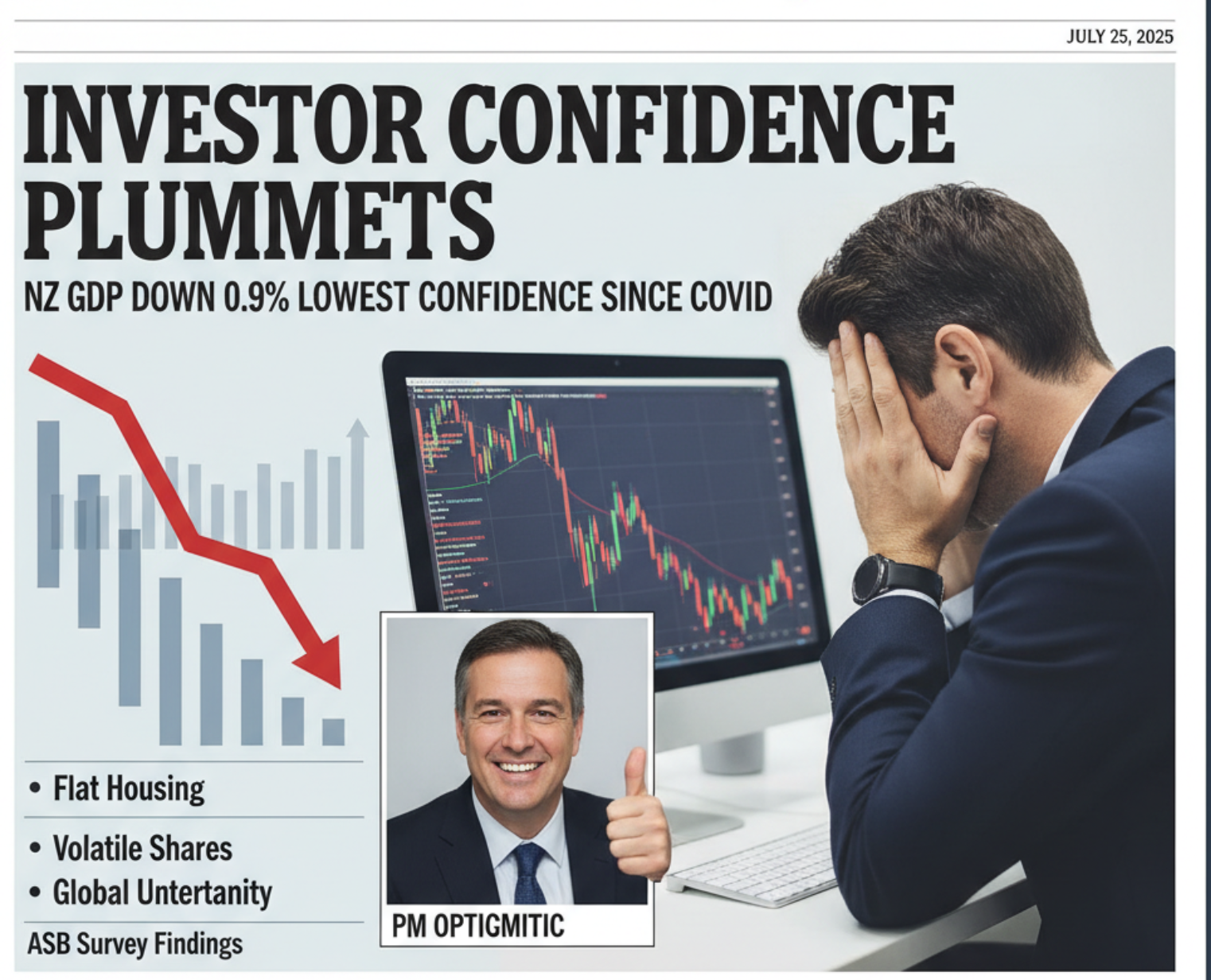
Survey shows lowest confidence levels since COVID-19 as GDP shrinks 0.9%
New Zealand’s economy has hit another rough patch, with GDP figures for the June 2025 quarter showing a 0.9% decline. The contraction has rattled households and businesses, with an ASB survey revealing that investor confidence has dropped to its lowest point since the height of the COVID-19 pandemic.
The findings highlight growing concerns about the resilience of the economy, with many pointing to a sluggish housing market, volatile global conditions, and falling share market returns as key drivers behind the downturn in sentiment.
What’s behind the confidence slump?
The ASB survey shows that investors are increasingly pessimistic about returns over the next year, reflecting both domestic and global headwinds. Key factors include:
- Flat housing market: For decades, property has been a cornerstone of investment in New Zealand. But recent stagnation in house prices, tighter lending rules, and ongoing affordability challenges are dampening investor enthusiasm.
- Volatile share markets: Global uncertainty, including geopolitical tensions and fluctuating commodity prices, has created unpredictable market conditions.
- Weak GDP growth: The 0.9% quarterly contraction has renewed fears of broader economic slowdown, particularly if consecutive declines push the country toward recession.
ASB senior economist Jane Turner explained that investor pessimism is not surprising given the current mix of pressures:
“When economic growth stalls, housing and share markets underperform, and international uncertainty looms, confidence naturally takes a hit. Investors are becoming far more cautious.”
Government response
Despite the weak figures, Prime Minister Christopher Luxon has urged calm, saying the government remains confident in the country’s long-term prospects. He pointed to ongoing infrastructure investment, trade opportunities, and planned tax reforms as measures that will support growth.
“Yes, this quarter has been challenging, but our economy has strong fundamentals. We are focused on getting productivity moving again, building business confidence, and ensuring New Zealanders see the benefits of growth.”
Finance Minister Nicola Willis also stressed that short-term fluctuations should not overshadow long-term opportunities, though she acknowledged households are feeling the strain of rising costs and slower wage growth.
Comparisons to COVID-19 era
The ASB survey’s findings draw inevitable comparisons with the pandemic years, when uncertainty about lockdowns, border closures, and global markets sent confidence to historic lows. Analysts say today’s situation feels different but equally concerning — with no single crisis driving sentiment, but rather a combination of persistent economic pressures.
Impact on households and businesses
The slump in confidence doesn’t just matter for investors; it carries broader implications for the wider economy. Lower confidence can reduce willingness to spend, invest, or take risks — all of which are crucial for driving growth.
Small businesses, in particular, may struggle if reduced optimism translates into lower demand or tightened credit conditions. Meanwhile, households already stretched by higher mortgage rates and living costs may delay big spending decisions, creating a feedback loop that slows recovery.
Analysts call for action
Critics have urged the government to present a clearer plan for boosting growth, including targeted support for small businesses, investment in skills, and incentives for innovation. Opposition parties argue the government’s optimism isn’t enough to reassure struggling households and investors.
Economist Dr. Michael Reddy commented:
“We need to see a rescue plan. Right now, the numbers show people are losing faith in the economy’s direction. Without stronger policy action, that pessimism risks becoming self-fulfilling.”
Looking ahead
The next GDP release will be closely watched to determine whether the June quarter marks the beginning of a longer downturn or a temporary blip. For now, the survey results show that confidence is fragile, and the government faces mounting pressure to turn sentiment around.
For everyday New Zealanders, the message is clear: uncertainty is back, and its effects are being felt not just in boardrooms but in households across the country.