Warning: Washing Your Car at Home Could Now Result in a Hefty Fine
By Lions Roar News Public Interest Desk
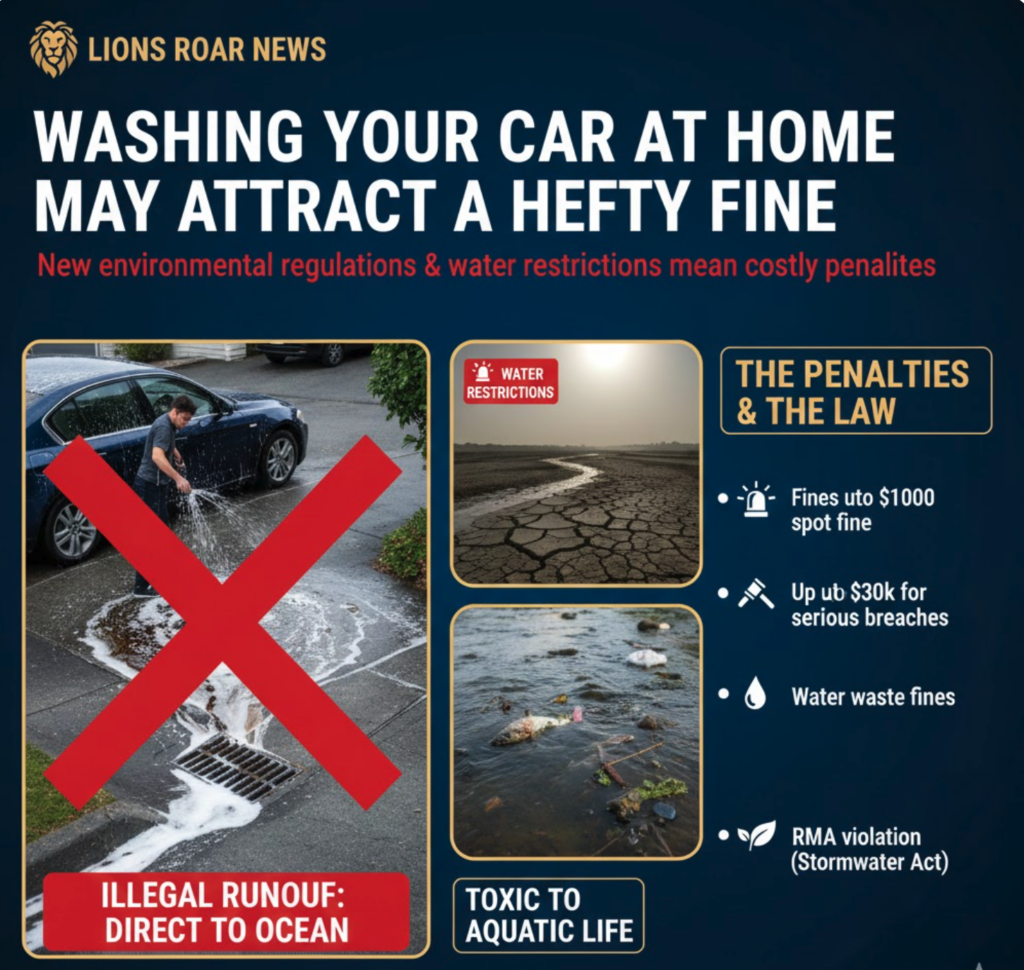
NEW ZEALAND (January 8, 2026) — That weekend ritual of pulling out the hose and bucket to wash the car could now cost you thousands of dollars. Local authorities are stepping up enforcement against home car washing, citing both severe water shortages and environmental contamination of the stormwater system.
As temperatures soar across Aotearoa this January, the environmental and legal risks associated with domestic car washing have reached a critical point.
⚠️ Why the Crackdown?
The “hefty fines” being reported stem from two primary legal frameworks that many residents are inadvertently violating.
1. Stormwater Pollution (The “Drain is for Rain” Rule)
Under the Resource Management Act, it is illegal to allow anything other than clean rainwater to enter the stormwater system.
- The Contaminants: When you wash your car on a driveway, the runoff includes detergents (even “biodegradable” ones), oils, grease, and heavy metals from brake pads.
- The Destination: Unlike the sewage system, stormwater drains lead directly into local streams, rivers, and the ocean, poisoning aquatic life.
- The Penalty: On-the-spot infringement notices can range from $300 to $1,000, while serious or repeat breaches prosecuted in court can lead to fines exceeding $30,000.
2. Water Restrictions
With the current heatwave blanketing the country, many councils have triggered Level 2 or Level 3 water restrictions.
- The Ban: In many regions, the use of handheld hoses for washing cars is currently prohibited.
- The Enforcement: Water patrols and “neighbor reports” are being used to identify residents wasting water during the drought.
🛡️ How to Wash Your Car Without Breaking the Law
Authorities are urging New Zealanders to change their habits to avoid penalties:
- Commercial Car Washes: These facilities are legally required to capture and treat their wastewater or divert it to the sewer system.
- Wash on Grass: If you must wash at home and there are no water restrictions, do it on a flat lawn. The grass and soil act as a natural filter for the soapy runoff.
- Waterless Wash: Use specialized spray-and-wipe products that do not require a hose.
- Bucket Only: If local rules allow, use a single bucket and a sponge rather than a running hose to minimize waste and runoff.
💬 Official Advice
Environmental journalists, including Liu Chen, have highlighted that councils are shifting from a “teaching” phase to an “enforcement” phase.
“People often think one car wash won’t hurt, but when a thousand people on one street do it, the local stream becomes a toxic soup,” a council spokesperson noted. “We are now at a stage where fines are necessary to protect our infrastructure and our environment.”