The Dawn of the “Indo-Pacific Century”: A Deep Dive into the New Zealand-India Free Trade Agreement
By Lions Roar News Investigative Desk
WELLINGTON / NEW DELHI (Monday, January 19, 2026) — It began as a bold campaign promise, transitioned into a high-stakes diplomatic mission in March 2025, and concluded shortly before Christmas with a handshake heard across the Southern Hemisphere. The conclusion of free trade negotiations between New Zealand and India marks more than just an economic treaty; it is a fundamental shift in New Zealand’s geopolitical orientation.
As Prime Minister Christopher Luxon prepares to ratify what Trade Minister Todd McClay calls a “once-in-a-generation” achievement, we unpack every facet of this massive deal—from the multi-billion dollar wins for forestry and horticulture to the controversial exclusions in the dairy sector and the political storm brewing at home.
Part I: The Grand Architecture – A Deal of Two Halves
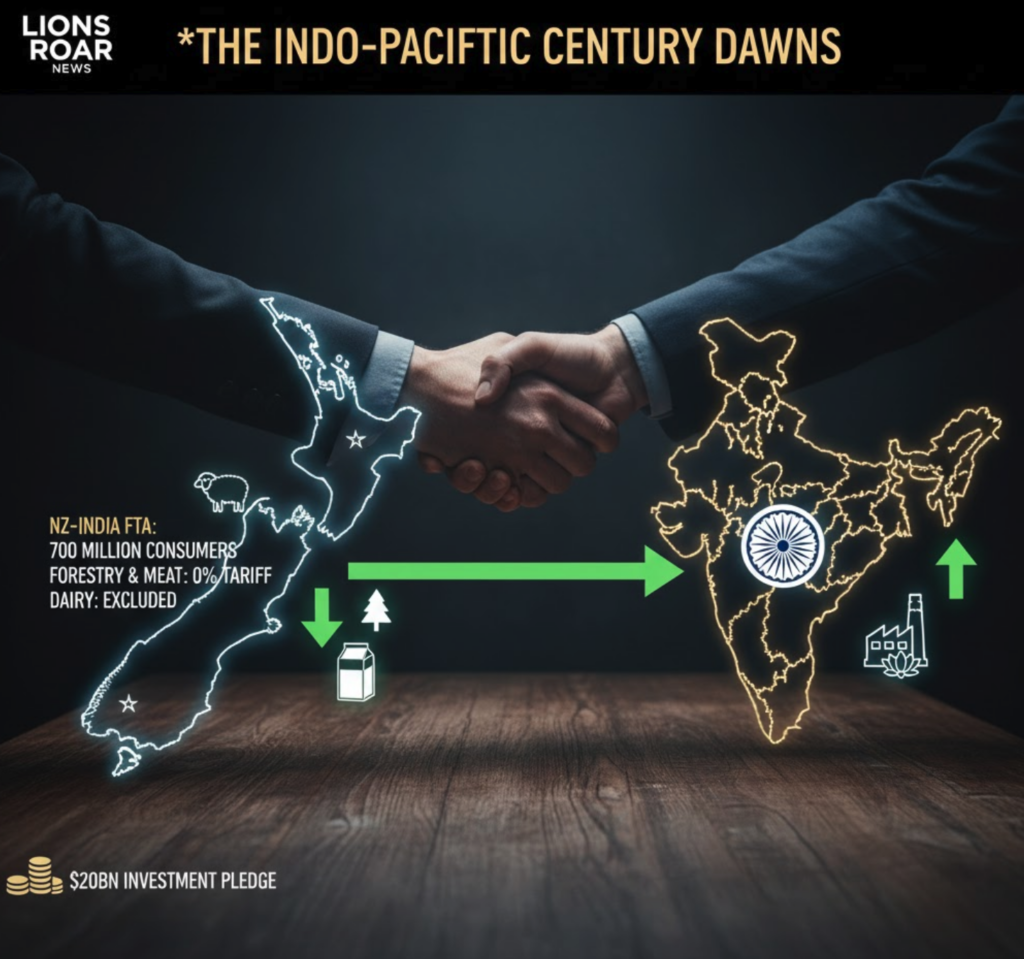
The New Zealand-India Free Trade Agreement (FTA) is a “rebalancing” act. For India, it is a “forward-looking partnership” designed to invigorate its labor-intensive manufacturing sectors. For New Zealand, it is the ultimate “diversification play,” providing unprecedented access to an Indian middle class set to exceed 700 million people within five years.
The Core Numbers
As of June 2025, two-way trade sat at $3.68 billion. Analysts forecast this could double within the first five years of the agreement.
- NZ Exports to India ($1.79bn): Dominated by travel services ($948m), industrial products, and logs.
- Indian Imports to NZ: Focused on machinery ($174m), textiles ($147m), and pharmaceuticals ($131m).
Part II: Sector Winners – Scaling the Tariff Walls
For decades, New Zealand exporters faced “prohibitive” walls, with tariffs ranging from 30% to 150%. The new agreement dismantles these systematically.
1. Forestry & Wood: The “Green Gold” Rush
The NZ Forest Owners Association is hailing the deal as a platform for massive volume growth.
- The Win: Tariffs on almost all forestry products (currently 5.5%–11%) will be eliminated.
- The Opportunity: New Zealand saw-millers and wood processors now have a direct line into India’s booming construction and furniture sectors.
2. Horticulture: Apples, Kiwifruit, and Cherries
This sector represents one of the most complex “give-and-take” negotiations in the deal.
- Apples: The 50% tariff drops to 25% for an initial quota of 32,500 tonnes, growing to 45,000 tonnes.
- Kiwifruit: The 33% tariff is eliminated for a 6,250-tonne quota, with a 50% reduction for anything exceeding that.
- The “Center of Excellence”: In a unique move, New Zealand will establish “Centres of Excellence” in India to help local growers improve their orchard management, technical skills, and supply chains.
3. Meat & Wool: Leveling the Playing Field
Beef + Lamb NZ and the Meat Industry Association have described this as a “strategically significant milestone.”
- Sheep Meat: The current 33% tariff is eliminated, finally putting Kiwi farmers on the same level as their Australian competitors.
- Wool: Tariffs are abolished, providing a much-needed boost to New Zealand’s struggling wool industry.
4. The Wine Sector: Breaking the 150% Barrier
New Zealand wine currently faces a staggering 150% tariff. Under the FTA, this will be slashed by 66–83% over 10 years, eventually landing at a manageable 25–50%. Critically, India has guaranteed “Most Favored Nation” status—meaning if they give a better deal to another country later, New Zealand gets it automatically.
Part III: The Dairy Dilemma – Why Was It Left Behind?
While the government celebrates, the Dairy Companies Association has a more muted tone. For India, dairy is not just an industry; it is a social safety net for millions of small-scale subsistence farmers.
“India is never going to open up dairy to any nation.” — Piyush Goyal, Indian Trade Minister
The Reality Check:
- Exclusions: Butter, cheese, milk, and yogurt are entirely excluded from the deal.
- The “Silver Lining”: Tariffs on bulk infant formula (33%) and peptones (22%) will be phased out over seven years.
- The Albumin Quota: A new 3,000-tonne quota for albumin (milk protein) will see current tariffs halved.
Part IV: Beyond Goods – Services, Borders, and Red Tape
The FTA isn’t just about what is in the shipping containers; it’s about how they move and the people who manage them.
Customs “Single Window”
To cut through India’s notorious bureaucracy, a 48-hour release window for all goods has been mandated. For perishable items (like fruit and meat), the target is 24 hours. Exporters can now use “self-declaration” for proof of origin, significantly reducing paperwork.
The $20 Billion Investment Commitment
In a massive “rebalancing” clause, New Zealand has committed to promoting US$20 billion (NZ$34bn) in private sector investment into India over the next 15 years.
- The “NZ Desk”: India will create a bespoke investment desk to hand-hold Kiwi investors.
- The Penalty: If New Zealand fails to meet these investment levels, India retains the right to take “remedial measures” on other parts of the trade deal.
Part V: The “Human Element” – Immigration and Education
One of the most sensitive parts of any FTA is the movement of people. The NZ-India deal includes specific “Temporary Employment Entry” (TEE) visas.
- Working Holiday Visas: 1,000 young Indians (ages 18–30) can now come to NZ for 12-month working holidays.
- Post-Study Work: Indian students graduating in NZ can stay for 2–4 years, depending on their degree (STEM students get longer).
- Iconic Professions: The deal reserves 1,667 TEE visas per year for specific roles, including ICT professionals, music teachers, chefs, and yoga instructors.
Part VI: Traditional Medicine & Health
A fascinating addition to the deal is the Annex on Traditional Medicine.
- The Recognition: New Zealand has agreed to facilitate trade in Ayurveda and Yoga services, placing these “AYUSH” disciplines alongside Māori health practices.
- The Regulatory Bar: Despite the deal, New Zealand’s Medsafe maintains its firm stance: there are currently no approved Ayurvedic medicines in NZ. The deal facilitates the practice and services, but products must still meet stringent safety standards.
Part VII: The Domestic Battle – “Agree to Disagree”
While the deal is signed at a diplomatic level, its path to becoming law in New Zealand is fraught with drama.
Winston Peters and New Zealand First have invoked the “agree to disagree” clause, labeling the deal “neither free nor fair” due to the dairy exclusions. This means the National-led government must look to the Labour Party for support to pass the enabling legislation.
If the opposition supports the bill, the treaty could be ratified by mid-2026—just in time for the general election.
💡 Final Summary Table: The NZ-India FTA at a Glance
| Category | Status Under FTA | Timeline |
| Forestry & Wool | 0% Tariff | Day 1 |
| Sheep Meat | 0% Tariff (from 33%) | Day 1 |
| Apples | 25% Tariff (for quota) | Day 1 |
| Kiwifruit | 0% Tariff (for quota) | Day 1 |
| Mānuka Honey | 16.5% Tariff (from 66%) | 5 Years |
| Wine | 25% – 50% Tariff (from 150%) | 10 Years |
| Dairy (Core) | EXCLUDED | N/A |
| Investment | US$20bn Commitment | 15 Years |