The Boy Beyond the Books: 10-Year-Old Porirua Prodigy Defies Stereotypes with NCEA Success
By Lions Roar News Education Desk
PORIRUA, NEW ZEALAND (Tuesday, January 20, 2026) — While most 10-year-olds are preparing for Year 6 projects, Raymond Hsu is jumping for joy over NCEA results typically reserved for students five or six years his senior. The Porirua-based student recently made headlines after achieving Merit grades in NCEA exams, a feat captured in a viral moment of arm-flapping, arm-waving celebration filmed by his father, Michael.
However, behind the “child genius” headlines is a story of a boy who still loves Roald Dahl, loses at Monopoly to his sister, and had to fight an uphill battle against an education system that initially doubted his readiness.
📚 A Polymath in a Playground
Raymond’s academic repertoire is staggering for his age. He doesn’t just “do” schoolwork; he analyzes the complexities of the world:
- Literature: Breaking down symbolism in Shakespeare and Wole Soyinka’s Death and the King’s Horseman.
- Economics: Evaluating the nuances of Morocco’s national economy.
- STEM: Solving algebraic equations that baffle many adults.
- Curiosity: His search history spans from TED Talks and global politics to advanced biology.
Despite his aptitude for numbers, Raymond is quick to dismantle the “Asian maths genius” stereotype. His true passion lies in English Literature, and he found his Level 2 Maths exams to be a significant challenge.
🛡️ The Struggle for Recognition
For Michael Hsu, the journey wasn’t just about teaching Raymond; it was about convincing the system.
- The “Wait Your Turn” Barrier: Many gifted programmes in New Zealand typically begin in Year 8. Michael faced rejection from multiple schools that told him Raymond was “too young.”
- The Introvert Label: Educators initially questioned Raymond’s readiness for advanced study due to his quiet, softly-spoken nature in class.
- The Reserve List: In a 2025 Wellington maths competition, Raymond—despite his skills—was only kept as a “back-up” observer.
“They [the teachers] were probably thinking, ‘here’s another parent who thinks they’ve got [a gifted child],’” Michael reflects. “Public schools are often not catering for this kind of giftedness.”
⚽ Striking the “Toy-Track” Balance
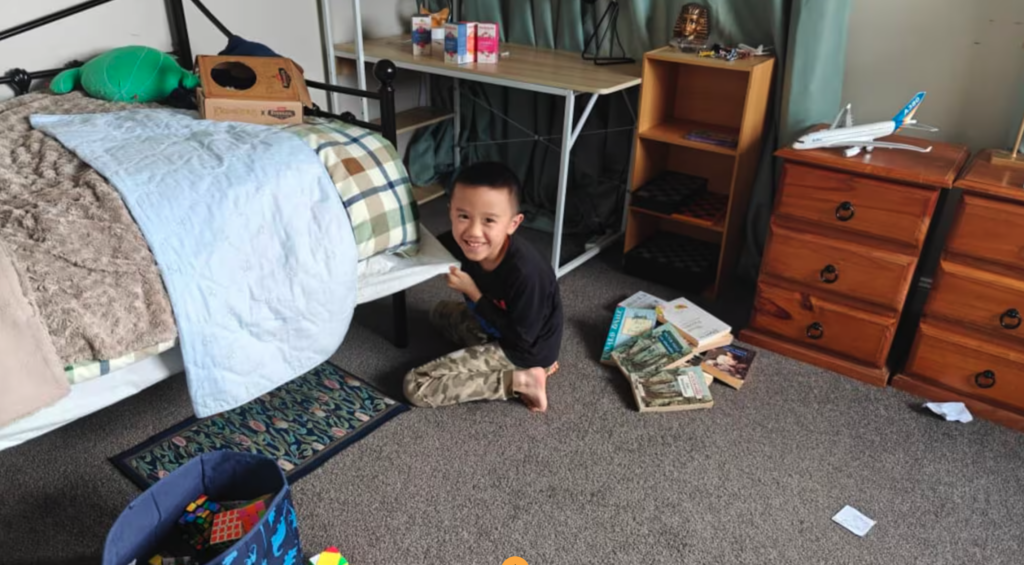
Walk into the Hsu household and you won’t find a sterile study hall. Instead, the lounge is a chaotic, happy mess of train tracks, board games, and whiteboard doodles.
- Normalcy: Raymond does karate, takes swimming lessons, and scoots with friends.
- Grumpy Mornings: Like any child, he wakes up a bit “grumpy” on school days and races to be the first one to play before the morning bell.
- Wellbeing First: Following school recommendations, Raymond will stay in Year 6 this year. Both the school and Michael agree that social wellbeing and protecting him from negative older peer influences are paramount.
📈 Gifted Education in NZ: The Statistical Context
Raymond’s story highlights a broader issue in New Zealand’s education system regarding how giftedness is identified and supported.
| Metric | Detail |
| Typical ID Age | Most gifted programmes target Years 7-13. |
| Ethnicity Trends | Research shows Asian and Pākehā students are more likely to be identified as gifted in formal settings compared to Māori and Pasifika counterparts. |
| The “Gifted Gap” | A significant percentage of gifted students in NZ public schools report feeling “under-challenged” by the standard curriculum. |