Safety First: China Becomes First Nation to Ban Concealed Door Handles on EVs Following Deadly Crashes
By Lions Roar News Tech & Automotive Desk
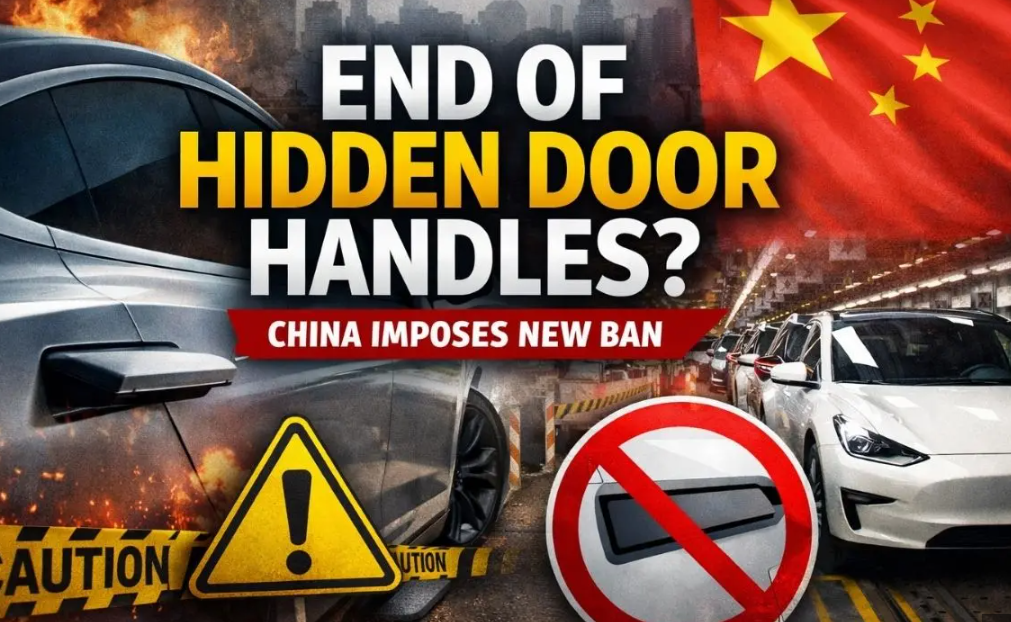
BEIJING, CHINA — Saturday, February 7, 2026 — In a move that is set to reshape the global automotive industry, China has officially banned concealed door handles on electric vehicles (EVs). The landmark ruling makes China the first country in the world to outlaw the sleek, minimalist design popularized by Tesla, citing critical safety concerns during emergencies.
The new regulations, issued by the Ministry of Industry and Information Technology (MIIT), require all cars sold in China to feature a mechanical release on both the interior and exterior of the vehicle.
1. The Timeline for Change
Automakers have been given a clear window to overhaul their designs to meet the new safety standards:
- Effective Date: The ruling officially takes effect on January 1, 2027.
- Grace Period: Models already approved or in the final stages of launching have until January 2029 to implement the changes.
2. Tragic Catalysts for Regulation
The crackdown follows a series of high-profile, fatal incidents in China that brought door handle safety into the public spotlight.
- Xiaomi Crashes: Two fiery crashes involving Xiaomi Corp SU7 sedans in 2025 were central to the debate. In both cases, power failures were suspected to have prevented the electronic concealed handles from functioning, leaving occupants trapped inside as the vehicles caught fire.
- Tesla Scrutiny: While Tesla popularized the design, their door mechanisms are already under a safety probe in the United States, and European regulators are reportedly considering similar restrictions.
3. Specific Design Mandates
The MIIT has issued highly specific requirements to ensure that handles are intuitive and accessible for both passengers and rescuers:
- Exterior: Doors must feature a recessed space of at least 6cm by 2cm for a hand to physically grasp a handle.
- Interior: Cars must include clear signage (no smaller than 1cm by 0.7cm) indicating how to manually open the door in an emergency.
- Mechanical Backup: The new rules prioritize physical connectivity over purely electronic systems, rendering some current “back-up battery” solutions insufficient.
4. Global Ripple Effects: China as the Rule-Setter
As the world’s largest EV market, China’s regulatory shift is expected to become the new global norm.
- Costly Redesign: One industry insider estimated that redesigning a single model to move away from concealed handles could cost upwards of 100 million yuan (US$14.4m).
- Affected Models: High-end models like Tesla’s Model 3 and Model Y, BMW’s iX3, and flagship vehicles from Nio, Li Auto, and Xpeng will all require significant overhauls for the Chinese market.
- The “Rule-Setter” Era: Analysts suggest this marks a historic shift where Beijing, rather than Washington or Brussels, sets the global safety standards for the next generation of transport.
5. Beyond the Door Handles
The Ministry of Public Security is reportedly looking beyond door handles to further regulate EV safety, including:
- Acceleration Limits: Plans to limit how quickly EVs can accelerate from a standstill.
- Driver Assistance Oversight: Increased scrutiny of “Smart Driving” and advanced driver-assistance systems (ADAS).