Election 2026: Why Polls are Snapshots, Not Predictions, as NZ Heads to the Ballot Box
By Lions Roar Aotearoa News Political Analysis
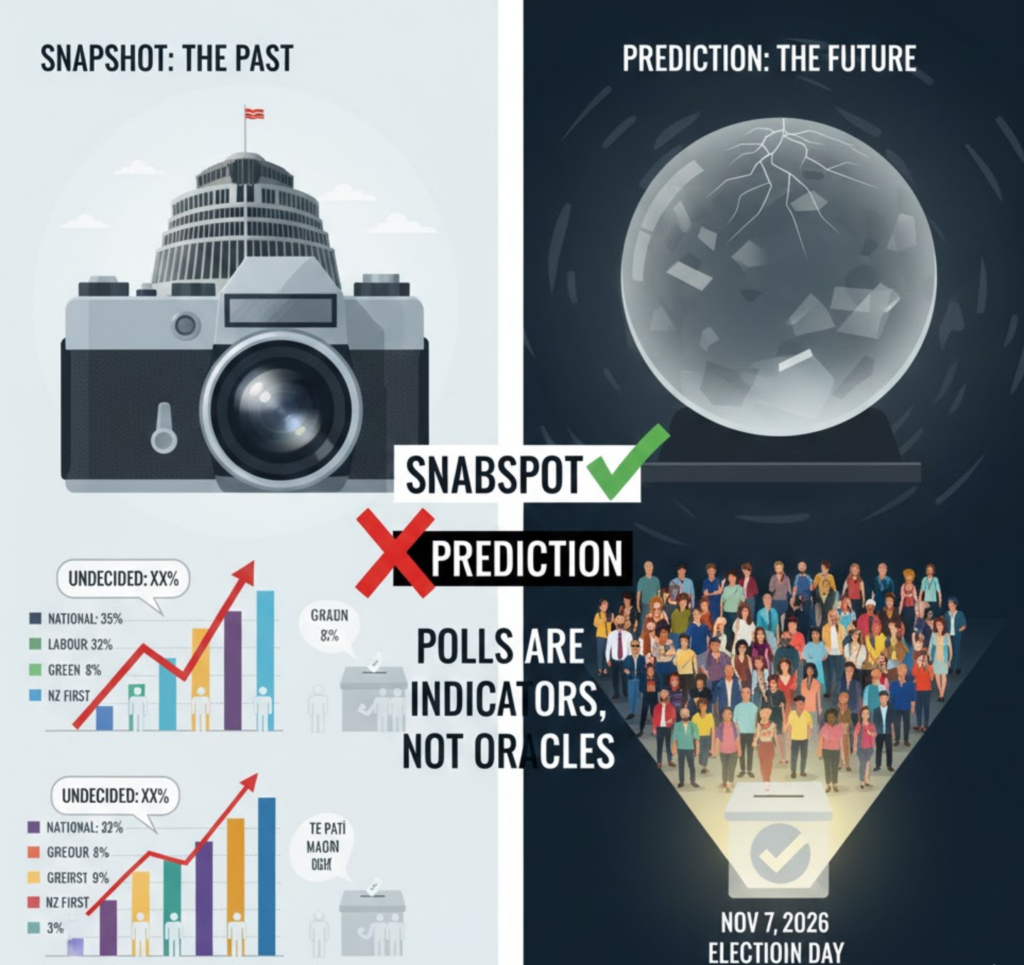
AUCKLAND, NEW ZEALAND — Sunday, February 8, 2026 — With New Zealand’s general election officially set for November 7, 2026, the flurry of opinion polls has begun. However, experts are warning voters to treat these figures as “blurry snapshots of the past” rather than a crystal ball for the future.
Writing for RNZ, Grant Duncan, a Research Associate at the Public Policy Institute of the University of Auckland, highlights that early polling rarely predicts the final outcome of a New Zealand election.
1. The “Noise” vs. The “Signal”
With nine months still to go, current polls are statistically unlikely to mirror the final result. Duncan points out that in the last three elections, early-year polling failed to predict the eventual winner due to shifting trends and unforeseen “black swan” events like the Covid-19 pandemic.
- Sampling Error: A standard poll of 1,000 people has an inherent margin of error. A shift of 1% or 2% is often just statistical “noise” rather than a genuine change in public sentiment.
- The “Undecided” Factor: Many polls fail to emphasize the percentage of undecided voters, who often hold the power to swing the election in the final weeks.
2. Current State of Play: A Hypothetical Change?
Recent indicators suggest a tight race, though the outcomes remain purely speculative:
- National: Current polling suggests National might secure fewer party votes than in 2023.
- Labour: While Labour’s numbers have seen a gradual rise throughout 2025, this growth appears to be coming at the expense of their potential coalition partners, the Greens and Te Pāti Māori.
- NZ First: Bucking the trend, NZ First has shown strength, polling at 9% or higher—a significant jump from their 6.1% result in the previous election.
3. The Psychology of the Poll
Polls don’t just measure opinion; they can sometimes shape it through several psychological effects:
- The Bandwagon Effect: Strong polling for a candidate may encourage voters to “join the winner.”
- The Underdog Effect: Conversely, it may motivate others to support a struggling candidate.
- The 5% Threshold (MMP): For smaller parties, polling below the 5% mark can become a self-fulfilling prophecy, as voters fear “wasting” their vote on a party that might not enter Parliament.
4. A Voter’s Guide to Reading the Data
Duncan advises a critical approach to media reporting on polling data. In a free society, while surveys are a vital part of feedback for political parties, they can be misleading if framed as a “horse race.”
- Check the Source: Who commissioned the poll?
- Check the Method: How was the data collected?
- Turnout is Key: Polls only represent those eligible to vote; they cannot perfectly predict who will actually show up on November 7.