Legal “Vacuum” Avoided: NZ Man Wins Battle to Adopt Own Surrogate Son Despite Judicial Concerns
By Lions Roar News National Desk
PALMERSTON NORTH, NEW ZEALAND — Saturday, February 7, 2026 — In a ruling that highlights the complexities of aging adoption laws, a New Zealand man has been granted a Family Court order to adopt his own surrogate son. The decision comes despite significant “discomfort” from the presiding judge regarding the methods used to secure the surrogacy arrangement in Georgia.
The case, presided over by Judge Belinda Pidwell, underscores the precarious legal position of children born via international surrogacy under New Zealand’s 1955 Adoption Act.
1. The Case: A “Legal Vacuum” in Georgia
The man, whose identity is suppressed, paid a Georgian fertility agency to facilitate an IVF arrangement with a surrogate mother from Uzbekistan. Under Georgian law, only heterosexual married or long-term de facto couples are eligible for surrogacy.
- The Discrepancy: The man entered the agreement with a woman he claimed was his de facto partner. However, the relationship ended shortly after the pregnancy was confirmed.
- The “Uncomfortable Inference”: Judge Pidwell noted that the relationship appeared to exist solely to satisfy Georgian legal requirements. “Without her, [the man] would not have been eligible to enter into a surrogacy agreement in Georgia,” the judge remarked.
2. Why the Order Was Granted
Despite suspicions that the Georgian agency may have “turned a blind eye” to the man’s actual relationship status, the court felt its hands were tied by the welfare of the child.
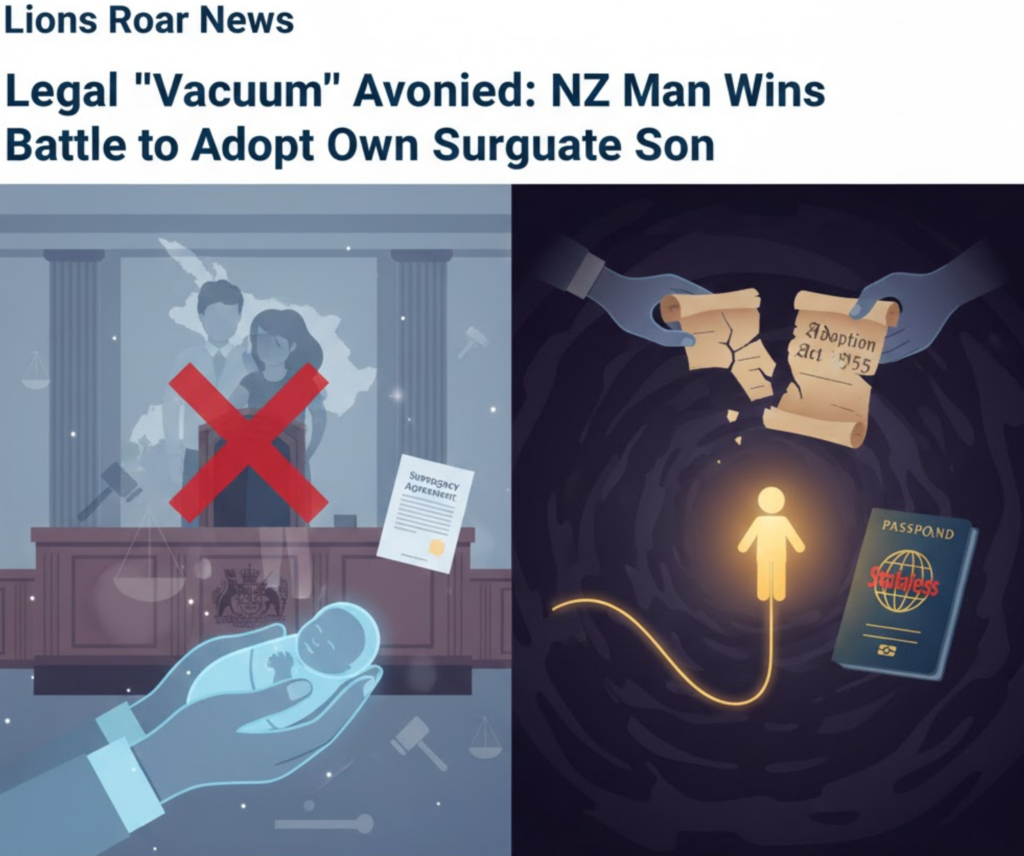
- Statelessness: Without the adoption order, the baby boy was at risk of becoming stateless. He had no right to remain in Georgia and no legal path to enter New Zealand.
- Fait Accompli: Judge Pidwell described the situation as a fait accompli—the child’s existence and lack of other guardians meant the court had to act to prevent a “legal vacuum.”
- Rights Over Punishment: “The focus of the New Zealand courts is to honour the child’s rights, rather than punish the parents,” Judge Pidwell stated in her judgment.
3. The “1955 Problem”
Under current New Zealand law, intending parents of a child born via surrogacy—even if they share a genetic link—have no automatic parental rights. They must go through a formal adoption process to be recognized as the legal parents.
- Citizenship: Children born via surrogacy overseas do not automatically acquire New Zealand citizenship, regardless of their DNA.
- The Legislative Fix: The Improving Arrangements for Surrogacy Bill is currently before a select committee. If passed, it would streamline this process, bringing New Zealand law closer to modern international standards and removing the need for parents to “adopt” their own biological children.
4. Judicial Warning on International Surrogacy
While granting the order, Judge Pidwell issued a stern warning. She expressed concern that granting such orders could be seen as endorsing illegal or ethically “grey” surrogacy contracts. However, in this specific instance, the child’s need for a stable home and legal identity outweighed the “uncomfortable facts” of his conception.