Massacre at Friday Prayers: ISIS Claims Deadly Suicide Bombing at Islamabad Mosque
By Lions Roar News International Desk
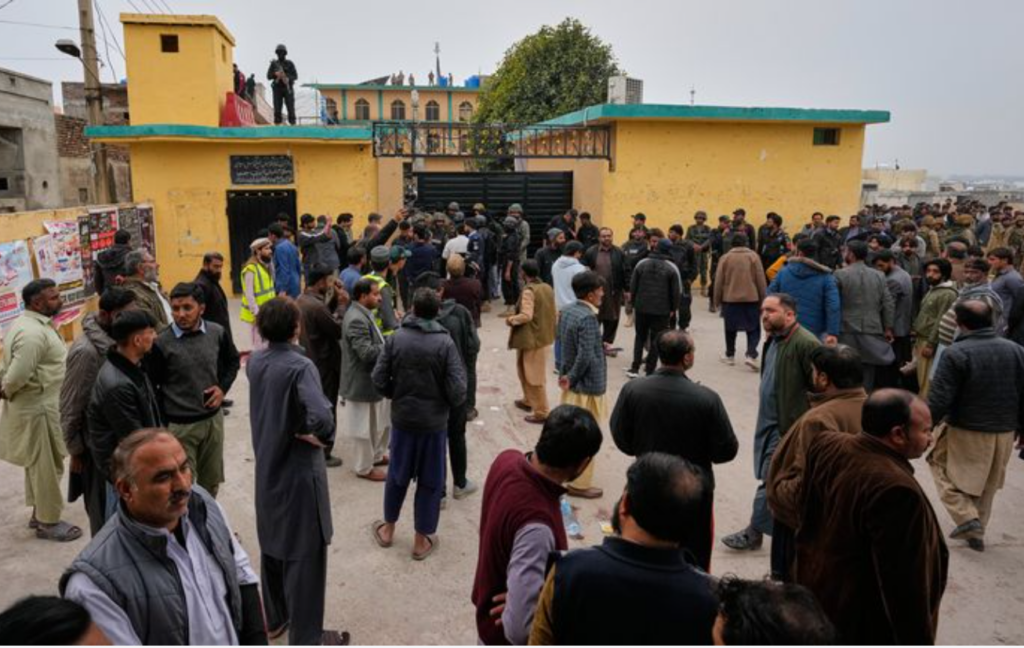
ISLAMABAD, PAKISTAN — Saturday, February 7, 2026 — A somber atmosphere has descended over Pakistan’s capital following a brutal suicide bombing at the Khadija Al-Kubra mosque during Friday morning prayers. The attack, which targeted the Shiite community on the outskirts of Islamabad, has left at least 31 people dead and 169 others injured.
The Islamic State (ISIS) has officially claimed responsibility for the massacre, an act that has heightened sectarian tensions and sparked a diplomatic firestorm between Pakistan, Afghanistan, and India.
1. The Attack: Chaos in the Sanctuary
Witnesses describe a scene of unimaginable horror. The bomber reportedly opened fire on security guards who attempted to intercept him before rushing to the back row of the worshippers and detonating his explosives.
- The Aftermath: Footage shows the mosque’s carpeted floors covered in debris and bodies, while survivors and local residents scrambled to transport the critically wounded to nearby hospitals.
- Eyewitness Account: “I immediately thought some big attack had happened,” said Hussain Shah, who was praying in the courtyard when the blast occurred.
2. Diplomatic Tensions: The Blame Game
The attack has triggered a swift and sharp exchange of allegations across borders:
- Pakistan’s Accusation: Defence Minister Khawaja Muhammad Asif claimed the bomber originated from Afghanistan and suggested the Taliban were acting as a “proxy” for India. “The threads of the alliance between India and the Taliban are being uncovered,” he wrote on X.
- India’s Rejection: India’s Foreign Ministry dismissed the claims as “baseless and pointless,” stating that Pakistan is “deluding itself by blaming others for its home-grown ills.”
- Afghanistan’s Denial: The Afghan Foreign Ministry also condemned the attack, stating that targeting mosques is strictly against Islamic values.
3. Explainer: Who is the Islamic State (ISIS) Group?
While Pakistan’s government points toward regional proxies, the Islamic State remains the group that claimed the act.
- What is ISIS? Formed as a radical splinter of Al-Qaeda, ISIS follows a violent extremist ideology. Their goal is the creation of a global caliphate governed by a hardline interpretation of Sharia law.
- Sectarian Focus: ISIS frequently targets Shiite Muslims, whom they view as “heretics.” This makes Shiite mosques, like Khadija Al-Kubra, frequent targets for their attacks.
- ISIS-K (Khorasan): The regional affiliate, ISIS-K, operates in the Pakistan-Afghanistan border regions. They are known for high-casualty urban attacks and are bitter rivals of both the Pakistani state and the Taliban.
4. A Nation in Mourning: Festivals Halted
The tragedy has cast a dark shadow over the return of the Basant kite-flying festival, which had just seen its 18-year ban lifted.
- Cancellations: Authorities in Lahore announced that major celebratory concerts associated with the festival have been cancelled out of respect for the victims.
- Leadership Response: President Asif Ali Zardari and Prime Minister Shehbaz Sharif have condemned the attack as a “crime against humanity” and ordered a full-scale investigation to punish those responsible.
5. Broader Security Crisis
This bombing follows a week of intense violence in Pakistan. Security forces recently concluded a 40-hour battle in Balochistan, where nearly 150 militants were killed following coordinated attacks by the Baloch Liberation Army (BLA). The country remains on high alert as it struggles to contain a multi-front surge in militant activity.