Waitangi 2026: A Nation at the Crossroads of Ture and Tikanga
By Lion’s Roar Aotearoa News Political Bureau
WAITANGI — Wednesday, February 4, 2026 — As the sun rises over the Bay of Islands, the air in Waitangi is thick with more than just the summer heat; it carries the weight of a nation grappling with its founding promise. The 2026 commemorations have become a flashpoint for New Zealand’s constitutional identity, pitting a government focused on “common ground” against an opposition and iwi leadership who warn that the ground beneath Māori-Crown relations is shifting dangerously.
Prime Minister Christopher Luxon arrived at the Treaty Grounds on Wednesday morning for the highly anticipated Iwi Chairs Forum, marking a pivotal return after his notable absence from the 2025 commemorations. What followed was a day of intense rhetoric, emotional appeals from flood-ravaged communities, and a starkly divided vision for the future of Te Tiriti o Waitangi.
1. Common Ground vs. An “Anti-Treaty” Agenda
The political divide was laid bare before the first formal hui even began. Labour leader Chris Hipkins, speaking from the Treaty Grounds, launched a blistering attack on the government’s legislative program, labeling the National-led coalition as “anti-Treaty” and, by extension, “anti-Māori.”
Hipkins pointed to a “litany of setbacks” that he argued signaled a systematic dismantling of Māori rights. “This is a government that has made it their mission to scrub Te Reo Māori from our streets, our departments, and our schools,” Hipkins stated. He specifically cited the Treaty Principles Bill—which has remained a sore point despite government assurances—along with the reordering of English and Māori on passports and the removal of Treaty references from various legislative frameworks.
“They are reordering words just for the sake of it,” Hipkins said. “It’s not just about aesthetics; it’s a big step backward for New Zealand.”
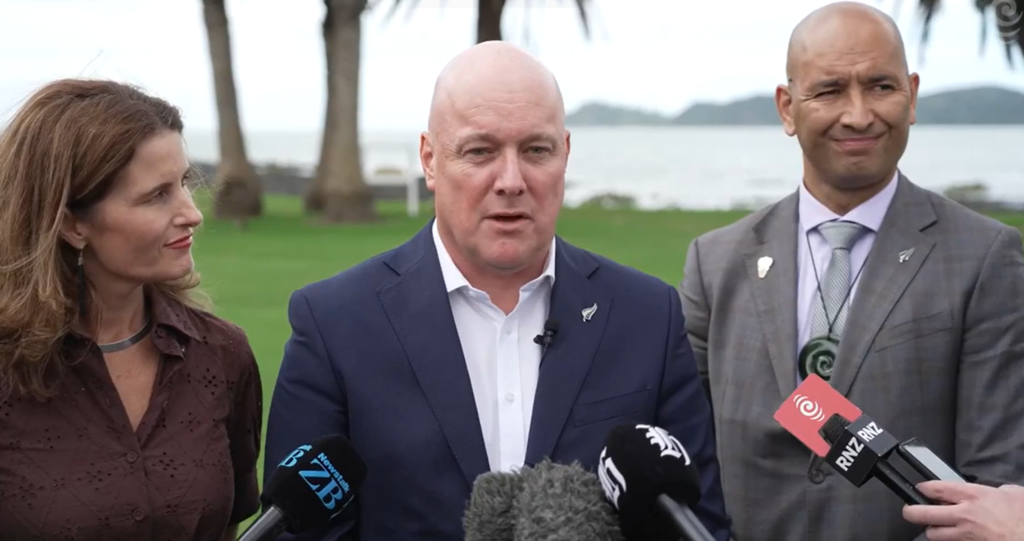
Prime Minister Luxon was quick to dismiss these claims as “baseless political theater.” Following his meeting with the Iwi Chairs Forum, Luxon characterized the engagement as the “best forum” he had ever participated in.
“I reject the ‘anti-Māori’ label entirely,” Luxon told reporters. “What we had today was a direct, robust, and constructive exchange. We talked about health, law and order, and education. Lo and behold, iwi want exactly what we want: better outcomes for their people. We agree on 70 percent of the issues; my focus is on that common ground.”
Despite Luxon’s optimism, Ngāti Wai Chair Aperahama Edwards noted that while the meeting was beneficial, the “pain” among Māori was palpable. “Our people are hurting,” Edwards said. “There is a calm here, yes, but it is a calm born of vigilance.”
2. The Prime Minister’s Return and the Northland Recovery
Luxon’s decision to return to Waitangi this year was seen by many as a necessary repair of his relationship with Te Tai Tokerau. In 2025, the Prime Minister opted to celebrate Waitangi Day with Ngāi Tahu in Akaroa—a move that was criticized by northern iwi as a snub to the “birthplace of the nation.”
This year, his return coincided with a region still reeling from the “remnants of Tropical Disturbance 05F,” a storm system in late January that some locals described as more devastating than Cyclone Gabrielle.
“I am here to engage, to listen, and to see the recovery firsthand,” Luxon said. The government has been under pressure to respond to the catastrophic flooding in communities like Whangaruru and Ōakura, where bridges were washed away and homes buried under silt.
Associate Housing Minister Tama Potaka visited flood-affected Ngaiotonga on Tuesday, where he oversaw the deployment of government-funded campervans. These mobile units are being used as emergency accommodation for whānau whose homes are currently uninhabitable.
“Our whānau have gone through severe trauma,” Potaka said. “We’ve taken action with the Temporary Accommodation Service, and we expect these motorhomes to provide dignity and stability for the next few months while the hard work of rebuilding begins.”
3. Iwi Chairs Stand Firm on Marine and Coastal Rights
While the government spoke of “common ground,” the Iwi Chairs Forum sent a clear message of resistance regarding the Marine and Coastal Area Act (MACA). On Tuesday, the forum unanimously gave its backing to a High Court challenge brought by Ngāti Manuhiri.
The challenge centers on recent government amendments that raised the threshold for iwi seeking customary marine title. The government argues the changes restore the legislation to its “original intent,” but iwi leaders see it as a breach of property rights and Treaty obligations.
Jamie Tuuta, chair of the forum’s economic arm (Pou Tahua), warned that Māori are at a “precipice.”
“We have spent years focusing on government policy, but we are now at a stage where we must transform our own realities,” Tuuta said. “We want to hear a program of mahi that bolsters Māori aspirations, not legislation that unpicks Te Tiriti.”
4. Policy Reversals and the “Political Pendulum”
The tension at Waitangi isn’t just about what the government is doing, but what the opposition might undo. Hipkins faced tough questioning on whether a future Labour government would reverse the controversial repeal of Section 7AA of the Oranga Tamariki Act or the changes to the Marine and Coastal Area Act.
Hipkins remained non-committal, citing a need for “sustainable change.”
“Where any government moves too quickly and doesn’t bring people with them, you run the risk of the pendulum swinging back even further in the other direction on the next political cycle,” Hipkins explained. “I don’t want to see that continue. We are focused on change that brings the whole country along.”
This “pendulum” analogy resonated through the Treaty Grounds, as many worry that the flip-flopping of Treaty policy with every change of government is creating a climate of permanent instability for both iwi and the Crown.
5. Economic Realignment: “We Need to Get Stuff Done”
Despite the high-level constitutional debates, the practicalities of the economy remained a core focus for iwi leaders. Tukoroirangi Morgan, a prominent iwi negotiator, echoed the sentiment that “stuff needs to get done,” regardless of the political noise.
Morgan characterized the Prime Minister as “very committed” to the Treaty relationship but noted that the current economic climate required “creative ways of working.”
“Treaty settlements are a solemn compact,” Morgan stated. “We have to ensure the Crown upholds these with honor, especially during tough economic times. There are still opportunities for infrastructure development and investment, and we need to take them.”
Finance Minister Nicola Willis, who joined Luxon in the meetings, argued that the most practical way the Crown upholds the Treaty is through the “honorable and swift” progression of historical Treaty settlements. She pointed to “good progress” made in the last quarter as evidence of the government’s good faith.
6. The Optimism of the “Exchange”
Māori-Crown Relations Minister Tama Potaka described the day’s hui as “robust” and “interrogative”—terms that in diplomatic speak usually suggest a fair amount of heat. However, he insisted the “exchange” was healthy.
“There needs to be an exchange of ideas and investigative queries,” Potaka said. “But what we saw today was also a sense of optimism. We are addressing the ‘deltas’—the gaps in health and education—in a way that befits Te Tiriti while staying true to the values of equal citizenship.”
7. Looking Ahead to the Pōwhiri
As Wednesday draws to a close, the focus shifts to Thursday morning’s formal pōwhiri at Te Whare Rūnanga. This is where the political leaders will move from the private hotel conference rooms to the public marae atea, facing the “invective” and challenges of Ngāpuhi orators.
For the first time in years, Ngāi Tahu has returned to Waitangi in force as a show of unity with northern tribes. This “pan-iwi” solidarity suggests that while the Prime Minister may find his 70 percent “common ground” with individual leaders, the collective Māori voice at Waitangi 2026 is louder, more unified, and more demanding than ever before.
With Waitangi Day itself on Friday, the nation watches to see if the “calm optimism” described by Aperahama Edwards can survive the political firestorm of an election year.
8. Summary of Key Events: Waitangi 2026
| Event | Key Participants | Outcome / Message |
| Iwi Chairs Forum Hui | PM Luxon, Nicola Willis, Iwi Leaders | Luxon claims “good alignment” on outcomes; Iwi seek “strategic action plans.” |
| MACA Challenge | Ngāti Manuhiri, Iwi Chairs | Unanimous support for court challenge against government’s coastal title changes. |
| Flood Relief Visit | Tama Potaka, Ngāti Wai | Deployment of campervans to Northland whānau displaced by Jan 2026 storms. |
| “Anti-Treaty” Speech | Chris Hipkins | Accused government of a “systematic step backward” regarding Te Reo and Treaty rights. |
| Ngāi Tahu Return | Ngāi Tahu Leadership | A gesture of inter-tribal unity and shared Treaty obligations across the motu. |
9. The Voices of Waitangi: Quotes of the Day
“Our people are hurting… but there’s also a calm here, and an optimism at the thought of what sort of change might be coming.” > — Aperahama Edwards, Ngāti Wai Chair
“The Treaty of Waitangi is not just history… it’s a living promise. This government is turning its back on that progress.” > — Chris Hipkins, Labour Leader
“Let’s focus on the common ground, the 70 percent that we can agree on… that we can actually move and advance forward.” > — Christopher Luxon, Prime Minister
“We have to try and find creative ways of working with the government in the face of tough economic times.” > — Tukoroirangi Morgan, Iwi Leader
10. Conclusion: A Living Document in a Changing Land
The events of February 4, 2026, have reinforced that Waitangi is no longer just a day of commemoration; it is a live laboratory for New Zealand’s constitutional future. As the government attempts to pivot toward “practical” outcomes and “equal citizenship,” they find themselves confronted by an iwi leadership that views the Treaty not as a hurdle to be cleared, but as the very foundation upon which those outcomes must be built.
As the pōwhiri approaches tomorrow, the question remains: Can the “common ground” Luxon seeks ever be found if the parties cannot agree on the meaning of the document that grants them the right to stand on that ground in the first place?
Lions Roar Aotearoa News New Zealand will continue to provide live updates from the Treaty Grounds throughout the week. Would you like me to focus on the details of the upcoming pōwhiri on Thursday, or should I look into the specific legal arguments being prepared for the Marine and Coastal Area Act court case?